Claude Frontier Academy and the push to train FDEs
Written by
FullStack Team
Last updated on:
October 14, 2026
Written by
Last updated on:
October 14, 2026
Enterprise AI adoption depends on more than access to advanced models. Anthropic’s new academy focuses on the engineers responsible for putting them to work.
Anthropic has announced a $100 million commitment to Claude Frontier Academy, an initiative that aims to train 10,000 Frontier Deployed Engineers by the end of 2027. Its first program, the Frontier Deployed Engineer Residency, is already underway with engineers from Accenture, Bain, Capgemini, Deloitte, McKinsey, Morgan Stanley, Novo Nordisk, and Commonwealth Bank of Australia.
The Academy is aimed at engineers who can take Claude from an idea to a production system: choosing the right workflow, connecting tools and data, working through security review, and supporting adoption once a system is live.
What are FDEs?
Forward Deployed Engineers, or FDEs, are generally technical employees who work closely with customers to turn a company’s technology into working solutions for specific business problems. Rather than building a product at a distance and handing it off, they typically embed with a customer or work in close partnership with its teams to understand workflows, adapt the technology, and help deliver something that can actually be used.
The role has become especially relevant in enterprise AI, where the work often extends beyond the model itself. An FDE may help identify the right use case, connect internal data and systems, build the interfaces and supporting software around an AI application, and navigate requirements around security, access, and human oversight.
In practice, that means bridging two worlds: the technical capabilities of an AI platform and the operational realities of the business adopting it. The goal isn’t just to prove that an AI tool can work, but to help a customer move from a promising pilot to a repeatable, production-ready system.
Why Anthropic is investing
Anthropic’s announcement points to a growing challenge for enterprise AI: there aren’t enough engineers with the experience to move projects from early experiments into production. McKinsey’s 2024 survey attests to this, having found that 47% of C-suite leaders said their organizations were moving too slowly to develop and release generative AI tools. Of those leaders, 46% cited talent and skill gaps as a contributing factor.
“A small team of high-agency people with the right skills, access to Claude, and a deep understanding of how their business runs can transform an entire company,” says Steve Corfield, Anthropic’s Global Head of Business Development and Partnerships. “The hard part is building that depth of talent, engineers with the highest level of AI fluency who can take Claude from an idea to a system in production.”
The Frontier Academy aims to address that gap through practical deployment experience. Participants first work through a simulated enterprise deployment, then lead a real Claude project at their own organization, giving them experience with the technical, operational, and governance decisions that shape whether an AI system reaches production.
How the Frontier Academy works
The Frontier Deployed Engineer Residency is for hands-on software engineers with strong fundamentals, experience building with LLMs, and experience helping others adopt AI. Organizations nominate participants, each of whom arrives with a named Claude project to lead when they return.
The program begins with a multi-day, in-person session with Anthropic engineers and licensed instructors. Participants work through a simulated enterprise deployment, from use-case selection through security review and handover, then complete a graded practical. Those who pass earn the Claude Resident Engineer badge.
They then move into a 12-week residency, leading a real Claude use case within their organization with support from Anthropic engineers and their cohort. Engineers who pass the final assessment earn the Claude Frontier Deployed Engineer badge; Anthropic expects the first recipients in early 2027.
Anthropic says the format follows the medical model for building expertise: participants learn from practitioners, work through realistic cases, and are assessed on their work before earning the credential.
What enterprises can take from it
Not every company is going to participate in Anthropic’s Academy, and not every enterprise AI effort will follow Anthropic’s model exactly. Still, the announcement puts a clear operational question in front of leadership teams: who owns the work between an interesting AI use case and a production system that people trust?
In many organizations, that work gets split across too many groups. Strategy teams identify opportunities, innovation teams run pilots, engineering teams inherit an unclear prototype, and governance teams come in late. Anthropic’s FDE model points toward a different setup: put technically capable people close to the business problem, make them responsible for delivery, and train them to work across the full path from idea to deployment.
For companies building their own AI capability, the constraint isn't only model quality, but rather the ability to deploy those models inside real workflows, with the right architecture, controls, and adoption plan behind them.
What it means for FullStack
For FullStack, Anthropic’s announcement reinforces something our teams see in practice: enterprise AI value usually comes from implementation quality, not model access alone.
That requires people who can work across product, engineering, AI systems, and delivery constraints without treating them as separate handoffs. Anthropic is now putting substantial capital and program structure behind that same view.
That doesn’t mean every organization needs an academy, a badge, or Anthropic-specific training. However, it does show that the demand for people who can take AI from pilot to production has become visible enough for a leading model company to invest $100 million in developing them.
Anthropic’s Frontier Academy is a $100 million initiative designed to train 10,000 Frontier Deployed Engineers, or FDEs, by the end of 2027. Its first offering is the Frontier Deployed Engineer Residency, which focuses on helping engineers deploy Claude in real business environments.
What is a Frontier Deployed Engineer?
A Frontier Deployed Engineer is an engineer trained to help move AI systems from early concepts or pilots into production. The role combines software engineering with an understanding of business workflows, data access, security requirements, human oversight, and user adoption.
How does the Frontier Deployed Engineer Residency work?
Participants begin with a multi-day, in-person program led by Anthropic engineers and licensed instructors. They complete a simulated enterprise deployment and a graded practical, then spend 12 weeks leading a real Claude use case at their organization with support from Anthropic and their cohort.
Who can participate in the Anthropic Frontier Academy?
The residency is intended for hands-on software engineers with strong technical fundamentals, experience building with large language models, and experience helping others adopt AI. Organizations nominate participants, who arrive with a specific Claude project to lead when they return.
Why are FDEs important for enterprise AI?
Enterprise AI projects often require more than access to a powerful model. FDEs help organizations choose viable use cases, connect systems and data, navigate security review, establish appropriate human oversight, and create a clear plan for ownership and adoption after launch.
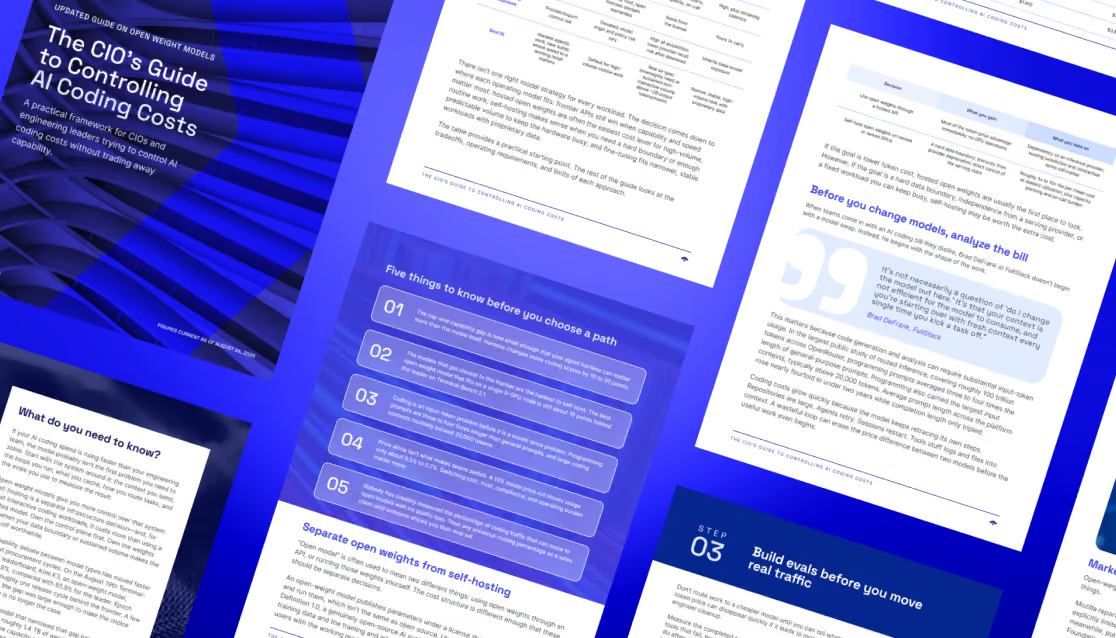
How can you cut your AI coding costs without switching models?
This guide gives you the math, the meaningful benchmarks, and a six-step plan to cut spend without giving up capability.
Enjoyed the article? Get new content delivered to your inbox.
Subscribe below and stay updated with the latest developer guides and industry insights.
Thank you! Your submission has been received!
Oops! Something went wrong while submitting the form.
Iframe is blocked. Accept cookies to load it.
Thank you! Your submission has been received!
Oops! Something went wrong while submitting the form.
We use cookies to provide our services, to allow us to better understand our audience, and to provide and serve personalized ads or content. By using our website, you consent to the terms of our Privacy Policy and our Cookie Policy, and the use of cookies, pixels, and other technology as described more fully therein
.svg)
.svg)