Claude Opus 5.5 vs. GPT-6 Astra: flagship showdown
Written by
FullStack Team
Last updated on:
October 28, 2026
Written by
Last updated on:
October 28, 2026
Claude Opus 5.5 and GPT-6 Astra are the premium models from Anthropic and OpenAI. We compare benchmarks, speed, price, and safeguards to show which one fits enterprise work.
Teams send their hardest work to frontier models: long-running tasks, large codebases, and analysis where a wrong answer is expensive. At that tier, the price gap between vendors is large enough to shape an AI budget, so the choice deserves more than a look at launch-day charts.
In our Ready for Enterprise (RFE) LLM Benchmark, Claude Opus 5.5 ranks #1 with a score of 66.4. GPT-6 Astra ranks #10 at 55.8. Opus 5.5 also has the higher capability score (93.4 vs. 88.9), runs about twice as fast (80 vs. 39 tokens per second), and costs 40% of Astra's per-token price ($8.00 vs. $20.00 blended per million tokens).
On paper, Opus 5.5 vs GPT-6 looks one-sided. But benchmark scores and per-token prices don't tell the whole story. Astra still has clear strengths, and what you pay per task depends on more than the price per token.
Which model fits which job?
Choose Claude Opus 5.5 for agentic coding, professional work, and anything users wait on. It leads on Terminal-Bench 4.0, Arena WebDev, and Arena Text, it's twice as fast, and it costs much less per token. It fits coding agents, agentic workflows, high-volume workflows, and enterprise assistants.
Choose GPT-6 Astra for science, math, and fact-heavy answers. It has the higher scores on GPQA Diamond (95.8% vs. 90.6%), FrontierMath (93.7% vs. 91.2%), and SimpleQA Verified (75.6% vs. 72.2%), and some teams may still prefer it for interactive responses through its Intelligent UI. It fits research and quantitative work where accuracy matters more than cost or speed.
Consider using both. Because Astra costs two and a half times as much per token, routing only the tasks that need its strengths to the more expensive model can keep most of the budget on Opus 5.5.
Opus 5.5 vs GPT-6 Astra at a glance
Claude Opus 5.5 vs GPT-6 Astra: FullStack RFE LLM Benchmark comparison of rank, score, benchmarks, price, and speed
Metric
Claude Opus 5.5
GPT-6 Astra
RFE rank
#1
#10
RFE score (out of 100)
66.4
55.8
Capability score (out of 100)
93.4
88.9
Tested benchmark components
6 of 6
6 of 6
SWE-Bench Pro
Not on the leaderboard yet
96.9%
Terminal-Bench 4.0
64.8%
58.2%
SimpleQA Verified
72.2%
75.6%
Arena Text, style control
1509
1476
Arena WebDev, Elo rating
1807
1775
GPQA Diamond
90.6%
95.8%
FrontierMath Tiers 1–3
91.2%
93.7%
Price per 1M tokens
$4 input / $20 output
$10 input / $50 output
FullStack blended price per 1M tokens
$8.00
$20.00
Output speed
80 tokens/second
39 tokens/second
Time to first token
3.31 seconds
3.49 seconds
Source: FullStack RFE LLM Benchmark, data snapshot used for this article. Rankings can change as new models ship and results are added.
Our RFE score combines six public benchmarks covering agentic work, factual accuracy, human preference, web development, graduate-level science, and advanced math, then adds price and speed.
The capability score reflects benchmark performance alone. SWE-Bench Pro isn't one of the six scored components, and Opus 5.5 doesn't have a SWE-Bench Pro result on the public leaderboard yet. Teams should also verify current API pricing before deciding, since rate cards and task-level costs can change.
What are Claude Opus 5.5 and GPT-6 Astra?
Anthropic released Claude Opus 5.5 on September 22, 2026, as the first model in the Claude 5.5 family. Anthropic says it performs at the level of Claude Fable 5.1 on most work, leads on agentic coding, computer use, and knowledge work, and costs about 40% less than Claude Opus 5 on typical workloads.
OpenAI launched GPT-6 Astra in early September 2026 and calls it "the world's most intelligent and aligned model." OpenAI positions it for computer use, software engineering, science, cybersecurity, and professional work.
Where Claude Opus 5.5 wins
It leads on agentic coding and web development
Opus 5.5 scores 64.8% on Terminal-Bench 4.0, which measures multistep terminal tasks in a command-line environment, compared with 58.2% for Astra. It also leads on Arena WebDev, a human-preference rating of web development output (1807 vs. 1775), and on Arena Text (1509 vs. 1476).
Anthropic's launch results point the same way. Anthropic reports Opus 5.5 at 66.4% on Terminal-Bench 4.0 versus 57.9% for Astra, and says Opus 5.5 edges Astra on FrontierCode (54.4% vs. 53.3%) at about 20% of Astra's cost per task. Vendors test in their own setups and at their own effort settings, so treat these as supporting evidence rather than head-to-head proof.
Early testers also reported efficiency gains over the previous Opus. Deloitte said Opus 5.5 caught 72% of known bugs in its code reviews at the lowest effort setting, compared with 56% for Opus 5 at high effort.
It's stronger on professional knowledge work in vendor tests
On GDPval-AA, a test of real-world professional work across many occupations, Anthropic reports Opus 5.5 at 1846 Elo versus 1542 for Astra. Anthropic also says Opus 5.5 at its default effort beats Astra at max effort on that test for about a fifth of the cost. On Humanity's Last Exam with tools, both vendors report Astra at 57.2%, and Anthropic reports Opus 5.5 at 67.7%.
It's about twice as fast
In our measurements, Opus 5.5 generated 80 tokens per second, about twice Astra's 39. Time to first token is close (3.31 seconds vs. 3.49), so the gap shows up mostly in longer responses.
For an agent that makes dozens of sequential model calls, that difference compounds. Across a long agent run, Astra’s slower speed adds up in overall output time, so runs can take noticeably longer.
It costs 40% of Astra's price per token
Opus 5.5 costs $4 per million input tokens and $20 per million output tokens. Astra costs $10 and $50. That makes Astra two and a half times as expensive per token, before any differences in how many tokens each model uses to finish a task. That second factor depends on your workloads and effort settings, so the per-task cost difference can be smaller or larger than the per-token gap.
Where GPT-6 Astra wins
It leads on graduate-level science and advanced math
Astra's clearest advantage is science. It scores 95.8% on GPQA Diamond, compared with 90.6% for Opus 5.5, its widest lead in this comparison. It also leads on FrontierMath Tiers 1–3 (93.7% vs. 91.2%).
Anthropic's own launch table backs this up. On Terminal-Bench Science, a test of scientific research workflows, Anthropic reports Astra at 64.6% versus 58.7% for Opus 5.5. OpenAI also reports Astra at 97.6% on FrontierMath Tier 4, its hardest tier, though it doesn't publish an Opus 5.5 score for comparison.
It has a narrow lead on factual accuracy
Astra scores 75.6% on SimpleQA Verified, compared with 72.2% for Opus 5.5. The gap is small. For workflows that depend on recalling facts without retrieval, Astra has a slight edge, but grounding either model with search or retrieval-augmented generation (RAG) will usually matter more than the choice of model.
It slightly edges Opus on business workflow automation
On AutomationBench, a test of multistep business workflows, Anthropic reports Astra at 41.4% and Opus 5.5 at 40.0%. Anthropic notes it ran Opus 5.5 without fallback models, so safeguard interventions counted as failures, and says this understates its score.
Why does Opus 5.5 rank nine places higher?
Astra is a highly capable model, with a capability score of 88.9. But our RFE score weighs speed and price alongside capability, and Astra is the slower and more expensive model by a wide margin.
Opus 5.5 doesn't trade capability for that advantage.“It also has the higher capability score (93.4 vs. 88.9). Each model leads on three of the six scored benchmarks, but Opus 5.5 comes out ahead overall. That combination of top capability, faster output, and a lower per-token price is why Opus 5.5 ranks #1.
Pricing: Astra costs more per token at every level
The short version on price: Opus 5.5 is cheaper per token on every pricing line we compared.
Cached input: Cached reads cost $0.20 per million tokens for Opus 5.5 and $1.00 for Astra, so caching is five times cheaper on Opus for workflows that reuse long system prompts.
Batch: Anthropic's Batch API charges half the standard rate for Opus 5.5, at $2 input / $10 output.
Long prompts: Astra bills prompts above 272,000 input tokens at twice the input rate and one and a half times the output rate, for the full request. Opus 5.5 lists flat rates across its full 1-million-token context window.
Fast mode: Opus 5.5 offers up to two and a half times the speed at $8 input / $40 output. Astra offers up to twice the speed at twice the standard price.
For output-heavy work, Astra’s output price of $50 per million tokens is the biggest line in the pricing gap. But per-token rates are only part of the bill. What you pay depends on how many tokens each model uses to finish a task, plus retries, tool calls, and human review. Both vendors say their models finish tasks in fewer tokens than earlier versions, so measure cost per completed task on your own workloads before you commit.
Context window, effort settings, and availability
Long context
Opus 5.5 has a 1-million-token context window and up to 128,000 output tokens. Astra's context window is slightly larger, at 1,050,000 tokens, which gives a little more room, with the same 128,000-token output limit. Both can hold large document sets or a sizable codebase in one request, but Astra's long-context surcharge makes very large prompts much more expensive.
Opus 5.5 is available on the Claude API, Amazon Bedrock, Google Cloud, and Microsoft Foundry, as well as in the Claude apps and developer tools such as Claude Code. Astra is available through the OpenAI API, Microsoft Azure, and Amazon Bedrock, as well as in ChatGPT paid plans and Codex. Both support zero data retention for eligible customers.
Cybersecurity safeguards
Both vendors restrict higher-risk security work. Anthropic routes most cybersecurity tasks from Opus 5.5 to Claude Opus 4.8, and says its Cyber Verification Program will expand to Opus 5.5 for vetted security teams. OpenAI says Astra refuses advanced cyber tasks such as creating proof-of-concept exploits, and has said it will offer broader access through its Daybreak program. Security teams should test their real workloads on either model before relying on it.
How to choose
Start with the work your team runs most often:
Coding agents and long-running automation: Opus 5.5. It leads on Terminal-Bench 4.0 in our benchmark, and its speed compounds across many sequential calls, such as a coding agent making multi-file edits.
User-facing assistants and copilots: Opus 5.5. Faster output and lower per-token pricing make it easier to run at scale.
Professional documents and analysis: Opus 5.5, based on vendor-reported results on GDPval-AA.
Scientific research and advanced math: Astra, when accuracy justifies two and a half times the cost.
Very long prompts: Opus 5.5, since Astra's rates rise above 272,000 input tokens.
The right choice depends on your workloads. Before standardizing, run both models on the same representative tasks with an identical prompt, tools, and effort setting for each. Track completion rate, factual errors, latency, and cost per accepted result. Many teams will get the best results by defaulting to Opus 5.5 and routing a small share of science and math work to Astra.
FullStack is an AI-native engineering partner and is Anthropic Certified through Anthropic's Claude Partner Network. We build production systems on whichever model fits the job, including Claude and OpenAI models, and we help enterprises evaluate models on their real workloads before they commit.
Our forward-deployed engineers embed with your team to build the agent or workflow you need and get it running in your systems.
For most enterprise work, yes. In FullStack's RFE benchmark, Claude Opus 5.5 ranks #1 with a score of 66.4, ahead of GPT-6 Astra at #10 with 55.8. Opus 5.5 also has the higher capability score (93.4 vs. 88.9), is about twice as fast, and costs 40% of Astra's price per token. Astra leads on graduate-level science, advanced math, and factual accuracy.
How much do Opus 5.5 and GPT-6 Astra cost?
Claude Opus 5.5 costs $4 per million input tokens and $20 per million output tokens. GPT-6 Astra costs $10 and $50, and bills prompts above 272,000 input tokens at higher rates. Cached input costs $0.20 per million tokens on Opus 5.5 and $1.00 on Astra.
Which is faster, Opus 5.5 or GPT-6 Astra?
Claude Opus 5.5. In FullStack's measurements, it generated 80 tokens per second versus 39 for GPT-6 Astra. Time to first token is similar, at 3.31 seconds versus 3.49, so the difference shows up most in long responses and multistep agent runs.
Which model is better for coding?
Claude Opus 5.5 has the edge for agentic coding. It leads on Terminal-Bench 4.0 (64.8% vs. 58.2%) and Arena WebDev (1807 vs. 1775) in FullStack's benchmark, and its speed shortens long agent runs. Treat independent coding benchmarks as one input, and still test both models in your own repositories before you standardize.
When is GPT-6 Astra worth the higher price?
When the task depends on science or math accuracy. Astra leads on GPQA Diamond (95.8% vs. 90.6%) and FrontierMath Tiers 1–3 (93.7% vs. 91.2%). For research and quantitative work where an error is costly, its accuracy can justify paying two and a half times as much per token.
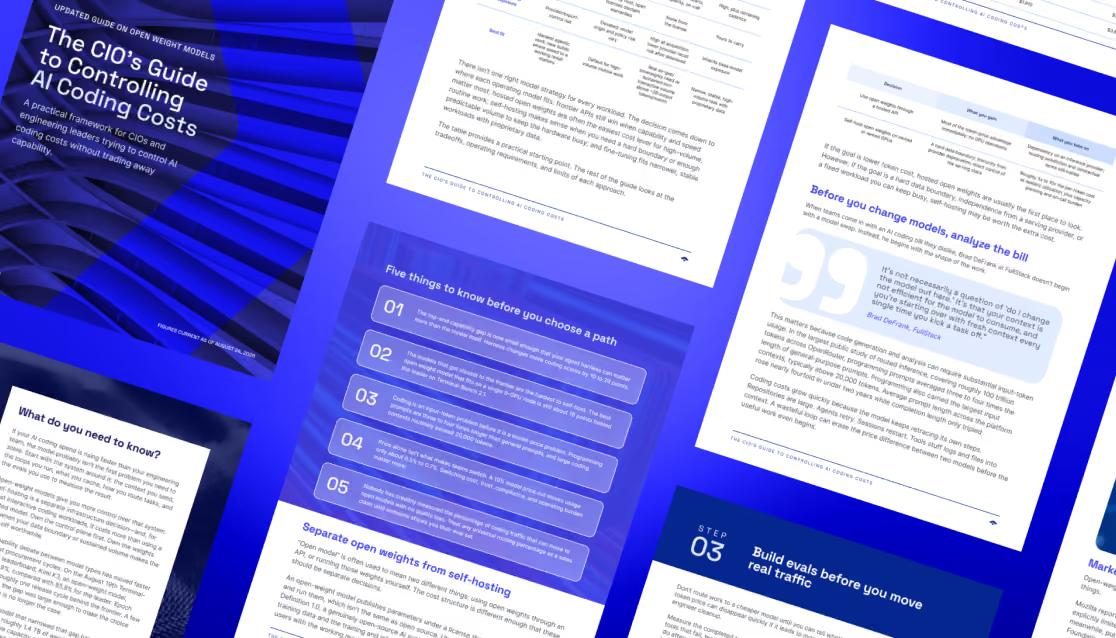
How can you cut your AI coding costs without switching models?
This guide gives you the math, the meaningful benchmarks, and a six-step plan to cut spend without giving up capability.
Enjoyed the article? Get new content delivered to your inbox.
Subscribe below and stay updated with the latest developer guides and industry insights.
Thank you! Your submission has been received!
Oops! Something went wrong while submitting the form.
Iframe is blocked. Accept cookies to load it.
Thank you! Your submission has been received!
Oops! Something went wrong while submitting the form.
We use cookies to provide our services, to allow us to better understand our audience, and to provide and serve personalized ads or content. By using our website, you consent to the terms of our Privacy Policy and our Cookie Policy, and the use of cookies, pixels, and other technology as described more fully therein