How to evaluate open-weight coding models before you deploy them
Written by
Fullstack Team
Last updated on:
October 28, 2026
Written by
Last updated on:
October 28, 2026
A practical guide to testing open-weight coding models against the work, risks, and quality standards that matter in your engineering organization.
Open-weight coding models are becoming viable options for more software engineering workflows. However, a strong benchmark score or low token price isn’t enough to justify using one in production.
Before deploying an open-weight coding model, engineering leaders need to know how it performs on their repositories, coding standards, internal tools, security policies, and review processes. The goal isn’t to find one model that can handle every task. It’s to determine which model can complete a specific type of work reliably, securely, and cost-effectively.
Start With the Work You Need Done
A model that handles a scoped bug fix or generates unit tests may not be reliable enough for a cross-repository refactor or autonomous work in production systems. Treating every coding task as though it carries the same complexity and risk leads to weak model-selection decisions.
Start by sorting potential use cases into practical categories:
Routine transformations, such as documentation updates, code comments, or standardized migrations
Well-scoped debugging and bug-fix tasks
Test generation and maintenance
Refactors across multiple files or services
Planning and architecture work
Security-sensitive changes
Long-running coding-agent tasks that require repeated tool use, testing, and iteration
Then consider what affects whether a model is appropriate for each category:
How much context does the model need to do the job well?
What happens if it changes the wrong file or introduces a regression?
Can tests, linters, security checks, or human review validate the output?
Does the model need permission to use tools, execute commands, update repositories, or create pull requests?
Is the work high-volume and repeatable, or rare and highly variable?
This approach helps teams avoid an all-or-nothing decision. Open-weight models may be a strong fit for routine, lower-risk tasks that are easy to validate. However, more complex or high-stakes work may still require a frontier model, more restrictive controls, or mandatory human approval.
Use Benchmarks to Build a Shortlist
Public benchmarks such as Terminal-Bench can help engineering teams shortlist models for agentic technical work. However, benchmark scores don’t capture every condition that affects production performance, so they shouldn’t determine a deployment decision on their own.
A coding model’s performance can change based on the agent harness around it. Prompts, context selection, tool access, retry behavior, stop conditions, and test environments all affect whether an agent completes a task successfully. Your internal setup may be very different from the environment used for a public score.
In 2026, OpenAI stopped reporting SWE-bench Verified scores after a targeted audit found material issues in 59.4% of 138 problems that OpenAI o3 didn’t consistently solve. OpenAI also found signs that every frontier model it tested had encountered at least some benchmark tasks or solutions during training.
Later that year, OpenAI found substantial issues in SWE-bench Pro as well, reinforcing that it’s best to use public benchmarks to shortlist models, then make deployment decisions with private evaluations that reflect your own engineering work. OpenAI’s later analysis estimated that roughly 30% of SWE-bench Pro tasks were broken.
When reviewing a benchmark, ask:
What kind of engineering work does it test?
Does that work resemble what your team wants to automate or accelerate?
Who ran the evaluation: the model provider, an independent evaluator, or the benchmark maintainers?
What tools, prompts, retries, and agent framework were used?
Can you reproduce the result in an environment that resembles your own?
Use benchmark results to narrow your candidate list. Don’t use them alone to select a production model.
Build an Evaluation Set From Real Work
The most valuable LLM evaluation framework is based on the engineering work your organization already does.
You don’t need a large evaluation set to begin. Start with a small, representative group of tasks that covers your most important workflows, risks, and failure modes, then expand it as you learn where performance varies.
Choose examples that reflect the work, risks, and failure modes your team cares about:
Bug fixes with clear expected behavior
Unit- and integration-test generation
Documentation updates tied to a code change
Repetitive migrations that follow an established pattern
Refactors involving multiple files
Tasks involving internal APIs, libraries, or frameworks
Changes that must comply with security, privacy, or architectural standards
Tool-using tasks that require a model to inspect logs, run tests, and recover from a failed command
Scenarios where the right response is to ask for clarification or decline an unsafe action
For each task, define success before you run the evaluation. Identify which files should change, which tests must pass, which behavior must remain intact, and which actions the model must not take.
This moves the conversation beyond whether a model produces convincing code. Instead, you can assess whether it completes the task to your engineering organization’s standard.
Evaluate each model on several dimensions:
Task completion: Did it produce a working, validated result?
Code quality: Is the implementation maintainable, correctly scoped, and consistent with your engineering standards?
Reliability: How often does it finish without looping, failing tools, or requiring an engineer to intervene?
Latency: How long does it take to produce a usable result?
Total cost: What does the full run cost after model use, tool calls, retries, infrastructure, and human cleanup?
Security and policy adherence: Did it touch restricted files, expose sensitive information, misuse a tool, or violate a required control?
Your internal evaluation set shouldn’t be a one-time exercise. It should become a reusable asset for testing new models, providers, agent workflows, prompts, and routing rules.
Measure Completed Work, Not Token Price
A lower token price doesn’t always mean lower cost.
A less expensive model may require more retries, additional tool calls, larger prompts, repeated repository scans, or significant engineer cleanup. It can look economical in a pricing comparison. However, it may take longer and cost more to produce a usable result.
Instead of comparing only input and output token rates, measure what it takes to complete and validate the entire task.
Track the model’s behavior across the workflow:
How many attempts did it take to reach a passing solution?
How often did it fail a tool call or use the wrong tool?
Did it repeatedly load the same repository context?
Did it continue working after it should’ve stopped?
How frequently did an engineer need to correct, finish, or revert the output?
Did the model create regressions that appeared only after review or testing?
Coding-agent workflows can consume substantial context. A model may need to examine source files, test failures, logs, documentation, and previous steps before it can act. If the system doesn’t preserve useful context or recognize when work is complete, it can waste tokens and time regardless of the model’s listed price.
Before switching models, examine the workflow around the model. Improve context reuse, caching, stop conditions, and task planning where possible. Those changes can reduce cost and improve reliability without changing the model.
Test Models in the Same Agent Harness
A coding model is only one part of the system that produces an engineering result.
The surrounding harness can determine whether a model succeeds or fails. That includes the instructions it receives, repository context, available tools, retry policy, tests, and the moment when the system decides the task is complete.
For an accurate comparison, run candidate models in the same environment. Keep the following consistent wherever possible:
System prompts and task instructions
Context-retrieval approach
Repository access
Tool definitions and permissions
Test and validation steps
Retry limits and stop conditions
Human approval requirements
Logging and observability
Otherwise, you may be comparing two different agent systems instead of two different models.
A useful starting point is to test an open-weight model against the frontier model that currently represents your quality baseline. You may also include a lower-cost model for simple, repeatable work.
The result doesn’t need to be a single winner. Different model tiers can make sense for different tasks. A lower-cost open-weight model might work well for structured, high-volume tasks. However, a frontier model may remain the better choice for complex refactors, ambiguous incidents, or long-horizon work.
That’s why model routing matters. Rather than hard-coding one model into every application, route requests through a central decision layer that can apply task, cost, risk, and policy rules.
Evaluate Security, Provenance, and Deployment Needs
Open-weight models can give teams more control over deployment and provider choice. However, downloading, serving, or customizing a model also creates responsibilities around security, provenance, infrastructure, and governance.
Treat model weights and the surrounding serving stack as software dependencies. Your review should include:
License terms: Confirm the license supports your intended commercial use and doesn’t create unacceptable restrictions.
Model provenance: Document where the weights came from, who released them, and which version your team approved. Pin approved versions and verify checksums or signatures when they’re available.
Data handling: Determine how prompts, source code, logs, telemetry, and embeddings are processed and retained.
Hosting location: Review whether the model and inference provider meet your jurisdictional, contractual, and compliance requirements.
Serving-stack controls: Assess network access, credentials, updates, dependencies, and monitoring.
Agent permissions: Apply least-privilege access to agent tools, including repository access, shell commands, external APIs, deployment actions, and production environments.
Fallback options: Ensure that teams can move workloads to a different model or provider if performance, availability, pricing, or policy requirements change.
It’s also important to distinguish between using open weights and self-hosting them. A hosted provider can serve an open-weight model without requiring your team to manage GPUs, capacity planning, model packaging, serving infrastructure, or on-call operations. Self-hosting is most relevant when you need a hard data boundary or want direct control over the serving environment.
Set a Quality Floor Before Deployment
Once you have evaluation results, establish a minimum acceptable quality standard for each type of work.
A documentation workflow may have a lower threshold if every output receives human review before it’s merged. A test-generation workflow may be appropriate for a lower-cost model when generated tests are reviewed for meaningful coverage and validated through CI. A security-sensitive refactor may require a stronger model, restricted tool access, and mandatory approval from an engineer.
Routing decisions should reflect your evidence and risk tolerance, not broad claims about which model is “best.”
Start with low-risk, high-volume tasks that are easy to validate. Keep a higher-capability fallback available. Monitor production performance, and make routing rules easy to update as models and workloads change.
The goal isn’t to select one permanent coding model. It’s to create a system that lets your organization evaluate, route, and replace models without rewriting every application or losing visibility into quality.
Evaluate Before You Deploy
Open-weight coding models can be strong candidates for well-bounded engineering work. However, each model should earn its place in production through evaluations based on your tasks, tools, quality standards, and operating constraints.
Use public benchmarks to build a shortlist, then compare candidates on task completion, reliability, latency, total cost, and risk in your environment. That process will show you where open-weight models fit, where higher-capability models still earn their premium, and which workloads shouldn’t be automated without additional controls.
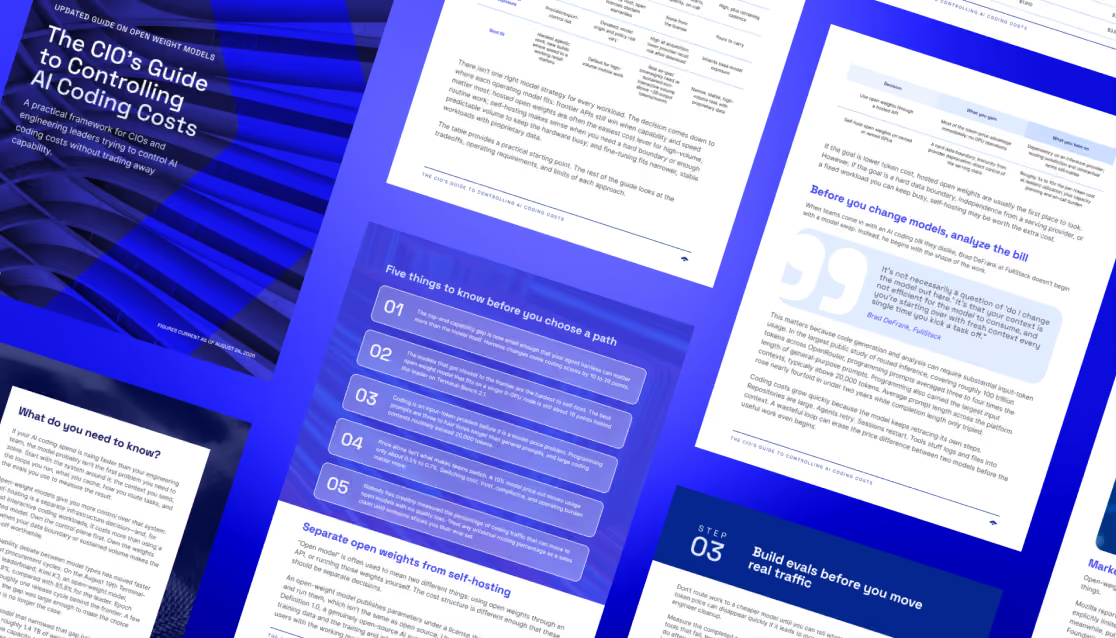
Once you know which tasks each model can handle, the next question is how to route that work and manage its cost. Our guide to controlling AI coding costs compares frontier APIs, hosted open-weight models, self-hosted models, and fine-tuned proprietary options. It also provides a six-step framework for building a model-routing control plane.
What should teams measure when evaluating coding LLMs?
Evaluate coding LLMs on more than benchmark scores or token pricing. Measure task completion, code quality, reliability, latency, total cost, and security or policy adherence. The most useful metric is whether a model can complete a validated task with an acceptable level of engineering oversight.
Are public AI coding model benchmarks enough to choose a model?
No. Public AI coding model benchmarks can help teams identify models worth testing. However, their results may be affected by the agent harness, prompts, tools, retry behavior, test environment, and whether a model has encountered benchmark tasks during training. Use benchmarks to create a shortlist, then test candidates against private tasks that reflect your own codebase and workflows.
How do you build an LLM evaluation framework for coding models?
Start with a small set of representative engineering tasks, including bug fixes, test generation, migrations, documentation updates, refactors, and security-sensitive changes. Define success in advance for each task, including expected file changes, required tests, prohibited actions, and review requirements. Run the same evaluation set whenever you change models, prompts, providers, agent workflows, or routing rules.
What are coding agent evals?
Coding agent evals assess whether an AI agent can complete real software engineering work, not simply generate plausible code. They measure the full workflow: understanding the task, retrieving context, using tools, running tests, handling errors, stopping at the right point, and producing a validated result. They should also capture retries, failed tool calls, human intervention, and regressions.
Should you self-host an open-weight coding model?
Self-hosting can make sense when your organization has a hard data-boundary requirement or needs direct control over the serving environment. However, using an open-weight model through a hosted provider may be a simpler option when you want deployment flexibility without managing GPUs, capacity planning, model packaging, serving infrastructure, and on-call operations.
How can you cut your AI coding costs without switching models?
This guide gives you the math, the meaningful benchmarks, and a six-step plan to cut spend without giving up capability.
Enjoyed the article? Get new content delivered to your inbox.
Subscribe below and stay updated with the latest developer guides and industry insights.
Thank you! Your submission has been received!
Oops! Something went wrong while submitting the form.
Iframe is blocked. Accept cookies to load it.
Thank you! Your submission has been received!
Oops! Something went wrong while submitting the form.
We use cookies to provide our services, to allow us to better understand our audience, and to provide and serve personalized ads or content. By using our website, you consent to the terms of our Privacy Policy and our Cookie Policy, and the use of cookies, pixels, and other technology as described more fully therein