Open-weight model security: A CISO’s pre-deployment checklist
Written by
FullStack Team
Last updated on:
October 14, 2026
Written by
Last updated on:
October 14, 2026
Open-weight models give enterprises more control over AI deployment. They also require a clearer review of model provenance, data access, hosting, and ownership.
Open-weight models are giving enterprises more options about where AI runs and what happens to the data around it. They’re also forcing security teams to evaluate a part of the stack that many organizations are only beginning to formalize.
That evaluation goes well beyond the model itself. A deployment decision can hinge on the provenance and integrity of model artifacts, the trustworthiness of adapters and containers, the boundaries around enterprise data, and the controls governing what the system can access once it is live.
CISOs can’t approve an open-weight model on flexibility alone. They need enough evidence to decide whether the model, its supporting components, and the environment hosting it can meet the organization’s security, privacy, and governance requirements.
What changes with open-weight models
Open-weight doesn’t mean fully transparent. In many cases, organizations can download the model weights while still lacking visibility into the training data, the training process, the evaluation methodology, or the full chain of dependencies surrounding deployment.
That changes the review process in a practical way. Instead of primarily evaluating a vendor’s security posture and contractual terms, the enterprise also has to validate the artifacts it is deploying, the infrastructure it is hosting, the data that will flow through the system, and the operational controls that will govern changes over time.
Security leaders don’t need to decide whether open-weight models are inherently safe or unsafe. They need enough evidence to make a risk-informed deployment decision for a specific use case, in a specific environment, with a specific model and its surrounding components.
Reviewing open-weight models before deployment
An open-weight model review usually follows a predictable path. CISOs don’t need to personally validate every artifact or test every deployment scenario, but they do need to make sure the right people have answered the right questions before a model reaches production.
The review should cover the intended use, model provenance, data access, hosting environment, application behavior, and ownership after deployment. Those areas need to be considered together, since a change in one can alter the risk profile of the entire system.
Start with the use case
A model review shouldn’t begin with the model card alone. It should begin with the business purpose, the users, the data classes involved, and the actions the model will be allowed to take. A local model used for low-risk internal summarization has a very different security profile from one that can access customer records, call tools, or generate outputs that feed directly into business workflows.
Start with the use case before selecting a model. The internal sponsor should document:
The intended business outcome and who will use the system.
The types of enterprise data the model may receive, retrieve, store, or transform.
Whether the model will have retrieval access, tool access, code execution, or workflow permissions.
Whether the system is internal, customer-facing, or tied to regulated decisions.
The likely impact of incorrect, manipulated, or sensitive outputs.
Those details shape the review from the start. They determine what kind of controls the system needs, how much oversight is appropriate, and how much risk the organization is actually taking on.
Verify the model supply chain
Supply chain review should be one of the first gates, not an afterthought. Open-weight models often arrive with a wider set of dependencies than teams first assume: model files, tokenizers, quantized variants, adapters, embeddings, inference servers, orchestration layers, and container images.
A pre-deployment review should answer several questions clearly:
Can the team confirm the official publisher and the approved source for the exact model version?
Can the artifact be validated using hashes, signatures, or other integrity checks before it is loaded into the serving environment?
What supporting components will be deployed alongside it, including tokenizers, quantized variants, LoRA adapters, embedding models, inference servers, orchestration layers, and container images?
Is there an inventory that maps each component to its source, version, owner, and approval status?
Is there a process to monitor for vulnerabilities, updates, revocations, or repository compromise?
Procurement and governance teams usually need to slow the process down here. A model card can be helpful, but it doesn’t guarantee trustworthy provenance, complete documentation, or a stable maintenance posture. Teams still need to verify what they’re deploying, where it came from, and whether they can support it over time.
Review data and privacy boundaries
Security review should cover every data flow around the model, not just the prompt window. Prompts, completions, logs, traces, embeddings, retrieval sources, evaluation datasets, fine-tuning data, and administrator access paths can all create privacy, security, and compliance exposure if they aren’t mapped and controlled.
The review should establish where information moves and who can access it:
What information can enter the model, retrieval layer, logs, and support tooling?
Where is that information stored, and how long is it retained?
Can any connected component send data outside the approved environment?
Who can access prompts, outputs, embeddings, and administrative records?
This is especially important for self-hosted AI security because internal deployment can create a false sense that sensitive data is automatically contained. In practice, sensitive information may still spread through observability tools, support logs, vector databases, backup systems, cached outputs, or unapproved external calls made by connected tools or runtime components.
Teams working through those questions may also benefit from guidance on AI data privacy and AI governance, especially when policy discussions need to turn into concrete controls around access, retention, monitoring, and accountability.
Secure the hosting environment
A self-hosted model should be held to the same production standards as any other enterprise system, with additional controls around model artifacts, prompts, outputs, and connected tools. The serving environment should be hardened, segmented, monitored, and integrated into the organization’s identity, secrets, vulnerability-management, and incident-response programs.
Teams should validate controls such as:
Strong authentication and authorization on model-serving endpoints.
Least-privilege runtime permissions for containers, users, and connected services.
Secrets stored outside prompts, code, and model files.
Restricted and monitored outbound network access.
Patch and vulnerability management for inference servers, drivers, packages, images, and supporting infrastructure.
Logging, alerting, backup, rollback, and recovery procedures that have actually been tested.
Self-hosted models also bring responsibility for the runtime stack around them. It’s not enough to secure the endpoint alone if the surrounding infrastructure, dependencies, or access patterns create a path to exposure.
Test for model-specific threats
A model can introduce risk even when its source has been verified, and the hosting environment is well secured. The application still has to account for adversarial prompts, untrusted retrieved content, sensitive data, and any tools or systems the model can access.
Testing should reflect how the model will be used in practice:
Can prompt injection alter model behavior or influence connected tools?
Can the system reveal confidential data through prompts, retrieval, logs, or outputs?
Does the application validate model output before using it downstream?
Can a malicious or malformed request exhaust model-serving resources?
Teams should also test how the application responds when the model is uncertain or wrong, especially when its output could influence a business decision or trigger an action.
Define ownership before go-live
A model can’t move into production without clear accountability. Someone should own the business outcome, the technical implementation, the data used by the system, and the decision to accept or mitigate security risk.
Before approval, CISOs should know:
Who owns the business use case and the technical deployment?
Who can approve the data sources, model changes, and connected tools?
What changes require another security or governance review?
Who can pause, roll back, or retire the system if the risk profile changes?
How will the organization respond to a data exposure, model compromise, or unsafe system behavior?
A new model version, adapter, dataset, tool integration, or expanded use case can change the system’s risk profile quickly. Teams need a clear path to reassess the deployment before those changes reach production.
Managing what you deploy
Open-weight models give organizations more control over how AI is deployed and operated. That control comes with ongoing responsibility: tracking changes to the model stack, maintaining the environment around it, and revisiting the review when the use case, data access, or system capabilities expand.
The decision also has operational implications beyond security. Teams weighing self-hosted and hosted models need to account for infrastructure, utilization, support, and runtime costs alongside their requirements for control and data handling.
Open-weight model security is the process of assessing and protecting a model’s weights, supporting components, data flows, hosting environment, and connected systems before deployment. It includes AI model supply chain security, access controls, privacy protections, testing, and ongoing governance.
Are open-weight models secure for enterprise use?
Open-weight models can be used securely in enterprise environments when organizations verify model provenance, secure the hosting stack, restrict data access, test application behavior, and define ownership for ongoing operations. Open weights alone don’t provide a complete view of training data, evaluation methods, or supporting dependencies.
What should CISOs review before deploying an open-weight model?
CISOs should review the intended use case, the source and integrity of the model and related artifacts, data access and retention, the security of the self-hosted environment, model-specific threats, and ownership after go-live. The review should also establish change-control and rollback procedures.
What are the main AI model supply chain security risks?
AI model supply chain risks can include unverified model files, compromised repositories, vulnerable container images, untrusted adapters, outdated dependencies, and unclear model ownership. Teams should inventory every deployed component, validate its source, and monitor the stack for updates, vulnerabilities, and compromise.
How does self-hosted AI security differ from hosted AI security?
Self-hosted AI security gives an organization more control over infrastructure and data handling, while also placing more responsibility on the organization. Teams must secure model-serving endpoints, runtime permissions, network connections, secrets, logging, recovery procedures, and the full set of model artifacts and dependencies.
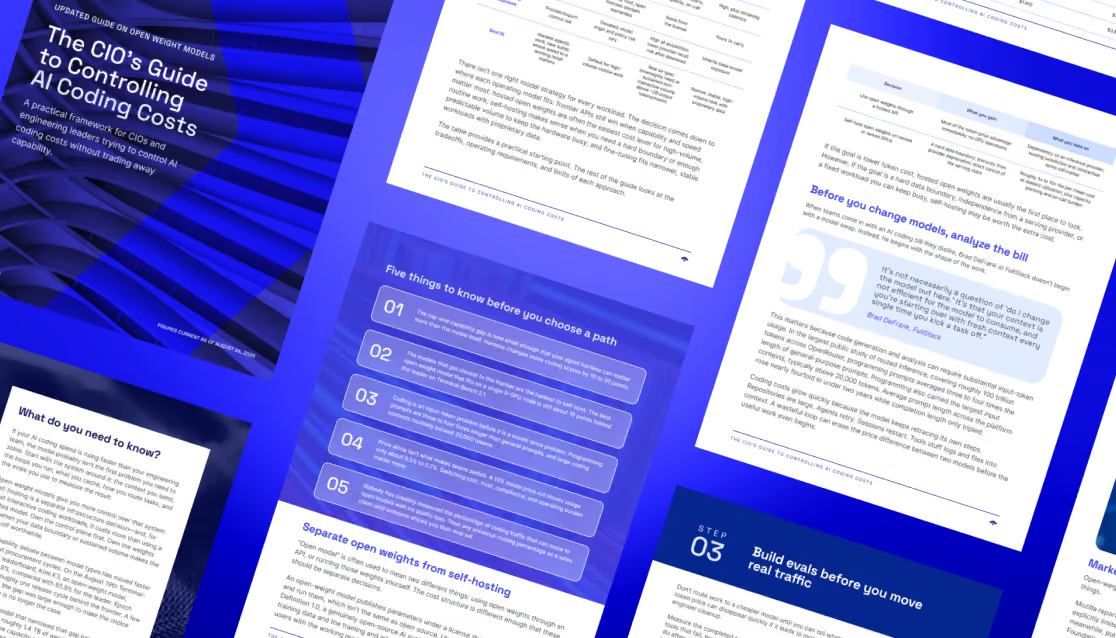
How can you cut your AI coding costs without switching models?
This guide gives you the math, the meaningful benchmarks, and a six-step plan to cut spend without giving up capability.
Enjoyed the article? Get new content delivered to your inbox.
Subscribe below and stay updated with the latest developer guides and industry insights.
Thank you! Your submission has been received!
Oops! Something went wrong while submitting the form.
Iframe is blocked. Accept cookies to load it.
Thank you! Your submission has been received!
Oops! Something went wrong while submitting the form.
We use cookies to provide our services, to allow us to better understand our audience, and to provide and serve personalized ads or content. By using our website, you consent to the terms of our Privacy Policy and our Cookie Policy, and the use of cookies, pixels, and other technology as described more fully therein
.svg)
.svg)
.jpg)