Open-weight models vs. open-source AI: What enterprise buyers need to know
Written by
FullStack Team
Last updated on:
October 14, 2026
Written by
Last updated on:
October 14, 2026
As open models become more viable for enterprise use, teams need to understand what they’re actually getting—and what they’re responsible for—before choosing one.
Open models are getting harder to ignore. As the performance gap narrows for some enterprise use cases, more teams are asking whether an open-weight model could be a practical alternative to a closed API.
The challenge is that teams don’t always use the same language. Open-weight, open-source, and open models are often treated as interchangeable, even though they describe different levels of access and different rights. Those differences affect licensing, deployment, governance, and the control a company has in production.
What’s the difference between open-weight and open-source AI?
An open-weight model makes its trained parameters available for download or use. Those parameters, or weights, are the values the model learned during training that allow it to generate outputs from an input.
Open-source AI involves broader access. Under the Open Source AI Definition, a system should be available under terms that allow people to use, study, modify, and share it. It should also provide the preferred form for making those modifications, including the model parameters, the code used to train and run the system, and enough information about the training data for meaningful study and reuse.
Put simply, open weight provides access to the finished model. Open-source AI provides the materials needed to examine and modify the system behind it.
What’s included with an open-weight model?
An open-weight release typically includes the trained model parameters. Depending on the provider, it may also include inference code, tokenizer files, model cards, and technical documentation.
These materials can help teams test the model, run it in their own environment, or adapt it to a specific use case. However, they don’t automatically grant every right an enterprise may need.
The license and related terms determine whether the model can be used commercially, modified, redistributed, or incorporated into a customer-facing product. Documentation may also offer only limited information about the model’s training process and data sources.
That’s why a model can be easy to test but harder to approve for production. Legal, procurement, security, and delivery teams still need to review the terms, documentation, and operating requirements.
What’s included in open-source AI?
Open-source AI is designed to support use, study, modification, and sharing—not simply access to a model file. For enterprise teams, that can mean broader rights and greater visibility into how the system was created.
Alongside the model itself, an open-source AI system should provide the code and data information needed to understand, modify, or substantially recreate it. This can matter when a company needs more control over customization, governance, or long-term portability.
Not every enterprise needs that level of access. However, access to model weights alone shouldn’t be assumed to provide the same rights or transparency.
Why do open-weight models have different terms?
Open-weight describes what a provider has released, not how an organization can use it. The license and any related usage terms set those conditions.
Two open-weight models can have very different rules for commercial use, fine-tuning, redistribution, attribution, and downstream products. A model that works for internal experimentation may not fit a customer-facing application, while another may be suitable for production but carry obligations that legal or procurement teams need to review.
Teams should resolve those questions before committing to implementation. Review should cover the deployment model, who will access the system, whether it will support a commercial offering, and what obligations apply in production.
Does open weight mean self-hosting?
No. Open weights and self-hosting are related decisions, but they aren’t the same thing. Open weights refer to model availability; self-hosting refers to where the model runs and who operates the supporting infrastructure.
A company can use an open-weight model through a hosted API, a managed deployment, or infrastructure it operates itself. The right approach depends on the workload, data requirements, security needs, cost profile, and required level of operational control.
Self-hosting can make sense when a team needs a tighter data boundary or direct control over the runtime environment. However, it also creates responsibility for infrastructure, uptime, patching, monitoring, security controls, and support. For many teams, that operational burden outweighs the cost of downloading the model.
How should enterprise teams evaluate an open model?
Enterprise teams should start with the workflow, not the model category. The right choice depends on what the system needs to do, who’ll use it, what data it will handle, and how it needs to perform in production.
A customer-facing assistant, internal knowledge tool, retrieval workflow, and AI coding workflow can have very different requirements for quality, latency, context length, data access, observability, and human review. Those requirements should guide the decision before teams focus on labels.
A practical evaluation should include:
Testing models against real tasks, not just public benchmarks
Reviewing license terms before implementation decisions become difficult to change
Confirming where prompts, outputs, logs, and embeddings will be processed
Defining who’ll own monitoring, evaluation, and support after launch
Comparing total operating cost, not just model or token price
A lower-cost model won’t necessarily produce a lower-cost system. If it requires more engineering time, retries, infrastructure, or operational support to meet the same business need, it may become the more expensive option.
Choosing between open-weight and open-source AI
Open-weight models can give enterprise teams greater flexibility in how and where they deploy a model. They may be a good fit when a team wants control over the runtime environment without needing to modify the underlying system.
Open-source AI may be a better option when broad modification rights, deeper transparency, or long-term portability are priorities. However, neither label should determine the decision on its own.
Teams should first define the use case, data requirements, deployment environment, required controls, and long-term ownership model. That makes it easier to determine whether an open-weight model is sufficient, a fully open-source system is necessary, or a hosted proprietary model is the more practical choice.
An open-weight model makes its trained parameters, or weights, available for download or use. It may also include materials such as inference code, tokenizer files, model cards, and documentation.
How is open-source AI different from open-weight AI?
Open-weight AI gives users access to the finished model. Open-source AI provides broader rights and the materials needed to use, study, modify, and share the system, including relevant code and training-data information.
Can businesses use open-weight models commercially?
Sometimes, but not always. Commercial use depends on the model’s license and related terms, which may set conditions for modification, redistribution, attribution, or customer-facing applications.
Does open weight mean a company must self-host the model?
No. An organization can use an open-weight model through a hosted API, a managed deployment, or infrastructure it operates itself. Self-hosting is a deployment choice, not a requirement of using open weights.
How should enterprises evaluate an open-weight model?
Start with the workload rather than the label. Test the model against real tasks, review its license, confirm how data and logs will be handled, assign operational ownership, and compare total cost—not just model or token price.
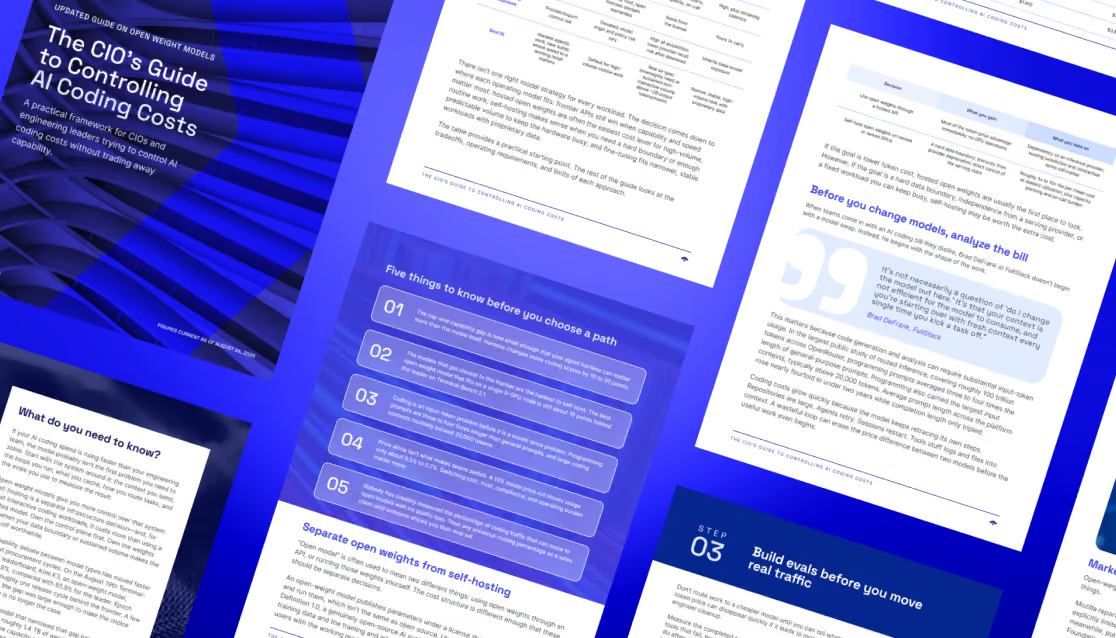
How can you cut your AI coding costs without switching models?
This guide gives you the math, the meaningful benchmarks, and a six-step plan to cut spend without giving up capability.
Enjoyed the article? Get new content delivered to your inbox.
Subscribe below and stay updated with the latest developer guides and industry insights.
Thank you! Your submission has been received!
Oops! Something went wrong while submitting the form.
Iframe is blocked. Accept cookies to load it.
Thank you! Your submission has been received!
Oops! Something went wrong while submitting the form.
We use cookies to provide our services, to allow us to better understand our audience, and to provide and serve personalized ads or content. By using our website, you consent to the terms of our Privacy Policy and our Cookie Policy, and the use of cookies, pixels, and other technology as described more fully therein
.svg)
.svg)
.jpg)