Software engineering is dead; long live software engineering
Written by
Serena Clifford
Last updated on:
October 14, 2026
Written by
Last updated on:
October 14, 2026
AI can write more code, faster. The harder work—making software reliable, secure, and useful in the real world—still depends on engineers.
On February 5, 2025, Business Insider posted The AI coding apocalypse, which presents a grim look into the future of software engineers. It notes that the job postings for software engineers fell by 50% from January to December 2023; that a poll on Blind, an anonymous workplace forum, had 42% of respondents agree that the career was doomed; that several major companies were conducting rounds of hiring freezes and layoffs.
While the article and the engineers interviewed in it agreed that software engineering wasn’t being driven extinct, the data seemed dire. However, come October 2026, Indeed reported that US software development postings rose almost 15% from late February, even as overall job postings fell by 7%.
The news may seem baffling. After all, a set of randomized controlled trials across Accenture, Microsoft, and an anonymous Fortune 100 company in 2025 found that developers using an AI coding assistant completed about 26% more tasks per week, on average. Salesforce claimed that AI had increased productivity by 30%. If AI allows the average software developer to do more in less time, why is there a sudden increase in open positions for the role?
The answer has less to do with the volume of code a team can produce than with what that code still needs to become. AI may generate a first draft quickly, but someone still has to turn that draft into software that works reliably in the real world—and keeps working after it ships.
What AI changes—and what it doesn’t
Writing code is only one part of building software. Engineering also includes turning business needs into technical requirements, designing systems that fit within existing architecture, accounting for reliability and security, and maintaining the result once it’s in production.
AI is getting very good at a narrow but highly visible part of that work. It can scaffold applications, draft functions, generate tests, explain unfamiliar libraries, and help developers move through routine implementation tasks faster. That changes the economics of code production, especially for straightforward work that already follows familiar patterns.
What AI doesn’t do on its own is decide what should be built, how it should behave when assumptions fail, or whether a feature actually fits the system around it. Those questions remain central to software engineering, and they become more important as the cost of producing code drops.
From AI-generated code to production software
AI can help teams create something that looks finished very quickly. A prompt can produce a user interface, connect a backend to an API, and deliver a convincing demo in minutes.
But a convincing demo isn’t the same as production-ready software. The real test starts when the system has to handle real users, messy data, changing requirements, partial failures, unpredictable traffic, and integrations that don’t behave the way they should.
That’s where engineering matters most. Production software needs monitoring, security controls, error handling, performance tuning, and a plan for keeping it maintainable over time. It also needs people who understand how a change in one part of the system can affect everything around it. AI can speed up the first draft, but teams still need engineers to make sure the finished product holds up in the real world.
Why demand can rise alongside productivity
Higher productivity doesn’t always reduce demand for labor. In software, it can change what organizations are willing—and able—to take on.
When development moves faster, teams won’t necessarily keep the same roadmap and reduce headcount. They may work through more of the backlog, modernize older systems, improve internal tools, expand automation, or build features that previously didn’t justify the cost. Faster implementation can create more viable work, not simply reduce the people needed to do it.
That may be part of what’s behind the latest hiring rebound. CNBC’s October 2026 reporting found that the increase in software-development postings was concentrated in experienced roles: 71% of the growth from May 2025 to May 2026 came from senior positions, while 37% came from roles with AI in the title. Software postings were still about 27.5% below their pre-pandemic level, though, suggesting a selective recovery rather than a full return to the earlier market.
What still requires engineering judgment
Generating code is getting easier, but turning it into software that’s safe, reliable, and maintainable still requires judgment. At the same time, experience and front-end engineering will expand as a human endeavor as AI enables more dynamic, tailored customer and user journeys.
Engineers need to understand dependencies, data flows, security requirements, performance constraints, and operational risk. They need to review AI-generated output in context, decide whether it belongs in the codebase, and diagnose the kinds of issues that won’t appear until real users and real workloads put the system under pressure.
They also have to make tradeoffs that don’t come with a single right answer: shipping quickly without creating unnecessary maintenance work, keeping a system flexible without making it overly complex, and adding convenience without losing control. As teams produce more software in less time, those decisions matter even more. A weak assumption or rushed integration can move into production just as quickly as a useful feature.
How AI is reshaping early-career roles
This shift isn’t evenly distributed across the profession. Early-career developers have more reason to feel unsettled, because some of the work that once served as the first rung on the ladder is now easier to automate or compress.
The same CNBC report cited Stanford’s 2026 AI Index in noting that employment for software developers ages 22 to 25 had fallen nearly 20% from 2024, even as older developer roles expanded. Business Insider likewise reported that the share of open software-engineering roles aimed at entry-level workers had fallen to just over 20%, down from nearly 30%, while roles seeking seven or more years of experience rose to nearly 40%.
That doesn’t mean there’s no place for junior talent, but it does mean their path is changing. Newer developers still need to learn how systems fit together, how to debug, how to review code critically, how to ask better questions about requirements, and how to recognize when AI output is incomplete or wrong.
That learning can’t happen only in theory—or only after someone has already become senior. Early-career engineers need opportunities to work alongside experienced teammates, see how production systems behave, and build the judgment that comes from investigating failures, reviewing tradeoffs, and maintaining software over time.
There’s a practical issue for employers, too. Companies that reduce junior hiring too aggressively may save time in the short term, but they’ll weaken their future pipeline of mid-level and senior engineers. Hiring early-career talent remains how teams build institutional knowledge, develop future technical leaders, and ensure there are people ready to take ownership of the systems the business depends on.
What AI-assisted development requires from teams
For engineering leaders, the challenge isn’t whether to use AI, but how to use it without mistaking acceleration for completion.
AI can be effective at helping teams move through boilerplate, documentation, tests, and initial implementation. It can also shorten the time needed to work in unfamiliar languages or frameworks. However, that speed only creates value when teams also preserve review discipline, architectural thinking, production readiness, and operational ownership.
This changes what strong teams should optimize for. It’s no longer enough to ask whether a developer can produce code quickly. Teams also need people who can evaluate generated output, reason across systems, maintain reliability, and decide when a fast answer isn’t a good answer.
Long live software engineering
Software engineering is changing as AI makes some coding tasks faster and reduces the time teams spend on routine implementation work, particularly at the entry level. Engineers will need to adapt—using AI well, building stronger systems-thinking skills, and taking greater ownership of the outcomes their software creates.
That evolution doesn’t make engineers less important—if anything, it makes their judgment more valuable. AI-generated code still needs to fit within real systems, handle failures, protect data, and remain maintainable as requirements change. Someone has to make the technical tradeoffs, understand the consequences of a change, and take responsibility when a system breaks.
As implementation becomes cheaper and faster, the need for capable engineers won’t go away. Their work will extend further upstream and deeper into production: shaping what gets built, evaluating what AI produces, and sustaining the software people rely on.
No. AI is changing software engineering by speeding up routine coding work, but teams still need engineers to design systems, review generated code, manage risk, and keep software reliable after release.
Will AI replace software engineers?
AI is unlikely to replace software engineers outright. It can help write code, generate tests, and speed up implementation, but it can’t independently own architecture, security, production reliability, or the tradeoffs involved in maintaining complex systems.
Why are software engineering jobs growing despite AI coding tools?
Faster development can expand what companies can afford to build. Teams may use AI to modernize older systems, automate internal work, tackle more of their backlog, and launch projects that previously weren’t worth the cost.
Are entry-level software engineering jobs disappearing?
Entry-level roles are becoming more competitive as AI automates or compresses some routine tasks. But companies still need to hire and develop early-career engineers to build their future pipeline of mid-level engineers, senior developers, and technical leaders.
What skills do software engineers need in the AI era?
Software engineers need to know how to use AI tools critically while strengthening skills in system design, debugging, code review, security, reliability, performance, and production operations. The key skill is judgment: knowing whether AI-generated code is appropriate, safe, and maintainable.
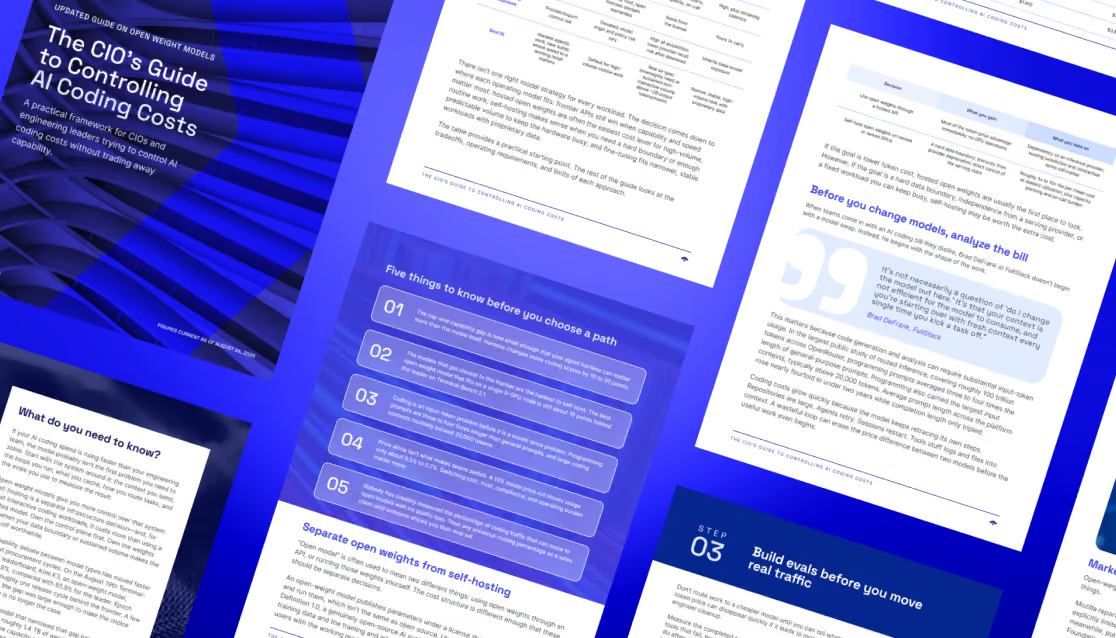
How can you cut your AI coding costs without switching models?
This guide gives you the math, the meaningful benchmarks, and a six-step plan to cut spend without giving up capability.
Enjoyed the article? Get new content delivered to your inbox.
Subscribe below and stay updated with the latest developer guides and industry insights.
Thank you! Your submission has been received!
Oops! Something went wrong while submitting the form.
Iframe is blocked. Accept cookies to load it.
Thank you! Your submission has been received!
Oops! Something went wrong while submitting the form.
We use cookies to provide our services, to allow us to better understand our audience, and to provide and serve personalized ads or content. By using our website, you consent to the terms of our Privacy Policy and our Cookie Policy, and the use of cookies, pixels, and other technology as described more fully therein
.svg)
.svg)
.jpg)