As AI costs, vendors, and architectures grow more complex, technology leaders must decide what to buy, what to build, and which core capabilities to keep under their control.
For organizations of all sizes, the procurement of artificial intelligence presents a significantly more complex challenge than traditional software acquisition. Technology leaders find themselves balancing a broad spectrum of responsibilities, encompassing cloud infrastructure, cybersecurity, data integrity, and vendor management.
At the same time, finance executives must develop forecasting models for a nascent spending category that frequently shifts from predictable licensing fees to usage-based consumption. This fundamental change in fiscal structure naturally engenders a degree of strategic uncertainty within leadership teams.
While legacy enterprise software allowed for straightforward budgeting based on seat count and negotiated fixed-term contracts, the advent of AI has introduced a paradigm shift toward performance-based billing. Managed AI solutions, such as those integrated into customer-service platforms like Intercom, Zendesk, and Salesforce, increasingly derive their pricing from specific outcomes. These outcomes often include the number of conversations conducted or customer issues successfully resolved.
Though this consumption-based model better aligns corporate expenditure with realized value, it requires more sophisticated internal controls to maintain budgetary predictability.
Why AI cost is also an architecture question
Viewing an AI application as a multifaceted collection of components, including model access, proprietary data, developer tooling, and business logic, is essential for making informed architectural decisions. As organizations transition from simple assistants to sophisticated systems that execute multi-step workflows, the frequency of model calls increases.
This shift means that declining model costs don’t necessarily translate to a lower total cost of ownership. Consequently, mid-sized firms should adopt a strategy of purchasing standardized technology layers while retaining proprietary control over the specific logic and data that define their unique business operations.
Strategic priority should be placed on owning business logic, proprietary processes, and control mechanisms rather than building technology layers from scratch. This pattern of internal ownership over core logic is significantly more critical to long-term success than the selection of specific vendors.
Where should you actually build?
Your success comes down to three strategic priorities—not any single vendor choice.
1. Own the meaning of your data
Strategic ownership begins with the semantic layer of corporate data, where the business must define the authoritative meaning of its metrics. For example, an AI assistant's ability to report on revenue is only as valuable as the underlying consensus on whether that term represents sales, recognized, or recurring revenue.
By establishing clear business definitions and quality rules within a purchased data platform, organizations ensure that AI implementations resolve rather than amplify existing ambiguities. This rigorous approach to data governance is what allows a company to truly own the insights generated by its technology stack.
2. Decide which decisions belong to AI
Furthermore, organizations must exercise deliberate control over business logic by determining where AI judgment should supplement traditional software predictability. In complex processes such as insurance claims intake, the most effective architectures utilize AI for qualitative tasks, such as interpreting evidence or summarizing documents, while relying on standard software to enforce mandatory steps and human approval gates.
By maintaining control over these workflow rules and internal test cases, leadership ensures that the AI adheres to corporate policy and produces reliable, auditable business outcomes regardless of the specific vendor tools employed.
3. Measure completed work, not just AI activity
Finally, the maturity of an AI program is measured by its capacity to complete meaningful work rather than just generating activity. While a vendor may report high containment rates in customer service, the true metric of success is whether the customer achieved their desired outcome. Facilitating complex tasks, such as issuing refunds or updating records, requires deep integration into core business systems and rigorous adherence to security principles like least privilege and separation of duties.
Ultimately, mid-sized companies create the most value when they leverage managed platforms for infrastructure while building custom integrations that reflect their specific operational requirements.
Evaluating a platform through critical questions
Before committing to a long-term platform, it’s essential to consider how well the solution maintains your technical flexibility. Start by asking whether the platform can connect to other systems without locking you into proprietary integrations. As AI applications increasingly need to interact with diverse databases, tools, and other AI systems, the emergence of standards like MCP for tool connectivity and A2A for agent communication is becoming vital.
While you may not require every vendor to support every standard immediately, you should clearly understand how dependent your architecture will become on proprietary connectors and evaluate the engineering effort required to replace them should the need arise.
A second consideration is whether you can change models without rebuilding the entire application. As AI models are evolving at a rapid pace, switching the underlying model should be a manageable engineering task rather than a major rewrite. While different models will inevitably require updated testing and evaluation, a sound architecture should prioritize this modularity to ensure you can leverage newer, more efficient models as they become available.
Similarly, you must verify that you can export your operational and testing data. Your team needs a transparent view of model calls, tool usage, errors, and timing, ideally through common formats like OpenTelemetry. This ensures that even if the product changes, the institutional knowledge and test cases your team builds remain your proprietary assets.
Data portability is equally important, particularly when looking three to five years into the future. You should confirm whether you can take your data with you in a usable form if you choose to migrate platforms. Utilizing open formats like Delta Lake or Apache Iceberg can significantly reduce switching costs, though it is important to recognize that security rules, business definitions, and specific integrations may still be platform-dependent.
Finally, you must determine how much control the platform allows over what the AI is permitted to do. While an AI that simply answers questions presents limited risk, a system capable of issuing refunds or changing orders requires rigorous oversight. You must be able to define who the AI acts on behalf of, what information it can access, and which actions require human approval, ensuring that classic security principles like least privilege and separation of duties remain central to your implementation.
It is important to acknowledge that the six-layer model is a strategic simplification, as modern platforms increasingly span multiple categories.
For instance, Microsoft integrates model access with agents and monitoring, while Databricks and Snowflake bridge the gap between data infrastructure and AI development. Salesforce similarly collapses the boundaries between customer data, workflows, and AI agents. As these technological boundaries shift and pricing models evolve—moving from per-user fees to consumption-based metrics like capacity or completed outcomes—long-term architectural decisions should not be based solely on current unit pricing.
Instead, evaluate each platform by asking what work it saves your team, which core business elements remain under your direct control, and how difficult the platform would be to replace if your requirements change.
For most mid-sized companies, the goal isn’t to build every layer from scratch but to assemble a stack that balances efficiency with ownership. This might involve using a managed model platform and existing data infrastructure while building custom integrations that reflect your specific operational requirements. A custom AI system doesn’t necessitate building everything yourself; rather, it means retaining ownership of the specific business definitions, workflow rules, and security policies that make the system unique to your organization.
By starting with a single, high-value workflow and choosing the smallest set of technologies needed to make it reliable, you can create meaningful value without over-committing to a single vendor or an overly complex architecture.
An AI tooling stack is the collection of technologies used to build and run an AI application. It usually includes models, data, development tools, workflow software, the user interface, and integrations with business systems.
Should a mid-sized company build its own AI application or use AI features in existing software?
Start with the AI capabilities already available in your existing software.
Build when the workflow is important to your differentiation, depends on company-specific data or business rules, crosses several systems, or requires more control over decisions.
Most mid-sized companies do not need to build an AI platform from scratch.
Which parts of an AI system should a company own?
Own the parts that describe how your business works: important data definitions, business rules, workflow logic, security policies, testing criteria, and key integrations.
Buy standardized infrastructure when operating it yourself does not create a meaningful advantage.
Why can AI costs rise even when models are becoming cheaper?
Multi-step AI applications may call models many times while gathering information, using tools, checking results, and recovering from errors.
The total amount of AI used per business task can therefore increase even as the price of individual model calls falls.
The more useful measure is often cost per successful business outcome.
What AI tools should a mid-sized company evaluate in 2026?
There’s no single best stack.
A reasonable evaluation list includes AWS Bedrock, Microsoft Foundry, and Google Vertex AI for infrastructure; Databricks, Snowflake, and Microsoft Fabric for data; GitHub Copilot, Cursor, and Claude Code for development; LangGraph, Temporal, and Microsoft Agent Framework for workflows; Vercel AI SDK, CopilotKit, and assistant-ui for AI interfaces; and Salesforce Agentforce, Zendesk AI Agents, and Intercom Fin for customer-service applications.
The right choices depend on the systems you already use, your team's skills, your security requirements, and the business problem you are trying to solve.
How can you cut your AI coding costs without switching models?
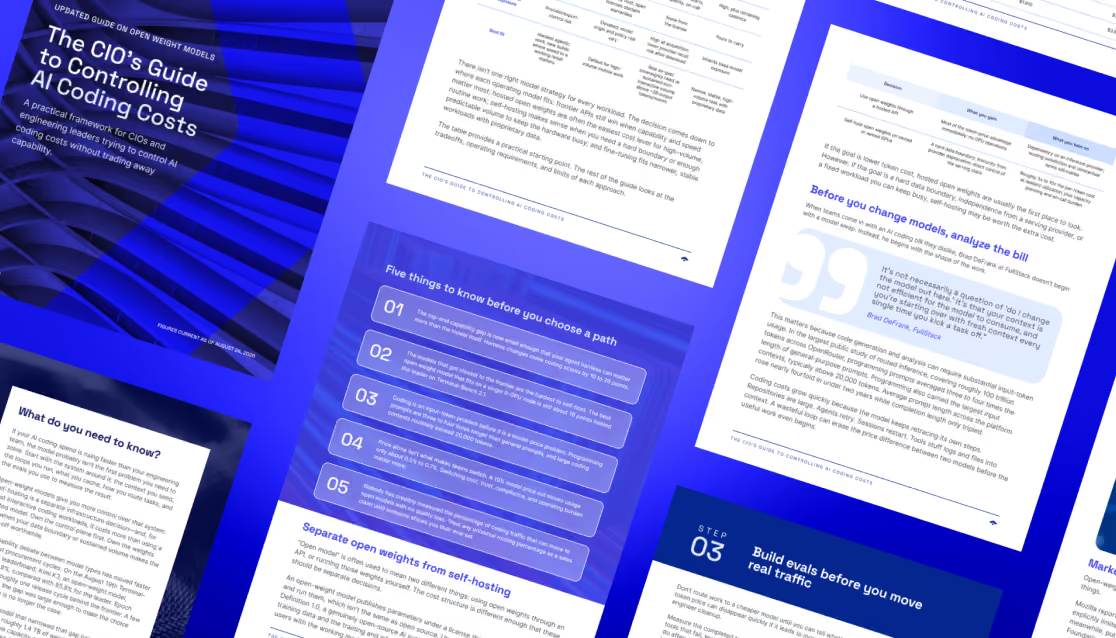
This guide gives you the math, the meaningful benchmarks, and a six-step plan to cut spend without giving up capability.
Enjoyed the article? Get new content delivered to your inbox.
Subscribe below and stay updated with the latest developer guides and industry insights.
Thank you! Your submission has been received!
Oops! Something went wrong while submitting the form.
Iframe is blocked. Accept cookies to load it.
Thank you! Your submission has been received!
Oops! Something went wrong while submitting the form.
We use cookies to provide our services, to allow us to better understand our audience, and to provide and serve personalized ads or content. By using our website, you consent to the terms of our Privacy Policy and our Cookie Policy, and the use of cookies, pixels, and other technology as described more fully therein
.svg)
.svg)