Gemini Flash 3.6 is Google’s long‑context, multimodal Flash‑tier model, designed to power coding agents and enterprise workflows with lower token costs and stronger built‑in safety controls.
Google released Flash 3.6 alongside two other additions to the Gemini lineup on July 21st, 2026: Gemini 3.5 Flash‑Lite and Gemini 3.5 Flash Cyber. Flash‑Lite is a faster, more cost-efficient 3.5‑class model tuned for high‑throughput, latency-sensitive tasks like agentic search and document processing, while Flash Cyber is a security-focused Flash variant rolling out in a limited pilot to governments and other trusted partners.
Within that new Flash family, Gemini Flash 3.6 is Google’s general-purpose model—balancing speed with intelligence to deliver stronger performance on agentic and multimodal tasks than 3.5 Flash, while using fewer tokens to get work done.
Update: Gemini 3.7 Flash Google released Gemini 3.7 Flash in August 2026 as the latest version of its Flash model family. It is generally available and brings stronger performance for coding, web development, and multi-step agent workflows while retaining the 1-million-token context window and built-in tool support familiar to Gemini Flash 3.6.
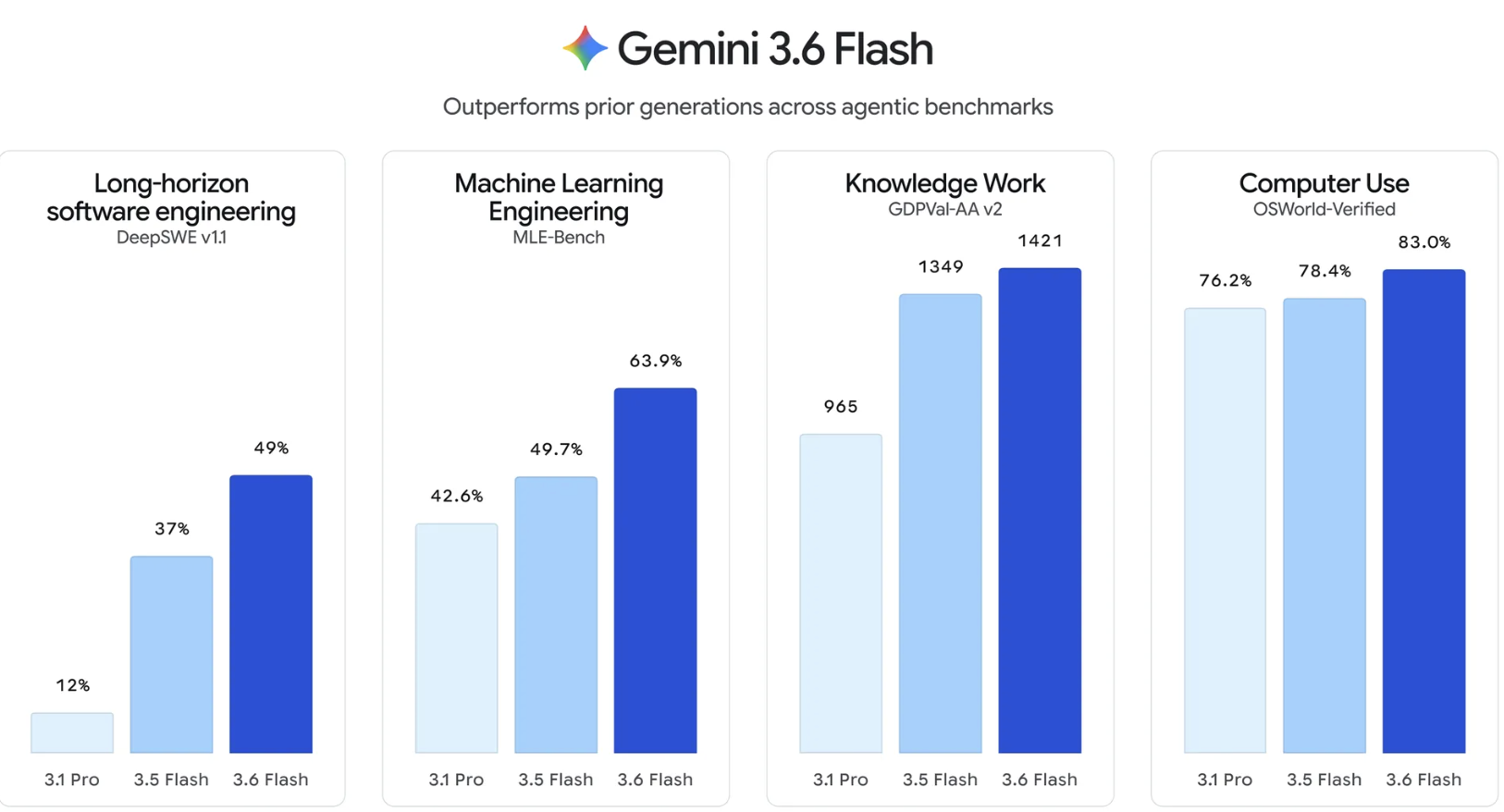
Chart courtesy of Google, 2026.
A brief history of Gemini
Gemini started as Google’s successor to PaLM 2 and was announced in December 2023 as a family of multimodal models, with Nano, Pro, and Ultra variants powering Bard (later rebranded to the Gemini app). In early 2024, Google introduced Gemini 1.5 with a 1‑million‑token context window and the first “Flash” variants, aimed at faster, more efficient coding and agentic workloads.
Through 2025, the lineup evolved into Gemini 2.0 and 2.5, with Flash and Flash‑Lite models becoming the default choice for speed‑sensitive applications, and Gemini 3 bringing a clearer split between Pro for frontier reasoning and Flash for token‑efficient agents and tools. Late 2025 and early 2026 saw Gemini 3 Pro and Gemini 3 Flash launch, followed by the 3.1 family, which refined the hierarchy between Pro, Flash, and Flash‑Lite for production use.
Gemini 3.6 Flash continued that progression as Google’s latest Flash‑tier model, released as part of a push to offer cheaper, more specialized options for long‑context agents, developer tools, and cybersecurity workflows.
In August 2026, Google followed with Gemini 3.7 Flash, its current Flash-tier model for coding and agentic workflows. It retains the 1-million-token context window and adds configurable thinking levels, with low, medium, and high settings, alongside improvements in software engineering, web development, and multi-step task execution.
Gemini Flash 3.6 at a glance
Gemini Flash 3.6 is Google’s newest Flash‑tier model for long‑context coding, agents, and multimodal work. It keeps the 1‑million‑token context window from 3.5 Flash and can take text, images, video, audio, and PDFs as input, with support for tool use, structured outputs, and computer use for agent workflows.
Flash 3.6 is built to do more with less, with improved coding and multi-step orchestration over 3.5, while using 17% fewer output tokens than 3.5 Flash according to the Artificial Analysis Index. This is useful for agents and internal tools that need to move across multiple files, interpret charts or layouts, and coordinate several actions in a single run.
Google also reports that Flash 3.6 closes much of the gap to Gemini Pro on long‑horizon coding and computer‑use benchmarks while keeping a Flash‑tier latency and price point. It jumps from 37% to 49% on DeepSWE and from 49.7% to 63.9% on MLE Bench, and its OSWorld‑Verified score rises from 78.4% to 83.0%. It also outperforms 3.5 Flash in knowledge work, with benchmarks like GDPval‑AA v2 improving from 1349 to 1421.
“Gemini Flash 3.6 delivers coding and reasoning quality close to Gemini Pro, while preserving the speed and cost profile that make Flash ideal for real-time developer workflows,” says Nick Frolov, the Head of Product for JetBrains’ Junie, an autonomous AI coding agent. “The new model also improves low reasoning coding performance by 10-20% compared to the previous Flash generation.”
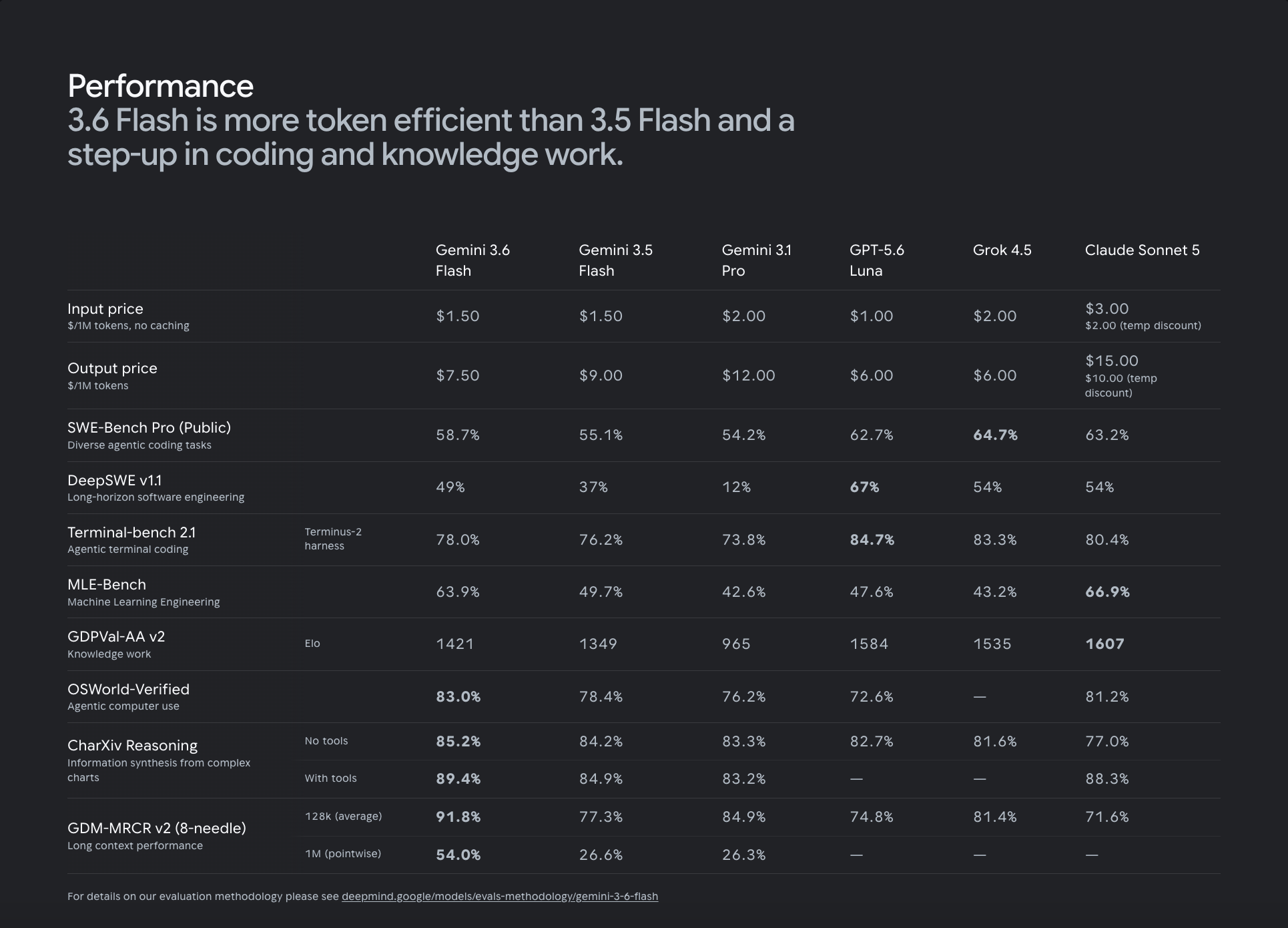
However, it’s also worth noting that Flash 3.6 is still part of Google’s Flash tier rather than its top frontier line. On Google’s own benchmark table, it clearly outperforms 3.5 Flash and 3.1 Pro on long‑context, chart reasoning, computer use, and several coding tests, but still trails GPT‑5.6 Luna, Grok 4.5, and Claude Sonnet 5 on the most demanding coding and knowledge‑work benchmarks like SWE‑Bench Pro and GDPVal‑AA v2.
Chart courtesy of DeepMind, 2026.
Governance
Much like Claude Fable 5, which released with a variety of limits and safeguards in place, Google released Flash 3.6 with enhanced Frontier Safety Framework, or FSF, protections. According to Google DeepMind, the FSF “operationalizes research [they’ve] done to identify and evaluate mechanisms that drive manipulation from generative AI”, mitigating the risk of users misusing their models.
The Frontier Safety measures bundled into Flash 3.6 specifically safeguard the model against Chemical, Biological, Radiological, and Nuclear (CBRN) and cyber offense misuses and make the model resistant to jailbreak attempts, while also minimizing refusals for beneficial uses. Together, these controls are meant to keep Flash 3.6 usable for everyday coding, analysis, and agent workflows without opening up obvious pathways to serious real‑world harm.
Applications for Gemini Flash 3.6
Gemini Flash 3.6 is well‑suited to long‑context coding agents and multi‑step developer tools that need solid reasoning on a budget. These include full‑stack refactors, multi‑file debugging, and code migrations where an agent has to plan changes, run diagnostics, and apply edits over several steps.
It also fits enterprise workflows that mix documents, data, and UI: parsing and analyzing large document sets, interpreting charts or dashboards, working across PDFs and spreadsheets, and driving computer‑use actions via built‑in computer‑use tools in the Gemini API and Enterprise platform. The long context and multimodal input make it easier to keep all of that in one model instead of splitting work across separate "vision" and "code" tiers.
Finally, Flash 3.6 is a good match for long‑running agentic workloads that need to stay within a budget, since it uses fewer output tokens and costs less per completed task than 3.5 Flash. That token efficiency helps keep multi‑step processes affordable even as they grow more complex.
Pricing and availability
Gemini Flash 3.6 is positioned as a strong but still reasonably priced model in Google’s lineup. It keeps input at 1.50 dollars per million tokens and lowers output from 9.00 dollars to 7.50 dollars per million compared to 3.5 Flash, which reduces the cost of workflows that generate a lot of tokens on the way to an answer.
It’s also designed to use fewer steps and fewer generated tokens than Flash 3.5, making it easier to keep agents, internal tools, and other long‑running workflows within a reasonable budget.
Flash 3.6 is available through the Gemini API, AI Studio, and the Gemini Enterprise Agent Platform, with 3.5 Flash-Lite also broadly available, while 3.5 Flash Cyber remains limited to governments and trusted partners via CodeMender.
When to choose Flash 3.6 vs Claude Fable 5 and Grok 4.5
Gemini Flash 3.6 doesn’t exist in a vacuum. Anthropic’s Claude Fable 5 and SpaceXAI’s Grok 4.5 are both positioned as frontier models for software engineering, long‑horizon agents, and complex analysis—and teams considering Flash 3.6 are often evaluating those stacks at the same time.
Each has its own merits, making the best choice dependent on your needs, your budget, and your existing infrastructure.
Choose Flash 3.6 when…You want a general‑purpose Gemini model for long‑context coding agents and multimodal enterprise workflows, where Flash‑tier pricing and low latency matter and you don't need Mythos‑class extremes to get the job done.
Choose Claude Fable 5 when…Your hardest work demands Anthropic's Mythos‑class frontier capability—large‑scale codebase operations, multi‑document knowledge tasks, and long‑running agents—and you're willing to pay a premium for stronger guardrails and top‑tier reasoning quality.
Choose Grok 4.5 when…You're focused on software engineering and agentic workflows, and SpaceXAI's code‑centric frontier model plus aggressive token pricing fit your stack better than Claude, GPT, or Gemini alternatives.
Ultimately, your team doesn’t need to pick a single model and run every workload through it. Instead, you can alternate between different models as needed, when needed—using Fable for more demanding long‑horizon reasoning, Grok 4.5 for code‑heavy agentic workflows, and Flash 3.6 when Gemini‑centric agents and multimodal work line up with your stack.
FullStack works with teams on designing these evaluations and deciding where each model belongs in their architecture. If you’re interested in discussing your current roadmap and constraints, contact us today to learn more.
Learn more
Frequently Asked Questions
What is Gemini Flash 3.6, and how is it different from Gemini 3.5 Flash?
Gemini Flash 3.6 is Google’s newest Flash‑tier model for long‑context coding, agents, and multimodal work, designed to be more efficient than Gemini 3.5 Flash. It improves coding, knowledge work, and computer‑use benchmarks while reducing output token usage by about 17% compared to 3.5 Flash.
How does Gemini Flash 3.6 compare to Claude Fable 5 and Grok 4.5?
Gemini Flash 3.6 is a high‑efficiency workhorse, whereas Anthropic’s Claude Fable 5 and SpaceXAI’s Grok 4.5 are frontier models aimed at the most demanding long‑horizon reasoning and software‑engineering workloads. In practice, teams tend to use Fable 5 for Mythos‑class reasoning, Grok 4.5 for code‑heavy agents, and Flash 3.6 for Gemini‑centric long‑context and multimodal enterprise workflows where cost and latency are key.
What are the best production use cases for Gemini Flash 3.6?
Gemini Flash 3.6 is ideal for long‑context coding agents, multi‑file refactors, and migrations where an AI needs to plan changes and coordinate tools over several steps. It also suits enterprise workflows that mix large documents, dashboards, and UI—such as parsing PDFs, interpreting charts, and driving computer‑use actions through the Gemini Enterprise Agent Platform.
How much does Gemini Flash 3.6 cost, and why does token efficiency matter?
On Google’s standard tier, Gemini Flash 3.6 is priced at 1.50 dollars per million input tokens and 7.50 dollars per million output tokens. Because it generates fewer output tokens than 3.5 Flash for comparable tasks, many multi‑step agent workflows end up cheaper overall while maintaining similar quality.
What safety and governance features ship with Gemini Flash 3.6?
Gemini Flash 3.6 launches under Google DeepMind’s Frontier Safety Framework, which adds targeted safeguards against CBRN and cyber‑offense misuse and hardens the model against jailbreak attempts. These controls are designed to block high‑risk behavior while minimizing refusals on legitimate coding, analysis, and agentic use cases in production stacks.
AI is changing software development.
The Engineer's AI-Enabled Development Handbook is your guide to incorporating AI into development processes for smoother, faster, and smarter development.
Enjoyed the article? Get new content delivered to your inbox.
Subscribe below and stay updated with the latest developer guides and industry insights.
Thank you! Your submission has been received!
Oops! Something went wrong while submitting the form.
We use cookies to provide our services, to allow us to better understand our audience, and to provide and serve personalized ads or content. By using our website, you consent to the terms of our Privacy Policy and our Cookie Policy, and the use of cookies, pixels, and other technology as described more fully therein
The GPC signal has been honored.
Thank you! Your submission has been received!
Oops! Something went wrong while submitting the form.
.svg)