Enterprise vibe coding: From prototype to production
Written by
FullStack Team
Last updated on:
November 23, 2026
Vibe coding has moved from a developer joke to a topic in Harvard Business Review. It gives more people a way to build software, but turning a prototype into a tool a company can rely on still takes engineering.
AI researcher Andrej Karpathy coined the term "vibe coding" to describe building software with AI while you "forget that the code even exists." To many engineers used to traditional programming, it sounded like a shortcut to fragile apps and technical debt.
Vibe coding for business, including enterprise vibe coding, is no longer a fringe idea. The question now is how to turn what it produces into tools a company can depend on, with the security controls enterprises need.
What is vibe coding?
Vibe coding is software creation through natural language. Instead of writing code line by line, you describe what you want in natural language prompts, and large language models generate the code. Collins defines it as "the use of artificial intelligence prompted by natural language to assist with the writing of computer code."
In practice, you describe a tool, the AI proposes a plan and builds it, and you test the result and ask for changes. As the HBR authors put it, "The human supplies the intent, and the AI determines the architecture."
Vibe coding is different from low-code tools, which let people build apps from visual components and templates. Vibe coding uses AI to produce actual source code, which gives builders more flexibility, but also means that code needs the same care as human-written code once it reaches production.
Popular vibe coding tools include Claude Code, Cursor, GitHub Copilot, and Replit Agent. These vibe coding platforms range from AI code assistants that help developers write code faster to AI agent tools that can build functional applications from a single plain-language request.
Why is vibe coding more accessible now?
Building software used to require knowing at least one programming language well, plus how databases, servers, and interfaces fit together. AI-assisted development lowers that barrier for non-technical employees with good ideas.
"It allows an even playing field between programmers and non-programmers," says Nabil Karimi, Senior GTM Engineer at FullStack. "For people that don't have a programming or engineering background, it allows them to build and iterate faster."
It also teaches as it goes. Coding agents typically lay out a plan before they build: where the data will live, which services connect to which, and how the app will be hosted. For non-technical builders, that's a practical education in how software is put together.
"Vibe coding is a great way for people who are not computer science graduates to understand how applications are made, because it tells you what it's doing," says Abhi Vanamali, CMO at FullStack. "Modern applications don't have one language. With vibe coding, I don't need to know them all, because it will select the technologies for me and build it. I just need to know how things fit together."
What does vibe coding change for business teams?
Ideas get an outlet
Most teams have a list of small problems that software could solve, but that never make it to the top of IT's backlog. Vibe coding lets the business users closest to those problems build a first version themselves, like an internal dashboard or other small internal tools, and run more experiments at lower costs.
For Vanamali, that has changed how he approaches marketing. "Vibe coding has empowered me to really go deep into problems in marketing that can be solved through technology," he says. "All the ideas that previously never had an outlet now have an outlet. I can quickly solve them and then work with the engineers to make them ready for my work and for my colleagues."
Prototypes replace specs
Traditionally, a product manager or executive would write a requirements document and hand it to engineering. Words on a page leave a lot open to interpretation.
"Now those same people can vibe code the base layer and say, 'I built this, now build on top of it,'" Karimi says. "No one understands what you really want until it's built."
Feedback loops get shorter
Rapid prototyping also cuts the wait. "Previously, I would have written a long email to my IT person, and it would go in the backlog," Vanamali says. "It would come back in three weeks, and then I'd realize it doesn't work. Now I can prototype, send it to him, and then he makes it."
With working software in hand, the business owner and the engineer start from the same example, and feedback happens in days instead of weeks.
Where do vibe-coded tools get stuck?
A prototype where the code works for one person is different from a tool a team relies on every day. The HBR authors call this the "deployment gap." As a tool reaches more users, handles more situations, and connects to existing systems, its complexity grows, and the cost to maintain it can end up exceeding what an off-the-shelf product would have cost.
The authors describe a major European bank that piloted seven coordinated AI agents with a startup to automate administrative work for relationship managers. The pilot gave each relationship manager more than an extra hour of client-facing time per day. The bank then decided to build the full solution itself with the same AI tools. Six months later, its internal team had only basic prototypes and couldn't handle the "last mile": regulatory requirements, coordinating multiple agents, and everyday reliability. The bank went back to the vendor, which found it faster to rebuild from its original pilot than to fix what the bank had built.
In our experience, AI-generated code usually runs into the same common failure modes:
Real data. Prototypes often run on sample files. Production tools need live, permissioned database access, with data that's messy and owned by different teams. Once an app touches customer records or other sensitive data, data protection rules and any data residency requirements apply too.
Integration. Connecting to a CRM, data warehouse, or identity provider brings authentication, rate limits, and error handling the prototype never had to face. Internal apps usually need to sign people in through the company's single sign-on, not a separate login the builder set up.
Security vulnerabilities. Generated code that no one has reviewed may expose data, store API keys in source code or configuration files, use weak authentication, or skip input validation. In Veracode's October 2026 testing of 18 models, about 38% of AI-generated code samples failed security tests, down from about 44% in July 2026. Security is improving, but a large share of generated code still has security flaws.
Maintenance. If the people who built a tool never learned how it was put together, they won't know what to fix when it breaks or needs to change. Without clear ownership, small AI-built apps can turn into technical debt.
Shadow AI. When vibe-coded applications and other AI apps go live without IT or security teams knowing, they handle company data outside the usual security controls. That governance gap can be harder to see than a bug, and harder to fix later.
None of these problems are reasons to stop vibe coding. They are, however, reasons to plan for what comes after the prototype.
How do you turn a vibe-coded prototype into a real tool?
The HBR authors studied 11 companies over two years and found that the ones that closed the deployment gap followed three steps.
Bring engineers in before the build
Decide early which parts of a solution a non-technical person can build alone and where experts need to weigh in. At Roche, all 18 members of one data team use generative AI to build dashboards and automate analysis, and three engineers on the team review every solution before it goes into production or spreads beyond its original builder.
Keep connections to other systems few
Every integration with internal systems is something that can break when the tool changes. Before adding one, weigh its real value against the complexity it adds.
Hold the scope
When a pilot goes well, it's tempting to roll the tool out to more teams right away. The authors suggest deciding up front who the tool is for and what it needs to do, then sticking to that. In their words: "scale the approach, not the solution."
We'd also suggest giving each tool a clear owner who maintains it and signs off on changes. Before more people start relying on it, add the basics any production software needs, like logging, error handling, access controls, and a security review.
What security controls do enterprises need for vibe coding?
Enterprise environments raise the stakes because a vibe-coded app can reach production systems and the data in them. The goal isn't to block business teams from building. It's to put guardrails around how AI-built apps get from a builder's development environment into production environments. Most of these are the same secure development practices engineering teams already use:
Human review before production. Have experienced developers do a code review of AI-generated code before it reaches other users, the same way they would for human-written code.
Security scanning and testing. Run vulnerability scanning and security testing on every vibe-coded app before it goes live, and again when it changes.
Secrets management. Keep API keys and passwords out of source code and configuration files, and store them in a dedicated secrets manager.
Access controls through your identity provider. Require single sign-on, and give each app access only to the data it needs.
Audit logs. Keep a full audit trail of who used an app and what data it touched, so security teams can investigate if something goes wrong.
Control at the deployment layer. Decide where AI-built apps are allowed to run. Infrastructure-level control, like an approved hosting platform, helps keep apps within your data protection and residency rules.
These controls let enterprise teams keep the speed of vibe coding while reducing the security risks that come with AI-generated apps. They can also make security reviews faster, because every app goes through the same path to production.
Do companies still need engineering partners?
If anyone can build software, it's fair to ask whether companies still need engineering teams or outside partners. Our view is that they do, but their role is shifting. Engineers spend less time building first versions and more time on what it takes to make them reliable.
"Now we're not relying on an IT team to build that initial layer," Karimi says, "but we're relying on them to expand it fully."
The European bank in the HBR study found that step harder than expected. Its team could build prototypes with AI tools, but not handle the regulatory requirements, coordination, and reliability a production system needed.
Developers are cautious about AI output, too. In Stack Overflow's 2026 Developer Survey, 80% of respondents said they use AI at least an hour a day, but 48% said they trust its output only when they can easily verify it. With a working prototype to start from, a development team can skip interpreting a spec and focus on the hard parts: data, integrations, security, and scale.
What vibe coding means for your business
Vibe coding means the first draft of a tool can come from the person who understands the problem best, whether that's a marketer, an analyst, or the owner of a small business. Companies that encourage it will surface more good ideas, faster.
The companies that get the most from it will also be clear about what happens next: who reviews the prototype, how it connects to the business, and who keeps it running. That's the work our forward-deployed engineers do every day, embedding with teams to take promising prototypes and turn them into tools people can rely on.
Vibe coding is building software by describing what you want in natural language and letting an AI model generate the code. Collins Dictionary named it its 2025 Word of the Year and defines it as "the use of artificial intelligence prompted by natural language to assist with the writing of computer code."
What are the most popular vibe coding tools?
Common vibe coding tools include Claude Code, Cursor, GitHub Copilot, and Replit Agent. Some help developers write code faster, while others can build a working prototype from a plain-language description.
Is vibe-coded software ready for production?
Usually not on its own. AI-generated code often needs work on data access, integration with existing systems, security, and maintenance before a team can depend on it. Harvard Business Review calls this the "deployment gap."
How can enterprises use vibe coding safely?
Involve engineers before the build, keep connections to other systems few, and hold the tool's scope. Before an app reaches production, add human review, security scanning, secrets management, and access controls through your identity provider, and assign an owner to maintain it.
Does vibe coding replace software developers?
No. It changes their role. Business teams can now build the first version of a tool, and developers focus on what it takes to make that tool reliable: data, integrations, security, and scale.
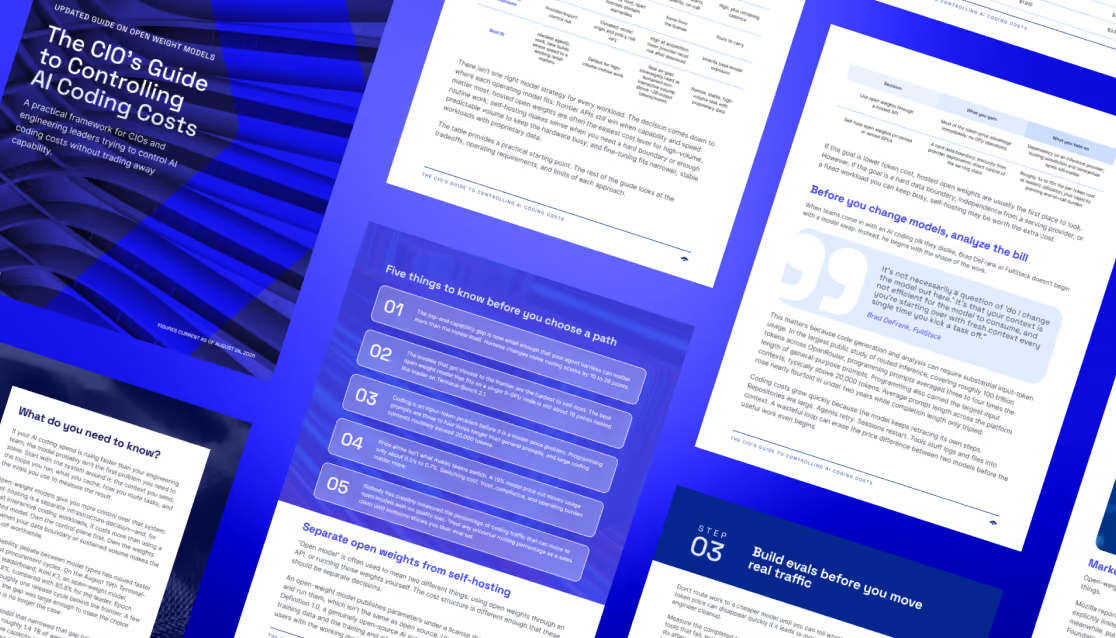
How can you cut your AI coding costs without switching models?
This guide gives you the math, the meaningful benchmarks, and a six-step plan to cut spend without giving up capability.
Enjoyed the article? Get new content delivered to your inbox.
Subscribe below and stay updated with the latest developer guides and industry insights.
Thank you! Your submission has been received!
Oops! Something went wrong while submitting the form.
Iframe is blocked. Accept cookies to load it.
Thank you! Your submission has been received!
Oops! Something went wrong while submitting the form.
We use cookies to provide our services, to allow us to better understand our audience, and to provide and serve personalized ads or content. By using our website, you consent to the terms of our Privacy Policy and our Cookie Policy, and the use of cookies, pixels, and other technology as described more fully therein