Five things you need to know about forward-deployed engineers
Written by
FullStack Team
Last updated on:
October 28, 2026
Written by
Last updated on:
October 28, 2026
Forward-deployed engineers have become one of the most discussed roles in enterprise AI. Here's what AI and engineering leaders should understand before bringing one onto a project.
Demand for forward-deployed engineers has grown quickly. Bloomberry's analysis of 1,000 job postings found that listings for FDE jobs grew 1,165% in a year, and AI companies such as OpenAI now run their own FDE teams.
With that attention comes confusion about what the role is for and when it's worth the cost. Below, we cover five things AI and engineering leaders should know about forward-deployed engineers.
1. FDEs exist to get AI out of the demo stage
Forward-deployed engineers exist to solve a specific problem: AI work that stalls between the demo and production. Pilots rarely fail because of the model. They fail when the model has to meet real systems and real people.
MIT's NANDA initiative studied this in 2025, drawing on 150 interviews with leaders, a survey of 350 employees, and an analysis of 300 public AI deployments. The researchers found that about 5% of AI pilots achieved rapid revenue acceleration. Most of the rest stalled with little measurable effect on profit and loss, and the researchers pointed to weak integration with real workflows, not model quality.
In practice, the gap looks familiar. The production data sits in several systems, often including legacy systems, and some of them need an IT ticket before anyone can read them. Security wants audit logs before it approves a launch. The people meant to use the tool were never in the room, so it solves a problem they would describe differently.
That's the gap FDEs are hired to close. A typical software engineer spends the day building features for a product roadmap. An FDE works on business problems inside one customer's systems, with real data, until a working system is in use.
2. FDEs are measured on whether people use what they build
A forward-deployed engineer is a senior software engineer who works inside a customer's team until a specific outcome is live and in use. For AI work, that outcome is usually an agent or an automated workflow running on the customer's real data.
The role started at Palantir, which hires for it under the title forward deployed software engineer. Palantir sums up the difference between its product engineers and its FDEs simply: product engineers work on "one capability, many customers," while FDEs work on "one customer, many capabilities." The core product team builds the company's platform, and the FDE makes it work for a specific customer. You'll also see related titles, such as applied AI engineer, agent engineer, and technical delivery engineer, though the responsibilities behind them vary.
That ownership is what separates FDEs from roles that look similar. Solutions engineers and sales engineers spend much of their time building prototypes and running demos, and their work usually ends when the customer agrees to buy. A solutions architect advises on the design, often from a distance. A staff augmentation developer works on your backlog, under your direction. In the FDE model, one engineer owns one AI outcome from start to finish, and success is measured by adoption and business results.
That takes an unusual mix of skills. Good FDEs pair hands-on implementation with customer-facing judgment and enough domain expertise to deeply understand how the work gets done. Whether FDEs work at the customer's site or alongside users remotely, they handle the day-to-day work alongside the people who will use what they build.
A typical engagement for one use case follows a loop:
Discovery: Sit with the people who do the work, a hands-on form of product discovery, and agree on one success measure with the business owner.
Evaluation: Collect real examples of good and bad outcomes, so the system has a test to pass.
A thin first version: Ship a narrow version on real data, inside your cloud, for a handful of real users.
Hardening and adoption: Add guardrails, logging, and cost tracking, then fix whatever gets in users' way.
Handover: Document the system and train your engineers to run it.
FDEs also create a feedback loop. Because they see how customer teams use a product in practice, they can bring lessons back to product managers and product teams. OpenAI's FDE job posting, for example, asks FDEs to share field feedback with its research and product teams.
FDEs are expensive, and many AI projects don't need one. Two questions sort most AI work:
Do you know the business result you want, and can you measure it? "Cut claims intake time in half" is clear. "Use AI in operations" is not.
Do you know what to build to get that result? If you can write the spec today, including the data sources and the model approach, you do.
If you know both, you need capacity, not discovery, and staff augmentation or your own team will cost less. If the result is still vague, start with a short discovery engagement before you staff anything. An FDE fits best when the result is clear but the AI solution isn't, and that solution has to run inside systems you control.
You can also skip the FDE when an off-the-shelf tool already covers the need, when nobody on the business side can say what "better" looks like, or when the data you'd need doesn't exist yet.
4. An FDE's time zone matters more than most engineers'
A backend developer working from a well-written backlog can hand off at 5 p.m. and pick up answers the next morning. FDE work doesn't fit that pattern. Much of its value happens live: watching a claims adjuster do the job, reviewing outputs with a user while they test the system, getting an IT admin to grant access before their next meeting, and fixing a broken workflow while the people who depend on it are still at their desks.
Research backs this up. In a study of more than 12,000 employees at a large multinational, researchers from Harvard Business School, Georgetown, and Rice found that synchronous communication, such as calls and video meetings, fell 11% when the time difference between workers grew by one hour. That one hour cut about 19% of the opportunities to talk live during a typical workday.
For US companies, that makes overlap a practical requirement. Latin America shares five to eight working hours with US teams, which lets an FDE answer questions the same day they come up.
"An FDE who answers the question while the user still remembers asking it is a different product from one who answers tomorrow morning," says Ben Carle, CEO of FullStack.
5. A stalled pilot usually costs more than the engineer
FDEs aren't cheap. They combine senior production engineering with the judgment to run discovery with business leaders, and demand has grown faster than supply. Bloomberry put the median base salary in FDE job postings at about $174,000, before equity.
But the more useful comparison is between a system in production and a pilot that never gets there. Take an illustrative example: a 20-person team that reviews insurance submissions, with a fully loaded cost of $90,000 per person. If they spend 40% of their time on a review step AI could mostly handle, that step costs about $720,000 a year. Cutting half of that work frees about $360,000 of capacity a year, so every month the system isn't live costs about $30,000 in value you don't capture.
Experience also changes the odds. A partner's FDEs arrive with real-world experience from similar systems, and the same MIT study found that AI projects bought from specialist vendors or run with partners succeeded about 67% of the time, while internal builds succeeded about a third as often.
"We tell clients to judge an FDE engagement on one number: the business result it moves, and how long it took to start moving," says Carle. "The hourly rate is the least interesting line on the invoice."
How FullStack can help
FullStack places senior nearshore FDEs who work in US time zones and own a working AI system in your environment. They embed with your team, co-develop solutions with the people who own the problem, build custom solutions inside your systems, and plan the handover from day one, so your engineers can run the system after launch. We've helped more than 600 US companies accelerate technology innovation since 2016.
Forward-deployed engineers are senior software engineers who work inside a customer's team until a specific AI outcome is live and in use. They run discovery with the people who do the work, build and test the system on real data, take it into production, and hand it over to the customer's engineers.
How is an FDE different from staff augmentation?
A staff augmentation developer works on your backlog, under your direction, which fits when you already know what to build. An FDE owns the path to a result when you know the problem but not the AI solution, and they're measured on adoption and business results.
When do you need a forward-deployed engineer?
You likely need an FDE when you know the business result you want but not the AI solution, and the solution has to run inside systems you control. If you already have a clear spec, staff augmentation or your own team will usually cost less.
Why does an FDE's time zone matter?
FDE work depends on live collaboration with business users, IT, and stakeholders. Harvard Business School research found that one extra hour of time difference cut synchronous communication by about 11%, so an FDE working in or near your hours can resolve questions the same day.
How much does a forward-deployed engineer cost?
Bloomberry found a median base salary of about $174,000 in FDE job postings, before equity. Partner-sourced FDEs are priced differently, and nearshore FDEs can lower the base cost. Weigh the cost against the value lost each month an AI system isn't in production.
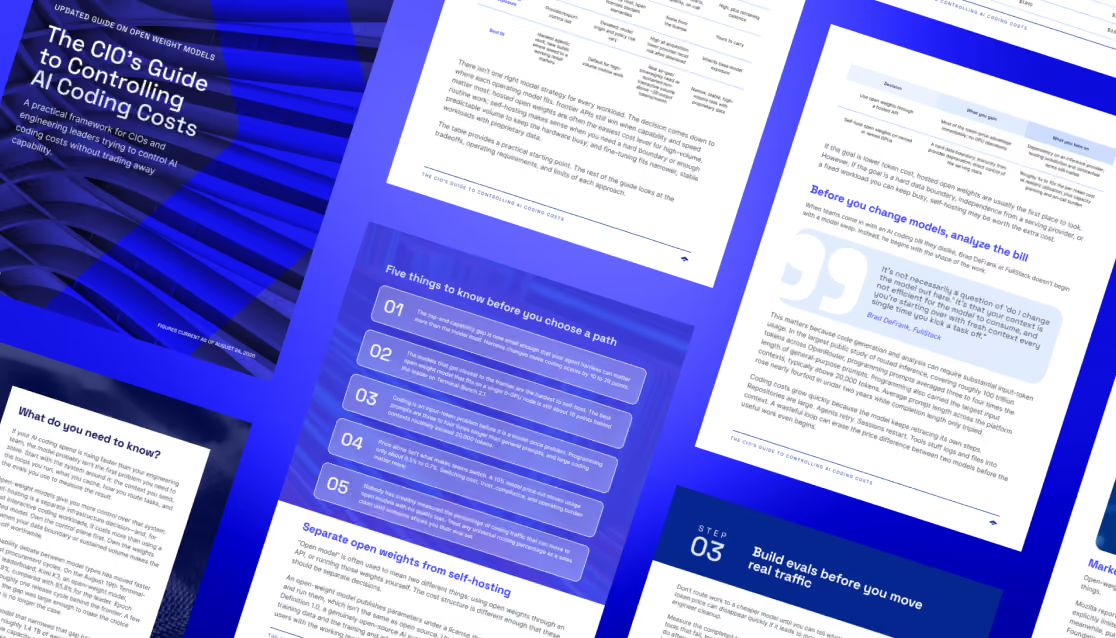
How can you cut your AI coding costs without switching models?
This guide gives you the math, the meaningful benchmarks, and a six-step plan to cut spend without giving up capability.
Enjoyed the article? Get new content delivered to your inbox.
Subscribe below and stay updated with the latest developer guides and industry insights.
Thank you! Your submission has been received!
Oops! Something went wrong while submitting the form.
Iframe is blocked. Accept cookies to load it.
Thank you! Your submission has been received!
Oops! Something went wrong while submitting the form.
We use cookies to provide our services, to allow us to better understand our audience, and to provide and serve personalized ads or content. By using our website, you consent to the terms of our Privacy Policy and our Cookie Policy, and the use of cookies, pixels, and other technology as described more fully therein