The biggest source of AI coding costs is often not generation, but navigation. Seven small workflow changes can give coding agents clearer context, reduce unnecessary file reading, and help teams make every token count.
A fact that surprises many people is that before your coding agent writes a single line, it’s often already spent a pile of tokens trying to find its way around your project. It opens a file, reads it, backs out, then opens another, wandering the hallways before finding the right room.
That wandering is where a lot of your token budget gets used up. Fortunately, while inconvenient, you do have a lot of control over it. Most of your token savings come from seven core habits, and none of them require you to add a new tool or change your setup.
1. Point the agent straight to the file
If you know which file has the problem, tell your agent early on. "The login logic is in auth/login.js" beats "fix the login bug" by a mile. If you’re vague about your instructions, the agent has to track down the file first, and might open five wrong ones on the way. Handing it the address is kinder to your token count, and kinder to the agent too.
2. Keep a short project map
Add a small file (many people call it CLAUDE.md, or just use a good README) that explains where the important files are and how to run the tests. The agent reads it once and stops rediscovering the same facts every session. Think of it as the note you leave for a house sitter so they aren’t texting you about where the spare towels are.
3. Start a fresh chat when the task changes
Long conversations include everything from earlier, and you pay for that history on every new turn. When you move to a different task, open a clean thread. Keeping one giant conversation going is a bit like hauling every grocery bag from the whole month around the store with you.
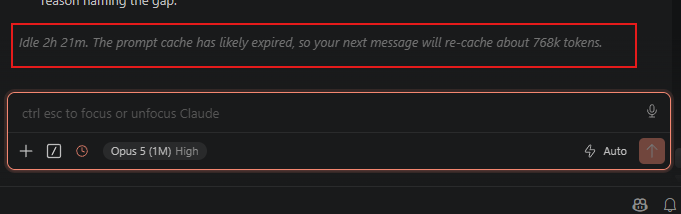
Here’s what that looks like in real money. Leave a coding agent open and idle for a couple of hours and its prompt cache often expires. That cache is the stored copy of your context that keeps repeat requests cheap, so once it’s gone, your next message has to rebuild it from scratch. In the screenshot below, that’s about 768,000 tokens of idle context, and re-caching that much on a premium model such as Opus 5 runs somewhere around five to eight dollars. That’s real money spent to reload what the agent already had twenty minutes ago.
Claude Code flags an expired prompt cache after sitting idle for two hours, and warns that the next message will re-cache about 768k tokens.
The fix is the same habit as above. Keep your working context small, and try not to leave a giant session parked when you step away. A smaller context is cheaper to carry and cheaper to rebuild.
4. Tell the agent what you actually want
When your request is fuzzy, the agent fills the gap by exploring, and every guess costs it a few file reads. Compare "the signup thing is broken" with "add email validation to the signup form and show a clear error when it fails." The second one tells the agent exactly what to build, so it doesn’t have to work that out first. A little more detail from you saves a lot of digging from it. Nobody has ever regretted being clear with a robot.
5. Match the model to the job
You don’t need the biggest model for everything. Plenty of everyday work (small edits, quick renames) runs just fine on a lighter, faster model. Reaching for the most powerful one every time, out of habit, is like hiring a full orchestra to play Happy Birthday. A good rule is to try the lighter model first (for example, Sonnet before Opus) and only move up when the task really asks for it.
6. Break giant files into smaller ones
If a single file runs three thousand lines, the agent usually has to load the whole thing to change one small part. Smaller, focused files mean it only pulls in what it needs. Your future self reading that code will quietly thank you as well.
7. Don’t paste huge logs or full dependency trees
When something breaks, paste the handful of lines that matter, not the entire stack trace with every warning stacked above it. The agent doesn’t need the whole novel to understand the plot. Trim first, then share.
Wrapping up
You don’t need new tools or a fancy setup to minimize your token costs: just tell the agent where to go, then clear away the clutter it’d otherwise have to read through. By doing that, you can get the same work done for a fraction of the tokens.
How can developers reduce token usage when coding with AI agents?
Developers can reduce AI coding token usage by giving agents precise instructions, naming the relevant files, keeping a concise project map, starting new chats for unrelated tasks, and sharing only the code or logs needed to solve the problem. These practices reduce the amount of repository exploration and conversation history an AI coding agent must process.
Why do AI coding agents use so many tokens before writing code?
AI coding agents often use tokens to understand the codebase before making a change. When a prompt is vague, the agent may search directories, open multiple files, review documentation, and inspect dependencies to locate the relevant code. Pointing the agent to the right file and describing the intended change clearly can substantially reduce this context-gathering work.
What should a project map for an AI coding assistant include?
A project map—often maintained in a README or a file such as CLAUDE.md—should briefly identify the project structure, important directories, main application entry points, test commands, build commands, coding conventions, and any files that agents should avoid modifying. The goal is to give an AI coding assistant reliable context without requiring it to rediscover basic project information in every session.
Does starting a new chat reduce AI coding costs?
Yes. Many AI coding tools carry earlier messages into each new request, meaning a long conversation can increase the amount of context processed and billed over time. Starting a fresh conversation when switching to a separate task helps limit irrelevant chat history, keeps the agent focused and can lower token consumption.
How does code organization affect AI agent token costs?
Large, monolithic files can increase token costs because an AI agent may need to read extensive code to make a small change. Splitting oversized files into smaller, purpose-specific modules allows the agent to load only the relevant context. Clear file organization also improves maintainability, testing and human developer productivity.
How can you cut your AI coding costs without switching models?
This guide gives you the math, the meaningful benchmarks, and a six-step plan to cut spend without giving up capability.
Enjoyed the article? Get new content delivered to your inbox.
Subscribe below and stay updated with the latest developer guides and industry insights.
Thank you! Your submission has been received!
Oops! Something went wrong while submitting the form.
Iframe is blocked. Accept cookies to load it.
Thank you! Your submission has been received!
Oops! Something went wrong while submitting the form.
We use cookies to provide our services, to allow us to better understand our audience, and to provide and serve personalized ads or content. By using our website, you consent to the terms of our Privacy Policy and our Cookie Policy, and the use of cookies, pixels, and other technology as described more fully therein
.svg)