Benchmark leaderboards can narrow the field, but they cannot show how a model will perform inside a company. For CXOs, the real question is whether it can deliver reliable, timely, and cost-effective results on the work that matters.
If you lead technology at an enterprise, you’ve probably been handed a slide full of benchmark scores before. They show up front and center in every model announcement, look clean and final, and feature one model on top and a neat number next to each name. These slides are useful because they give you a rough sense of the field and help narrow a long list of options.
The problem starts when a benchmark score becomes the deciding factor in major decisions, such as which model to adopt or where to place a budget that could run for years. Benchmarks are only one input among several, and there are six key reasons to treat them that way.
1. The test may already be in the training data
Many benchmarks are public, and large portions of the web are included in model training data. The exact questions from a popular benchmark are often part of what a model was trained on. When that happens, a high score can come from memorized answers rather than skill. Audits of well-known benchmarks have found leaked questions ranging from roughly a third of the test to nearly half of it, and it gets worse as models train on more of the web.
A perfect score means less when the student saw the exam the night before. As a result, a model can look brilliant on the board and still do poorly on the same kind of problem once the wording is fresh and the data is yours.
2. What gets measured gets gamed
There is a well-known principle in performance management: once a measure becomes a target, it can become less useful as a measure. AI benchmarks are a clear case. When everyone ranks models by the same leaderboard, model makers will start building specifically with the leaderboard in mind.
Take Meta's Llama 4, which scored well on a popular public leaderboard called LMArena. However, the version that scored well wasn’t the version people could download—it was a separate build, tuned to do well on that one leaderboard. Researchers later found that many private versions had been tested first, and only the best-looking one was shown in public.
Human-preference leaderboards can introduce a related problem. On leaderboards that rank models by human votes, longer answers and neat bullet points tend to win, whether or not they are more correct.
3. The tasks don’t look like your work
Most benchmarks test one clean question at a time, with tidy inputs and a single correct answer. Real work in your company is messier than that. It often involves multiple back-and-forth turns, incomplete or messy inputs, and systems that do not have one clear answer. It also has to fit into the systems and data you already have.
This can create a large gap. UI-CUBE, a benchmark of computer-use agents on enterprise tasks, found that five current models handled simple screen tasks most of the time, but got through complex, real enterprise workflows less than a fifth of the time. A model that tops a public board can still do poorly on your actual queries.
There’s a further catch, too. Many older benchmarks are now too easy, so the top models bunch up within a point or two of each other, all near the ceiling. A gap that small is mostly just noise. Between a ranking that’s bunched at the top and tasks that look nothing like yours, the leaderboard order is a weak basis for a decision. The most reliable way to compare models is to test them on tasks that resemble the work they will perform.
4. Cost and speed aren’t in the scoreboard
Almost no headline benchmark tells you what a task will cost or how long it will take. Both feed into how you scope and budget a project, and they can matter as much as accuracy. Researchers have found setups that reach about the same accuracy on agentic tasks while costing up to fifty times as much. A model can be accurate and still be too slow for the job, and a slow response makes the experience worse for the people using it.
A model that is accurate but too slow or expensive for the workflow will not be a practical production choice. Rather than focusing on token price or a headline score, measure the cost of completing a finished task and the response time at expected production load.
5. Reliability and risk aren’t in the benchmark
A benchmark may report one score from one run under controlled conditions, but production use is less predictable.The things you care about are often what a single run can’t show: does the model give the same quality answer every time, or only when it gets lucky? Does it stay steady when traffic spikes? Does it hallucinate? On regulated or high-stakes work, one rare mistake can cost far more than a few points of benchmark accuracy would ever earn back.
A model that looks flawless on a test can still fail under real load, and your customers are the ones who feel it.
Benchmark quality can also be limited by errors in the underlying labels or answer keys. Since benchmarks are built by people, the grading isn’t always correct. An audit of widely used text-to-SQL benchmarks found annotation error rates above 50%. Additionally, one popular coding benchmark turned out to have broken tests in most of its hardest problems, and its makers stopped reporting the score.
Grading against a faulty answer key is like marking a spelling test with a dictionary full of typos. Even a clean, uncontaminated model can end up looking better or worse than it really is, for reasons that have nothing to do with the model.
So what should you do?
None of this means benchmarks are useless. They still make a good first filter, and help you cut twenty options down to a shortlist you can look at closely. However, you shouldn’t let them cast the final vote on your decision-making.
The step that most teams skip is taking their real tasks, the actual jobs they would hand a model, and building a small test set out of them. From there, run your shortlist against it and measure what the public boards leave out. What does a finished task actually cost? How fast is it under real load? How steady are the answers when you run them again? Then, have someone on your team review the outputs, because your best judge of quality is someone who knows the work.
Benchmarks tell you who did well on a test that someone else wrote. Your own evaluation tells you who’ll do well on yours. When real money and a real roadmap are on the line, you need to be sure about the second answer.
AI model benchmarks can be flawed because benchmark questions may appear in a model’s training data, allowing models to recognize or memorize answers rather than demonstrate general reasoning ability. Public benchmarks can also be optimized for by model providers, contain outdated or overly simple tasks, or include errors in their answer keys. A high benchmark score is useful for initial comparison, but it does not guarantee strong real-world enterprise performance.
Should CXOs use AI benchmark scores to choose a model?
CXOs should use AI benchmark scores as an early screening tool, not as the final basis for an enterprise AI model selection decision. After building a shortlist, leaders should test models against representative internal tasks and assess output quality, reliability, latency, security, governance requirements and the total cost of completing a task.
How should enterprises evaluate AI models for real-world use cases?
Enterprises should create a small internal evaluation set using realistic workflows, company-specific data patterns and the actual prompts employees or customers will use. Teams can then run shortlisted AI models through the same tests and compare accuracy, consistency, response time, cost per completed task, error rates and human-reviewed output quality.
What AI model evaluation criteria matter beyond benchmark accuracy?
Beyond benchmark accuracy, enterprise AI evaluation should consider:
Cost per completed task rather than token price alone.
Latency and performance under realistic user demand.
Reliability and consistency across repeated runs.
Hallucination rates, error handling and failure modes.
Security, privacy, compliance and AI governance requirements.
Integration fit with existing enterprise systems, data and workflows.
The quality of outputs as judged by subject-matter experts.
Why do cost and latency matter when evaluating enterprise AI models?
A model can perform well in a benchmark yet be too costly or slow for production use. Enterprise teams should evaluate the total cost to complete a real workflow, including input and output tokens, retries, tool calls, human review and infrastructure needs. They should also measure latency at expected production volume, since slow responses can limit adoption and degrade the customer or employee experience.
How can you cut your AI coding costs without switching models?
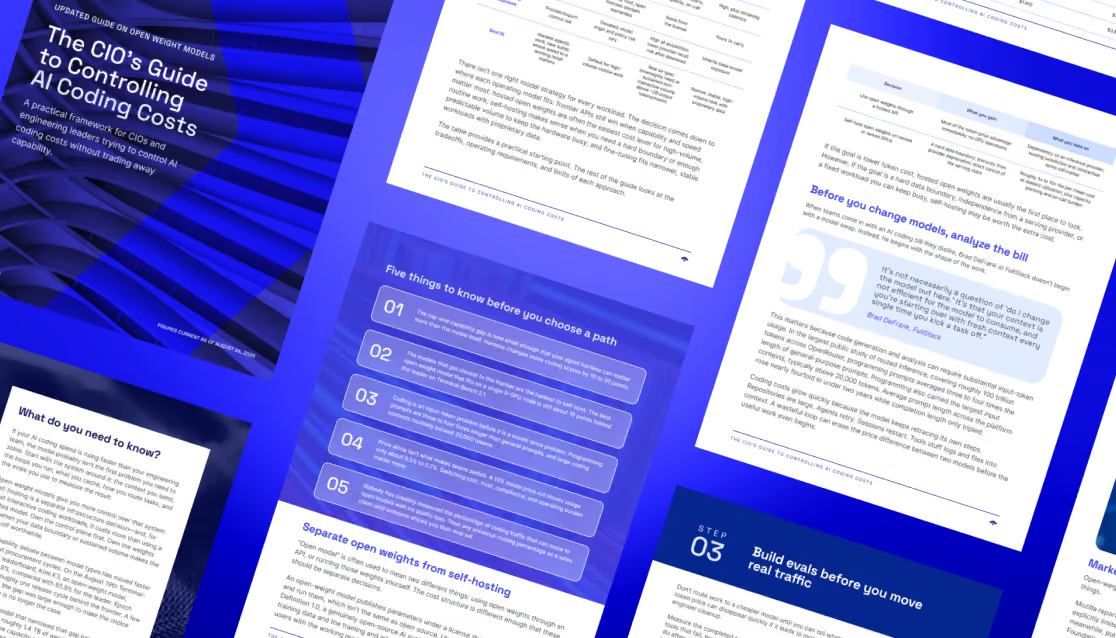
This guide gives you the math, the meaningful benchmarks, and a six-step plan to cut spend without giving up capability.
Enjoyed the article? Get new content delivered to your inbox.
Subscribe below and stay updated with the latest developer guides and industry insights.
Thank you! Your submission has been received!
Oops! Something went wrong while submitting the form.
Iframe is blocked. Accept cookies to load it.
Thank you! Your submission has been received!
Oops! Something went wrong while submitting the form.
We use cookies to provide our services, to allow us to better understand our audience, and to provide and serve personalized ads or content. By using our website, you consent to the terms of our Privacy Policy and our Cookie Policy, and the use of cookies, pixels, and other technology as described more fully therein
.svg)
.jpg)