Muse Glimmer is Meta’s latest Muse‑family model: an Apache‑licensed, 30‑billion‑parameter system tuned for always‑on local agents, long context, and tool‑driven workflows on a single GPU.
Meta released Muse Glimmer on August 10, 2026—a 30‑billion‑parameter, Apache‑licensed model built to power always‑on local agents on a single Mac or PC GPU. Unlike most proprietary models, Muse Glimmer is open‑weight, allowing teams to download, run, and fine-tune the model on their own hardware instead of relying solely on a managed API.
Glimmer is the latest member of Meta’s Muse family, and a distilled version of Meta’s larger Muse Spark model. It’s built for coding, document analysis, and other tasks that require a model to call tools and work through several steps. It can handle text and images, making it suitable for agents that need to work across code, files, screenshots, and local services.
A history of Meta’s models
Meta had already spent several years releasing downloadable AI models before releasing Muse Glimmer. Its original Llama models came out in 2023, followed by Llama 2, Llama 3, and Llama 3.1. Each generation gave developers more capable model weights to run, modify, and build into their own software.
Over time, the company expanded its models’ capabilities. Code Llama, released in August 2023, adapted Llama 2 for writing and working with code. The following year, Llama 3.2 added Meta’s first multimodal Llama models, allowing models in the family to work with both images and text. It also included smaller models intended for edge and mobile devices.
In April 2026, Meta introduced a different model family: Muse. Its first release, Muse Spark, came from the newly formed Meta Superintelligence Labs and was presented as a closed, multimodal reasoning model. Spark supported tool use, visual reasoning, and multi-agent orchestration, and was initially used to power Meta AI while access to its API remained limited.
Meta released an updated Muse Spark 1.2 on August 5. Five days later, it added Muse Glimmer to the family, extending the Muse line beyond Meta’s own cloud products and into a model developers could download and run locally.
Glimmer at a glance
Glimmer is a 30‑billion‑parameter multimodal model built for local agentic workflows on a single GPU, with built‑in vision support and a long context window. It keeps 131,072+ tokens in view and processes images alongside text, so it can work across long documents, codebases, screenshots, and other visual inputs in the same conversation.
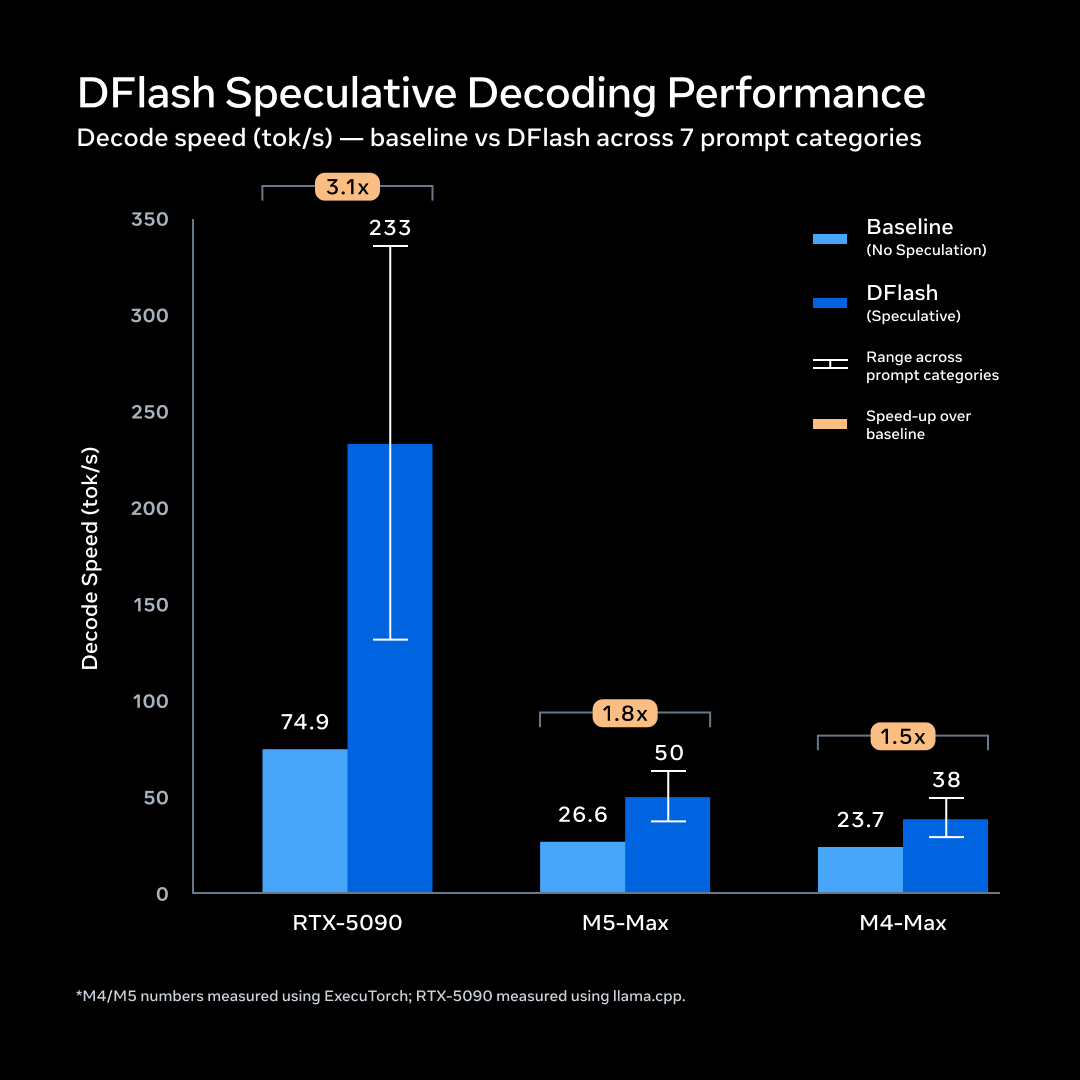
Meta provides approximately 4‑bit quantized versions sized for 24GB and 32GB GPUs, while the full‑precision model requires more than 55GB of memory to run. Glimmer also ships with a smaller DFlash “drafter” used for speculative decoding, which proposes blocks of tokens that Glimmer then verifies—helping keep generation speeds competitive for a dense 30B local model.
Together, the dense architecture, multimodal perception, long context, and quantized deployment make Glimmer practical as an always‑on local agent rather than a cloud‑only frontier model.
What are open-weight models?
Open‑weight models are AI models whose trained parameters are available for people to download. Those parameters—often called weights—are the values a model learned during training that shape how it responds to a prompt.
However, that doesn’t mean that every part of the model is necessarily public. A company might release the weights while keeping the training data, source code, and the full process used to build the model private. Open-source models, by contrast, generally means the underlying code is available too, and may include more of the materials needed to study, modify, and reproduce the system.
With Muse Glimmer, Meta has released the model weights alongside smaller quantized versions that are easier to run locally. Its Apache 2.0 license allows commercial use and modification, so organizations can host the model themselves, fine‑tune it for specific workflows, or build it into their own applications.
What are Glimmer’s capabilities?
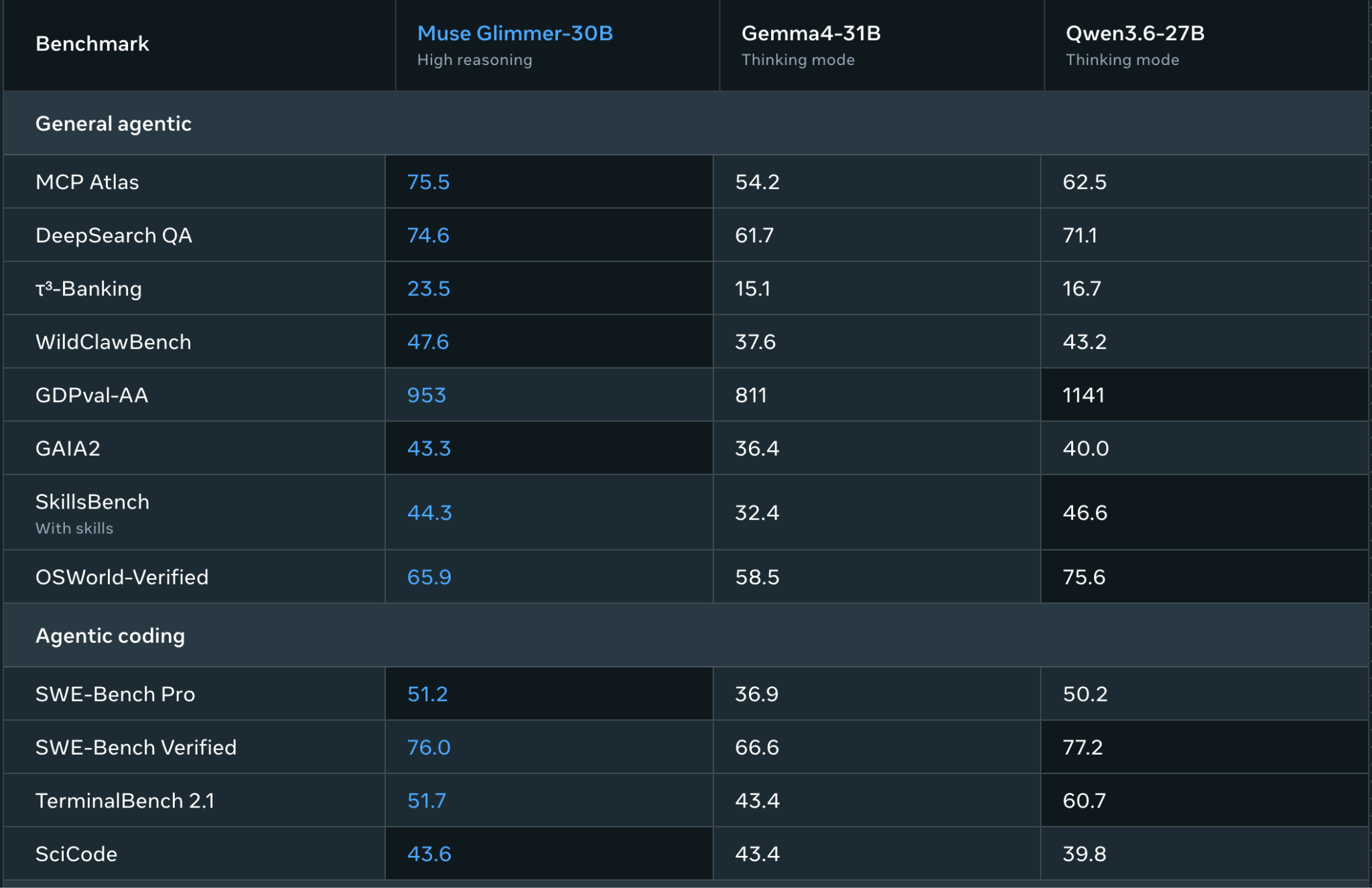
Meta's benchmark tables compare Glimmer to Qwen3.6-27B and Gemma4-31B, two open models in a similar size class, across agentic, coding, multimodal, safety, and general reasoning tests.
Agentic task completion. Glimmer is built to carry tasks through multiple steps without stopping for input at each one. On MCP Atlas, a benchmark for full task completion, it posts stronger scores over both comparison models, with a similar edge on DeepSearch QA and WildClawBench. Qwen3.6 pulls ahead on the more generalist OSWorld-Verified test, suggesting Glimmer's strength lies in structured, tool-driven agent work rather than broad computer-use control.
Coding. On SWE-Bench Pro, which grades a model against real GitHub issues rather than isolated snippets, Glimmer performs close to Qwen3.6 and well ahead of Gemma4. Qwen3.6 still leads on TerminalBench 2.1, so agents built around heavy command-line use may see stronger results there.
Multimodal reasoning. Glimmer's vision scores land within a point or two of both peers on tests like Charxiv Reasoning and MMMU Pro. That parity suggests multimodal input functions as a supporting capability for agent workflows—reading a screenshot or chart mid-task—rather than something Meta optimized to lead the category.
Long context and memory. This is where Glimmer separates itself most. On AA‑LCR, Glimmer scores 80.0 versus 68.3 for Gemma4 and 73.3 for Qwen3.6, with a smaller edge on Beam 128K (65.1 vs. 58.2 and 63.0). Paired with its 131,000-token context window, that points to more reliable retention over long, multi-step tasks, such as working through a large codebase or an extended research task.
Safety under pressure. On Siren AgentDojo, which simulates prompt-injection attacks, Glimmer sits between Gemma4 and Qwen3.6 on how often attacks succeed, but posts the highest utility score of the three—meaning it keeps doing useful work rather than becoming overly cautious. It also shows more information leakage than Gemma4 on CI Memories, though with better context coverage. Together, these results suggest Meta prioritized keeping Glimmer productive over making it maximally conservative, which puts more responsibility on teams to build their own guardrails around how it's deployed.
How Glimmer fits into workflows
Muse Glimmer is tuned for workflows where an agent has to plan several steps, call tools, and maintain a large amount of context while running on a single machine. Meta describes it as an “open agentic” model intended to sit inside existing agent frameworks rather than as a general‑purpose chat assistant.
In practice, that makes it a good fit for workflows like:
Local coding agents. Glimmer can act as a repo‑aware assistant that reads your codebase, calls tools like test runners or linters, and iterates on fixes inside scaffolds such as OpenClaw and Hermes Agent. This fits terminal coding agents, CI helpers, and long‑running dev tools that need to stay close to source and build systems.
Privacy‑aware personal and team assistants. Meta explicitly calls out agents that manage schedules, draft messages, organize files, and learn how someone works, using long‑horizon execution and precise tool calling on local context. Because Glimmer runs on a single GPU, those assistants can live on a laptop or workstation instead of a shared cloud surface.
Document and screenshot analysis in internal tools. Through its perception encoder, Glimmer accepts interleaved text and images, so agents can interpret screenshots, charts, and documents alongside conversation. This suits workflows where an internal tool needs to move across PDFs, dashboards, and UI states without switching models.
LLM‑as‑a‑judge and evaluation pipelines. Glimmer is trained and evaluated on “end‑to‑end agentic task completion,” including benchmarks where it writes, debugs, and assesses code inside scaffolds. Teams can use it to score other models’ outputs—grading code changes, checking tool runs, or enforcing policy checks—inside larger multi‑model systems.
In practice, Glimmer slots best into places where long context, reliable tool use, and local deployment materially improve the workflow: coding agents that live next to your repos, document‑heavy assistants on internal machines, and evaluator roles inside orchestration frameworks, rather than customer‑facing chat or the most demanding frontier reasoning tasks.
What Glimmer means for open‑weight, local AI
Glimmer is arriving at a moment when open‑weight models are becoming a strategic question for enterprises. Meta, Microsoft, and NVIDIA, among various others, have all publicly argued that access to model weights matters for AI competitiveness and for avoiding a world where only a handful of closed providers control advanced systems.
Meta and several other large corporations also signed an open letter in support of open-weight AI in late July, underscoring that weight‑level access is now seen as a first‑class concern for how organizations design, benchmark, and operate their AI stacks.
In that context, Muse Glimmer is less an isolated model release and more a concrete example of what these companies are trying to achieve: a capable agentic system whose weights are open, sized for a single GPU, and ready to be integrated into local agents, internal tools, and multi‑model architectures alongside existing cloud‑hosted frontier models.
If your team is starting to test Muse Glimmer—or trying to decide how it should sit alongside Gemini Flash, Grok, Claude, or other models already in your stack—it helps to have a clear plan. FullStack can work with you to identify the workflows where a local, open‑weight model makes sense, design pilots that measure it against what you're already running, and build the guardrails and processes needed to make Glimmer a dependable part of your production environment rather than a one‑off experiment.
Contact us today to book a free consultation to discuss your AI timeline.
Learn more
Frequently Asked Questions
What is Muse Glimmer and why did Meta build it?
Muse Glimmer is Meta’s 30‑billion‑parameter, open‑weight AI model designed for always‑on local agents that run on a single Mac or PC GPU. Distilled from the larger Muse Spark family, it’s tuned for multi‑step reasoning, tool use, and autonomous workflows rather than generic chat.
What hardware do you need to run Muse Glimmer locally?
At full precision, Muse Glimmer would need well over 55GB of memory, but Meta’s 4‑bit quantized variants fit within 24GB and 32GB VRAM envelopes. In practice, that means high‑end consumer GPUs (like RTX 4090/5090) or M‑series Macs with sufficient unified memory are suitable for running the model as a local AI agent.
What are the main use cases for Muse Glimmer as a local AI agent?
Meta targets Muse Glimmer at repo‑aware coding assistants, local personal and team agents, document and screenshot analysis tools, and LLM‑as‑a‑judge evaluation pipelines. These workflows benefit from long‑context reasoning, reliable function calling, and keeping data and credentials on a single machine instead of a remote API.
How does Muse Glimmer compare to other open‑weight models like Qwen3.6 and Gemma?
On Meta’s own benchmarks, Muse Glimmer posts stronger results on agentic task completion and coding tasks while roughly matching peers on multimodal reasoning. Qwen3.6 and Gemma still lead on some broad computer‑use and general‑reasoning tests, suggesting Glimmer is most competitive when used as a tool‑driven local agent rather than a frontier chat model.
Is Muse Glimmer really “open‑weight,” and what does that mean for enterprises?
Muse Glimmer’s Apache 2.0 license and downloadable weights make it a true open‑weight model that organizations can host, fine‑tune, and integrate into their own stacks. Enterprises can pair it with closed cloud models, using Glimmer for local, privacy‑sensitive agent workflows while relying on frontier systems for tasks that need maximum general‑purpose performance.
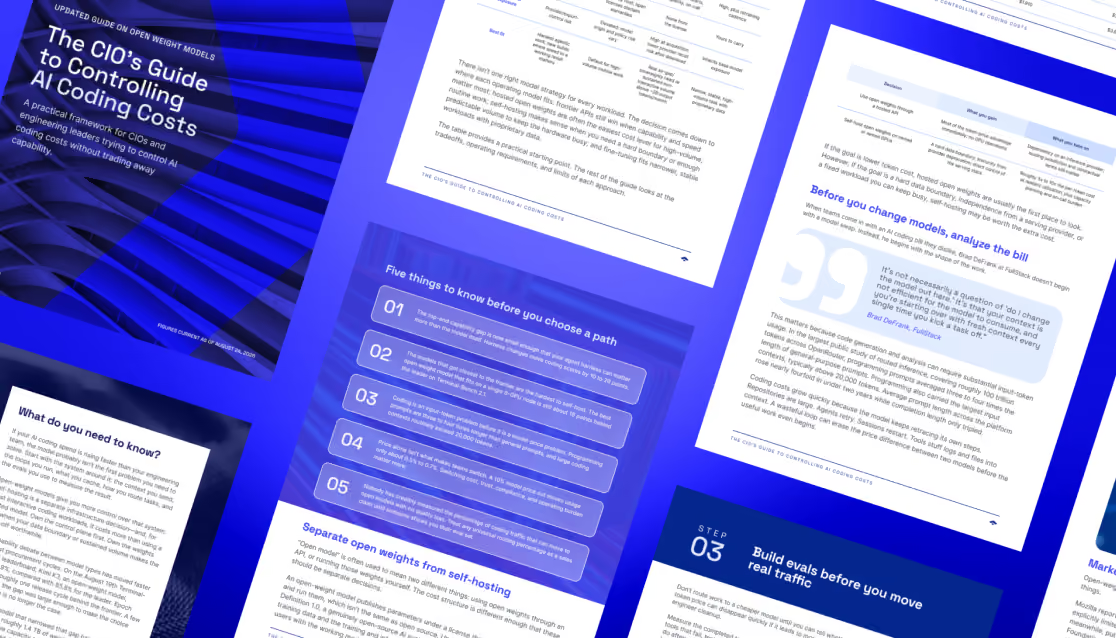
How to cut your AI coding costs without switching models?
This guide gives you the math, the meaningful benchmarks, and a six-step plan to cut spend without giving up capability.
Enjoyed the article? Get new content delivered to your inbox.
Subscribe below and stay updated with the latest developer guides and industry insights.
Thank you! Your submission has been received!
Oops! Something went wrong while submitting the form.
Iframe is blocked. Accept cookies to load it.
Thank you! Your submission has been received!
Oops! Something went wrong while submitting the form.
We use cookies to provide our services, to allow us to better understand our audience, and to provide and serve personalized ads or content. By using our website, you consent to the terms of our Privacy Policy and our Cookie Policy, and the use of cookies, pixels, and other technology as described more fully therein


.svg)