NVIDIA’s Nemotron 3.5 Lightning is an open-weight model built for high-volume, text-based tasks within long-running AI agent workflows.
NVIDIA’s Nemotron 3.5 Lightning is the newest efficiency-focused member of the Nemotron 3 family, built to be the workhorse model behind modern agentic AI workloads rather than a standalone frontier chatbot. Launched on August 11th, 2026, it combines a 30‑billion‑parameter mixture‑of‑experts (MoE) architecture with only ~3 billion parameters active per token, an approach intended to reduce inference compute for high-volume agent workloads.
Lightning is released under NVIDIA’s OpenMDW-1.1 license with downloadable weights, training data, and recipes. Organizations can run it on their own infrastructure or access it through hosted providers.
NVIDIA released Lightning alongside NeMo Switchyard, an open-source routing library for agent systems that use more than one model. Switchyard can direct individual steps in a workflow to different models based on factors such as cost, speed, and task requirements. In that kind of setup, Lightning can handle high‑volume execution work, while a larger model is reserved for steps that need more complex reasoning.
What is Nemotron 3.5 Lightning, and why did NVIDIA build it?
Nemotron 3.5 Lightning is a text-only mixture-of-experts model built for the execution layer of autonomous agents: high-volume steps such as tool calls, code edits, document actions, and monitoring loops.
NVIDIA describes it as “the highest‑efficiency model in its class for long‑running agentic AI workloads,” explicitly positioning Lightning as the small, specialized engine that keeps complex multi‑agent systems responsive across PCs, workstations, data centers, and the cloud. Thanks to its MoE design, it activates only a subset of its experts for each token, which is what allows it to match or approach the performance of much larger dense models like gpt‑oss‑120B at roughly a quarter of the total parameter count.
The history of the Nemotron family
NVIDIA's Nemotron line traces back to November 2023, when the company released Nemotron-3 8B as an early enterprise-ready model built on its NeMo framework, itself rooted in the earlier Megatron-LM training infrastructure. The family expanded quickly through 2024: Nemotron-4 15B arrived in February as a multilingual model, followed by the much larger Nemotron-4 340B in June, a release notable for detailing NVIDIA's synthetic data generation pipeline and for being sized to run on a single 8-GPU DGX H100 system.
NVIDIA introduced the current Nemotron 3 generation on December 15, 2025. The family includes Nano, Super, and Ultra models built around a hybrid Mamba-Transformer mixture-of-experts architecture for agentic, multi-step AI workloads. Nano was available at launch, while Super and Ultra followed in 2026.
Nano shipped immediately as a 30-billion-parameter model activating roughly 3 billion parameters per token, delivering 4x the throughput of its Nemotron 2 predecessor, while the larger Super (~100B parameters, ~10B active) and Ultra (~500B parameters, ~50B active) models were slated for release in the first half of 2026.
Nemotron 3.5 Lightning is the first ".5" update to that generation, refining the Nano-class model with better agentic accuracy and speed rather than introducing an entirely new size tier. It arrived alongside NeMo Switchyard, extending the family's focus beyond individual models toward the infrastructure needed to combine them into cost-efficient, multi-model agent systems.
What does being open-weight mean for Lightning?
Nemotron 3.5 Lightning ships with downloadable weights, documented training recipes, and associated datasets under NVIDIA’s OpenMDW‑1.1 license—a model‑specific framework that explicitly permits commercial use and customization. Unlike closed APIs, this gives organizations more control over where and how the model runs: they can deploy it on their own infrastructure, integrate it with internal tools, or consume it through third‑party providers.
Teams can post‑train Lightning with NVIDIA NeMo on their own data and tools, using supervised fine-tuning or reinforcement learning in environments that reflect their own agent workflows. Through that process, they encode coding conventions, security policies, and domain knowledge into the model, so its behavior matches the expectations of a particular organization rather than a generic public deployment.
What are Lightning’s main use cases?
Lightning is built for the repetitive, high-volume steps that keep an agent running rather than the occasional moment that needs deep reasoning: tool calls, code edits, document actions, and monitoring loops that have to execute fast and cheaply, over and over, for hours or days at a time. That makes it a natural fit for tasks like:
Coding assistants that review pull requests or generate fixes
Security tools that continuously watch for and triage alerts
Support or billing agents that field routine questions without escalating every ticket to a larger model
Several companies are already customizing Lightning for exactly these scenarios. For example, according to NVIDIA’s announcement, CrowdStrike is applying it to cybersecurity workloads, Harvey is working with Trajectory to adapt it for legal services, and CodeRabbit has partnered with Baseten to fine-tune it for automated code review.
How does Nemotron 3.5 Lightning compare to other models?
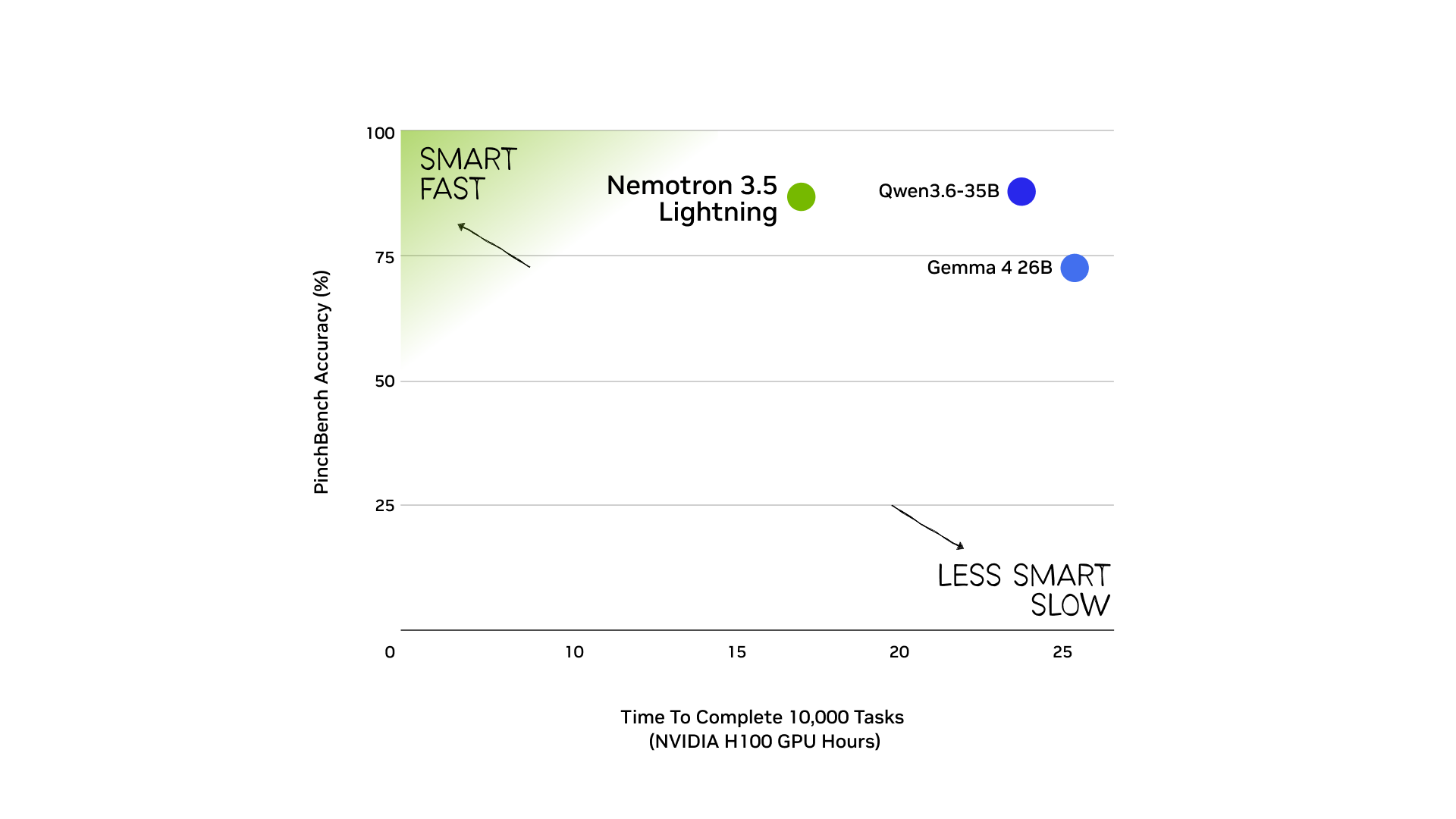
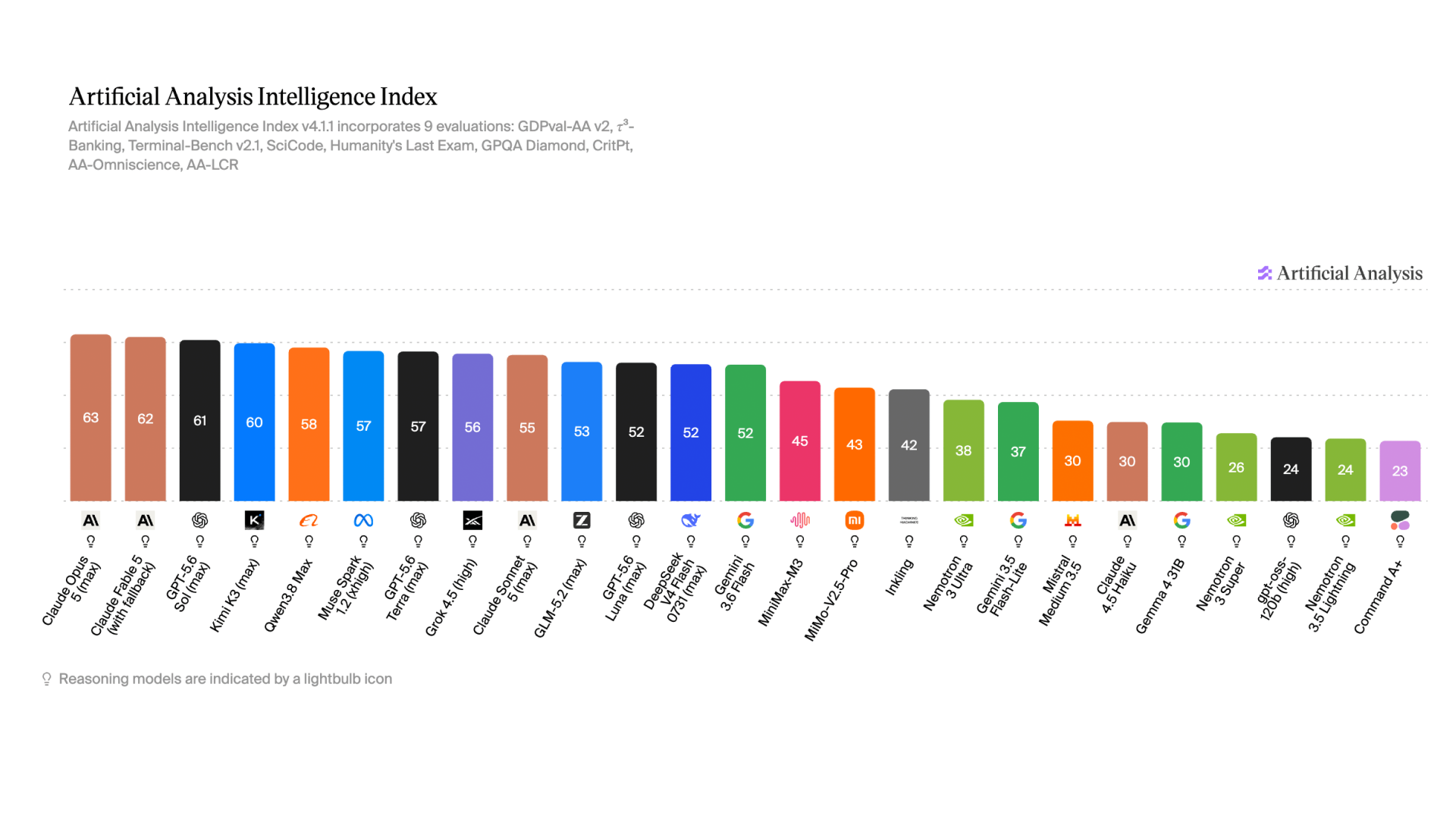
Lightning competes with other 20B–120B-class agent models, and its architecture lets it achieve competitive results on some agentic evaluations despite having fewer active parameters. Artificial Analysis scores it roughly on par with gpt-oss-120B on intelligence, even though it's a fraction of that model's size. It also showed major gains over its own predecessor, Nemotron 3 Nano, on agentic task benchmarks, edging past both gpt-oss-120B and the larger Nemotron 3 Super.
The model also prioritizes speed and efficient execution over top performance on broad reasoning, coding, and long-context benchmarks. Artificial Analysis, an independent platform and benchmarking organization, places it behind stronger small open models such as Qwen3.6 35B A3B and Muse Glimmer, while closed models such as Gemini 3.6 Flash lead on several general agent, coding, and reasoning evaluations.
The biggest differences between the models are in token costs and deployment options. For example, Grok 4.5 is priced at about $2 per million input tokens and $6 per million output tokens, with cached input discounted but still billed per token. By contrast, Lightning can be deployed on your own GPUs, so its ongoing costs are spent on hardware and operations rather than per‑token API fees.
Where can you access Nemotron 3.5 Lightning?
Nemotron 3.5 Lightning is available through Hugging Face, ModelScope, OpenRouter, and NVIDIA’s build.nvidia.com platform as an NVIDIA NIM microservice. It is also available through a range of cloud and inference providers, including DeepInfra, Fireworks AI, FriendliAI, CoreWeave, GMI Cloud, Nebius, and Crusoe.
Teams that want managed inference can use a hosted API, while organizations with suitable NVIDIA infrastructure can deploy the model locally or on premises. NVIDIA lists support across RTX PCs, RTX PRO workstations, DGX Spark, DGX Station, Jetson devices, data centers, and cloud environments.
Our thoughts on Nemotron 3.5 Lightning
Nemotron 3.5 Lightning highlights how agent systems are becoming more specialized. While larger proprietary models may still lead on broad reasoning and coding benchmarks, that level of capability is not necessary for every tool call, validation step, or routine action within an agent workflow.
For teams building long-running agents, Lightning’s appeal is its focus on fast, repeated execution and the flexibility to deploy and customize it within an existing stack. Its simultaneous release with NeMo Switchyard points to a multi-model approach, where individual workflow steps can be routed to the model best suited to handle them.
Whether Lightning is a good fit depends on the workload. It may be particularly relevant for organizations exploring text-based agent workflows, local or on-prem deployments, or model-routing strategies that balance performance, cost, and infrastructure needs.
If your organization is exploring how AI agents could support its products or internal operations, FullStack can help. Our team works with companies to evaluate AI technologies, design agentic workflows, and build secure, scalable applications around their business and technical requirements.
NVIDIA Nemotron 3.5 Lightning is an open-weight, text-only mixture-of-experts AI model designed for high-volume agentic AI tasks. It has 30 billion total parameters, with roughly 3 billion active per token, and is intended for repeated workflow steps such as tool calls, code edits, document actions, and monitoring.
What is Nemotron 3.5 Lightning used for?
Nemotron 3.5 Lightning is designed for the execution layer of long-running AI agents. Common use cases include coding assistants that review pull requests or generate fixes, cybersecurity tools that monitor and triage alerts, and customer support or billing agents that handle routine requests.
Is NVIDIA Nemotron 3.5 Lightning open-weight?
Yes. Nemotron 3.5 Lightning is released under NVIDIA’s OpenMDW-1.1 license with downloadable model weights, training data, and recipes. Organizations can deploy it on their own infrastructure, adapt it to domain-specific workflows, or access it through hosted inference providers.
How does Nemotron 3.5 Lightning compare to Gemini 3.6 Flash and Grok 4.5?
Nemotron 3.5 Lightning is built for efficient, high-volume execution within agent workflows, while proprietary models such as Gemini 3.6 Flash and Grok 4.5 generally perform better on broad reasoning, coding, and agent benchmarks. Lightning may be a better fit when teams need to self-host a model, customize it for a specialized task, or reduce reliance on per-token API billing.
What is NVIDIA NeMo Switchyard?
NVIDIA NeMo Switchyard is an open-source model-routing library released alongside Nemotron 3.5 Lightning. It helps agent systems send individual steps in a workflow to different AI models based on factors such as task requirements, speed, cost, and performance needs. For example, an organization might use Lightning for routine execution work and reserve a larger frontier model for more complex reasoning.
How can you cut your AI coding costs without switching models?
This guide gives you the math, the meaningful benchmarks, and a six-step plan to cut spend without giving up capability.
Enjoyed the article? Get new content delivered to your inbox.
Subscribe below and stay updated with the latest developer guides and industry insights.
Thank you! Your submission has been received!
Oops! Something went wrong while submitting the form.
Iframe is blocked. Accept cookies to load it.
Thank you! Your submission has been received!
Oops! Something went wrong while submitting the form.
We use cookies to provide our services, to allow us to better understand our audience, and to provide and serve personalized ads or content. By using our website, you consent to the terms of our Privacy Policy and our Cookie Policy, and the use of cookies, pixels, and other technology as described more fully therein