Everyone is an FDE now: Marketing, SEO, and web FDEs
Written by
FullStack Team
Last updated on:
November 18, 2026
The forward-deployed title has moved from engineering into marketing and go-to-market roles. Here's what those roles involve, and what leaders can learn from the model behind them.
Cognition, maker of the Devin coding agent, has advertised for a forward-deployed marketer who works with its biggest customer accounts, according to Growth Method. Stripe uses a different title for a similar idea. Its “Forward Deployed AI Accelerators” embed with groups of marketers to build AI tools and teach them to build their own, as Inc. reported.
Both roles borrow the working model of the forward-deployed engineer (FDE): put one person inside a team and keep them there until an AI project delivers results. Marketing teams have bought plenty of AI tools, so it makes sense that the model is spreading to them. For founders and executives, the useful questions are when this model is worth paying for, and how to tell a real forward-deployed role from a new name for an old job.
Why is the forward-deployed model spreading beyond engineering?
The FDE model is most closely associated with Palantir, where engineers work inside one customer's environment to make its software work for that customer. AI companies adopted this operating model because AI tools usually need adapting to each customer's data and workflows. Someone has to sit with the people doing the work and keep adjusting the tool until it delivers a result.
The title has grown with that need, first in technical roles. Postings with "forward-deployed engineer" in the title grew 1,165% from January to October 2025, compared with the same months in 2024, according to Bloomberry's analysis of about 1,000 job listings.
Marketing teams face a similar problem. More than half of generative AI budgets go to sales and marketing tools, but the biggest returns come from back-office automation, according to MIT's NANDA initiative, as reported by Fortune. The same research found that only about 5% of AI pilot programs achieve rapid revenue acceleration. Adoption takes someone who knows both the tools and how marketing teams work, and a forward-deployed marketer brings those technical skills into marketing work.
The role varies from company to company. Hightouch has posted a founding forward-deployed marketer role, and Eulerity has advertised for a forward-deployed marketing engineer. In his review of these postings, marketing leader Adam Woozeer found that the same title covers three quite different jobs:
The embedded customer marketer. At Cognition, the role works with customer teams to turn successful deployments into case studies and video.
The embedded practitioner. At Hightouch, the role meets with customers to find marketing workflows to automate, runs pilot programs, and trains their teams on the product.
The integration engineer with a marketing focus. At Eulerity, the role deploys APIs and SDKs into client systems and debugs campaign delivery.
Some agencies have adopted the model under the name forward-deployed marketing. Single Grain describes its forward-deployed marketer as someone who works inside the client’s stack and turns their judgment into AI agent workflows, judged on the work they save rather than demos.
What does a forward-deployed marketer work on?
In each of these roles, someone with marketing expertise sits inside the team, finds where AI can help, and owns the result. Some forward-deployed marketers build simple tools themselves with no-code AI tools. Bigger builds that touch internal systems usually need an engineer. In day-to-day marketing workflows, the work can look like this:
Competitive monitoring. Deciding which competitors and changes matter, then setting up AI agents that summarize them for product marketers and the sales team.
Reporting. Defining the numbers marketing ops actually needs each week, so an automated report can replace Monday mornings spent copying numbers between tabs.
Positioning research. Using AI to sort through customer calls and reviews, so product marketing can identify the language customers use and test positioning against it.
Content operations. Setting up AI-assisted briefs and first drafts from your own research, with a person reviewing before anything goes out under your brand.
The marketer’s value is context. Someone who sees the real work up close knows which tasks are worth automating and is less likely to solve the wrong problem. When a workflow needs access to internal systems and data across several cloud platforms, that’s where an engineer, often an FDE, comes in.
Strong versions of the role also leave the team more capable when the work is done. Stripe’s listings describe teaching marketers to build their own tools, “creating independence.” That raises AI fluency across the team, and it means you don’t lock in a dependency on one person or vendor.
Could SEO and web teams use FDEs, too?
SEO and web teams are a natural next fit for the forward-deployed model. Their projects have the same shape as an AI deployment: the goal is clear, and the path depends on your data and how your team works.
An SEO FDE would work inside your content team and connect AI tools to your CMS and search data, so the team can find pages that need updating and fix technical issues faster. They’d be measured on what happens to organic traffic and leads.
A web FDE would do the same for your site. Instead of handing over a redesign at the end of a project, they’d sit with marketing and sales, find where the site loses people, and ship changes in small steps until the numbers move.
In both cases, the working model is the same as for any FDE. The person sits inside your team, is accountable for one outcome, and stays until it works.
What should leaders take from this?
Much of the value of an AI tool depends on fitting it to a team and the process it supports, and that's what the forward-deployed model gets right. For founders and executives, the more useful question is which of your AI projects need someone embedded to make them work, and which ones just need more hands. Whether you call that person a forward-deployed marketer, an AI operator, or something else matters much less. What matters is whether they can operate inside your team and deliver something valuable.
A few questions help sort that out:
Is the path to the result clear? If your team knows what to build, more capacity may be enough.
Do you have someone to direct the work? If your leads are already stretched, an embedded specialist can own decisions they don't have time for and support the people doing the work.
What is the role accountable for? A business result, like pipeline or time saved, is a good sign. If a role produces demos or decks and ends before anything changes, it's closer to consulting, whether you're a startup or a large enterprise.
Who owns it after launch? Plan the handover from the start, so the knowledge and the new practices stay with your team.
We use the first two questions for engineering projects, too. They apply to any function AI reaches, so it’s worth building them into your strategy for the future.
Our forward-deployed engineers are senior nearshore engineers who work inside your team and stay with an AI project until it's running in production. That includes the systems behind marketing and web work, like connecting AI tools to your CMS and analytics. If a forward-deployed marketer is the person who knows what should change, an FDE is often the partner who makes it work in your stack, helping you create systems and build the capability to run them yourselves.
A forward-deployed marketer is placed with a team outside their usual one, such as a customer’s account, a client’s marketing team, or a group of their own company’s marketers, to help that team get results from AI or a product. Depending on the company, the role may turn customer results into case studies, help customers automate marketing workflows, or build AI tools for a company’s own marketers.
Is a forward-deployed marketer the same as a forward-deployed engineer?
No. Both follow the same model of working inside a customer's team, but an FDE builds and launches software in production, while a forward-deployed marketer focuses on marketing results. Some roles, like a forward-deployed marketing engineer, combine the two.
Which companies hire forward-deployed marketers?
Cognition, Hightouch, and Eulerity have all posted forward-deployed marketing roles, according to reviews by Growth Method and Adam Woozeer. Stripe uses a similar model under the title "Forward Deployed AI Accelerators."
Why is the forward-deployed title spreading?
AI tools usually need adapting to a team's data and workflows before they deliver results. The forward-deployed model puts someone who does that work inside the team, and companies are applying it beyond engineering as AI reaches marketing and other functions.
How do I know if a role is really forward-deployed?
Ask what the person is accountable for and whether they stay until the work is live. A real forward-deployed role owns a business result inside your team. A role that delivers demos or recommendations and then leaves is closer to consulting.
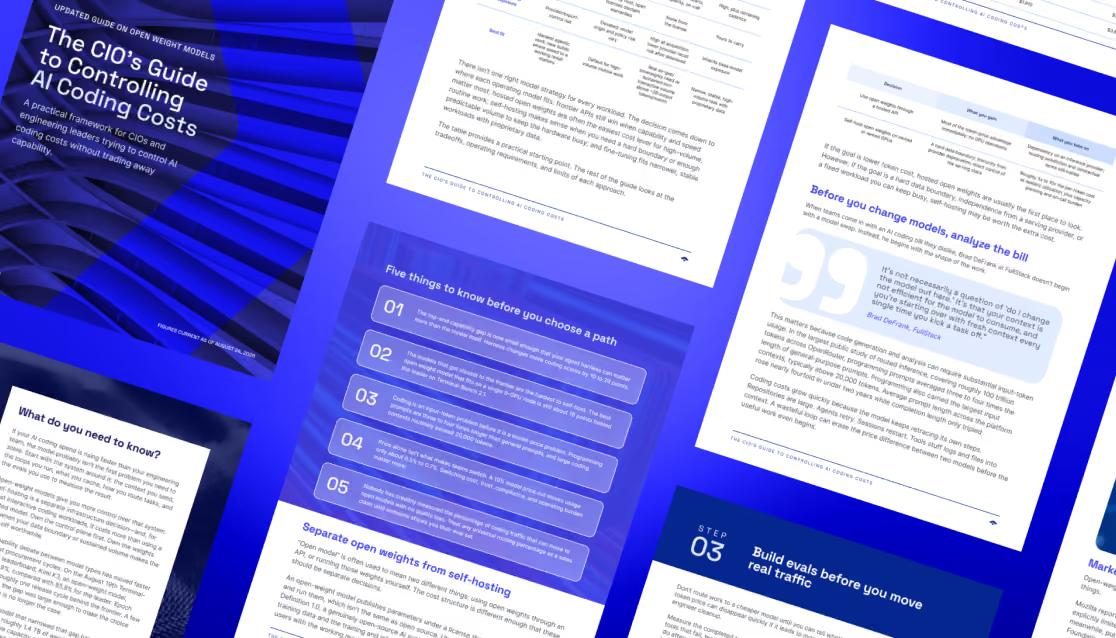
How can you cut your AI coding costs without switching models?
This guide gives you the math, the meaningful benchmarks, and a six-step plan to cut spend without giving up capability.
Enjoyed the article? Get new content delivered to your inbox.
Subscribe below and stay updated with the latest developer guides and industry insights.
Thank you! Your submission has been received!
Oops! Something went wrong while submitting the form.
Iframe is blocked. Accept cookies to load it.
Thank you! Your submission has been received!
Oops! Something went wrong while submitting the form.
We use cookies to provide our services, to allow us to better understand our audience, and to provide and serve personalized ads or content. By using our website, you consent to the terms of our Privacy Policy and our Cookie Policy, and the use of cookies, pixels, and other technology as described more fully therein