AI coding costs rise with context, tool calls, retries, and rework. Learn why cheaper models alone won’t fix the bill—and where open-weight models can help.
AI coding tools can help engineering teams move faster, but they can also make software development spending much harder to predict. What begins as a manageable investment in developer licenses and model access can grow quickly once teams use agents to search repositories, investigate bugs, generate pull requests, run tests, and work through more complex tasks.
Switching to a lower-cost model may reduce the price of an individual request, but it won’t solve the workflow problems that often drive AI coding costs: oversized context, repeated tool calls, unnecessary retries, poor task scoping, and limited visibility into agent behavior. Lowering spend requires looking at how the full workflow uses the model, then matching each task to the right level of capability.
AI Coding Costs Don’t Behave Like SaaS Licenses
Most enterprise software budgets are built around predictable licensing models. An organization can estimate how many developers need access to an IDE, source control platform, observability tool, or project management system, then forecast costs based on headcount and contract terms.
AI coding platforms add a variable usage layer to that model. A subscription may provide baseline access, while premium model requests, large-context retrieval, tool calls, agent retries, and API usage can increase costs according to the work developers ask the system to perform.
This becomes more visible as teams move beyond code completion and chat assistance. A developer using AI to draft a unit test or explain a function may create a modest amount of activity. An agent assigned to investigate an unfamiliar issue may search across a repository, read code and documentation, run commands, maintain a running history of its work, execute tests, and repeat parts of that process until it reaches a usable result.
A study highlighted by the Stanford Digital Economy Lab found that the agentic coding tasks it analyzed consumed roughly 1,000 times more tokens than code reasoning and code chat. Input tokens accounted for most of that cost because agents repeatedly processed the context accumulated during multi-step work.
This helps explain why an AI coding bill can rise even when developer headcount and the number of tool licenses remain stable. Each user may be asking agents to do more repository analysis, use more tools, and complete more multi-step work than they did during the initial rollout.
Lower Token Prices Don’t Always Lower Total Costs
Model pricing gets attention because it’s visible and easy to compare. In practice, the more useful question is how much an organization spends to complete a task successfully.
A lower-cost model may require more context, more detailed prompting, additional retries, or more developer corrections before the output is ready to use. A premium model may cost more per request, but it can still be more economical for a difficult production issue, a multi-file refactor, or a security-sensitive change if it produces a reliable result with fewer attempts.
Teams should measure more than token volume or cost per API call. They need to understand how much of a session is spent retrieving files, processing project instructions, repeating tool calls, carrying forward chat history, rerunning tests, and correcting earlier output. A model that generates inexpensive responses can still create an expensive workflow if the agent keeps retracing its steps or needs several loops to complete the work.
Databricks’ analysis of managing AI coding costs at scale describes an “efficiency frontier”: the models offering the best price for a given level of capability. Databricks found cost regressions in some of its model evaluations and reports that its Smart Router reduced average task cost by more than 30% while roughly matching the quality of the most expensive model in its working set.
Cost per completed task provides a more useful comparison because it accounts for the context processed, retries required, tools called, and developer work needed to reach a reliable result.
Context and Loops Drive Spend
Code generation is only one part of an AI agent’s work. Before an agent can make a useful change, it may need to understand the application structure, locate relevant files, review project instructions, inspect dependencies, read test results, and retrieve documentation or ticket context.
That information is necessary when it helps the agent make a better decision. Costs rise when an agent has to process broad, repetitive, or irrelevant context because the task was not scoped clearly enough or the codebase does not provide a reliable starting point.
An agent working on an authentication issue can move much more efficiently when the request includes the affected service, a relevant error message, and the expected behavior. Without that information, it may search multiple directories, inspect adjacent configuration, and retrieve unrelated services before it can identify the likely source of the problem.
Teams can reduce unnecessary context by:
Including relevant file paths when developers know where an issue is located.
Maintaining concise project guidance that covers key directories, build steps, test commands, and coding conventions.
Keeping requests narrow enough that agents don’t need to retrieve unrelated parts of the repository.
Sharing relevant log excerpts rather than full build output or dependency trees.
Starting a new conversation when work moves to an unrelated task.
Breaking oversized files into smaller, focused modules.
These practices can improve the quality of AI-generated code as well as reduce LLM coding costs. Agents make better use of their context window when they can focus on the relevant implementation details rather than spending time figuring out where to begin.
Prompt caching can lower costs when agents reuse stable information across requests, including system instructions, tool definitions, project guidance, and internal documentation. Anthropic’s prompt-caching documentation explains how repeated prompt prefixes can be reused to reduce processing costs and latency, although the results depend on cache duration, request structure, and how consistently reusable content is formatted.
Caching works best when shared instructions remain stable and task-specific details are added separately. When prompts include unnecessary variable information or carry forward large amounts of unrelated chat history, the system has fewer opportunities to reuse cached context and may reprocess information it has already seen.
Teams should also look at how agents retain memory between related tasks. If an agent starts from scratch whenever it receives a new request, it may repeatedly scan the same repository, retrieve the same documentation, and rebuild the same working context. Preserving useful memory, while discarding stale or irrelevant history, can reduce repeated spend and help agents reach useful conclusions with fewer loops.
Monitoring cache-hit rates alongside input tokens, retries, tool calls, and task outcomes gives platform teams a clearer view of where repeated processing is creating cost without improving results.
Use a Model Mix, Not a Single Default
Many teams begin by putting their most capable model behind every coding task. That can be a reasonable choice during an early pilot, when speed matters more than optimization and teams are still learning where AI delivers value. At scale, though, a premium model as the default for every request can become an expensive habit.
Different engineering tasks need different levels of capability. Frontier models are often worth the premium for difficult production issues, security-sensitive changes, large refactors, and work that requires an agent to plan, use tools, and stay coherent through multiple steps. Routine documentation, test generation, clearly patterned migrations, and lower-risk maintenance work may not need the same level of reasoning or context capacity.
Hosted open-weight models give teams another option for that routine work. Organizations can access lower-cost capacity through an API without taking on the infrastructure, utilization, and on-call demands of self-hosting. This distinction matters because open-weight adoption and self-hosting are separate decisions; using open weights through a hosted provider may be the practical first step for teams focused on reducing token spend.
Self-hosting has a different role. It can be appropriate when a company needs a hard data boundary, wants direct control of the serving stack, or has enough sustained and predictable demand to justify operating its own infrastructure. For most interactive coding workloads, however, the organization will get more flexibility by keeping model access behind a routing layer and using internal evaluations to decide where each model belongs.
Building the Control Plane Before You Migrate
Switching models is difficult when applications call providers directly, routing rules are scattered across tools, and teams can’t see which workflows are creating spend. A control plane gives organizations one layer for managing model access, applying routing rules, reusing cached context, monitoring cost and quality, and changing providers without rewriting every application.
That control layer can direct routine work to a lower-cost model, reserve frontier capacity for high-risk or complex tasks, apply a quality floor, and fail over when a provider is unavailable. It also gives leaders a consistent way to measure token mix, cache-hit rates, retries, tool calls, latency, and cost per completed task across teams.
The exact routing rules should come from internal evaluations rather than a vendor’s universal recommendation. There is no credible percentage of coding work that every organization can move to lower-cost or open-weight models without affecting quality. Teams need a small evaluation set based on their own codebase, security requirements, and engineering workflows, then they need to measure the whole task—not only whether the first response sounded plausible.
This is where governance and cost management meet. Agents that access internal data, call tools, or operate in production-adjacent environments need scoped identities, runtime permissions, audit trails, and clear ownership.
AI coding costs won’t come down simply because an organization changes providers or selects a lower-priced model. Teams need to reduce unnecessary context, control retry loops, reuse stable information, and measure cost per completed task before they can determine whether a model change is producing real savings.
Hosted open-weight APIs can be a practical part of that strategy for high-volume, well-scoped engineering work, while frontier models remain valuable for tasks that require deeper reasoning or longer autonomous execution. Self-hosting is a separate infrastructure decision, not an automatic replacement for an API bill.
AI coding costs often rise as teams move from autocomplete and chat to agents that search repositories, retrieve documentation, call tools, run tests, and retry failed tasks. Larger context windows, repeated tool calls, session history, and developer rework can add more cost than the final generated code itself.
Will switching to a cheaper AI model reduce coding costs?
Not necessarily. A lower-cost model may reduce the price per token, but it can raise total costs if it needs more context, retries, prompting, or developer corrections to complete the task. Measure cost per completed task—not just price per API call or token—to determine whether a model change is actually saving money.
How can organizations reduce AI coding costs?
Organizations can reduce AI coding costs by narrowing task scope, giving agents relevant file paths and concise project instructions, limiting retries, reusing stable context through prompt caching, and routing tasks to models that meet the required quality level. Tracking token usage, tool calls, cache-hit rates, latency, and developer rework also helps teams identify inefficient workflows.
What is AI agent cost optimization?
AI agent cost optimization is the practice of reducing the total cost of AI-powered workflows without sacrificing the quality or reliability of the outcome. For coding agents, it includes managing context, caching repeated information, setting limits on tool calls and retries, evaluating models against real engineering tasks, and routing work based on complexity and risk.
Can open-weight models reduce LLM coding costs?
Hosted open-weight models can reduce LLM coding costs for high-volume, well-scoped work such as test generation, documentation, routine migrations, and lower-risk maintenance tasks. They aren’t a replacement for frontier models in every situation, though, and organizations should use internal evaluations to determine where open-weight models meet their quality, security, and operational requirements.
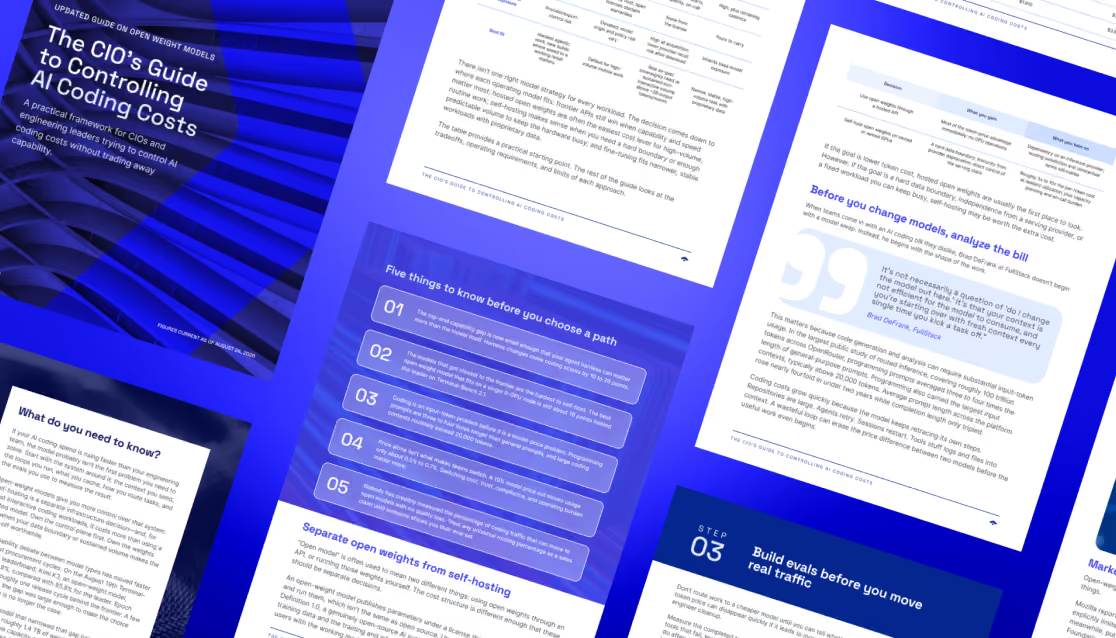
How can you cut your AI coding costs without switching models?
This guide gives you the math, the meaningful benchmarks, and a six-step plan to cut spend without giving up capability.
Enjoyed the article? Get new content delivered to your inbox.
Subscribe below and stay updated with the latest developer guides and industry insights.
Thank you! Your submission has been received!
Oops! Something went wrong while submitting the form.
Iframe is blocked. Accept cookies to load it.
Thank you! Your submission has been received!
Oops! Something went wrong while submitting the form.
We use cookies to provide our services, to allow us to better understand our audience, and to provide and serve personalized ads or content. By using our website, you consent to the terms of our Privacy Policy and our Cookie Policy, and the use of cookies, pixels, and other technology as described more fully therein


.jpg)