NVIDIA’s AVO used Claude Opus 5 to optimize GPU code and complete ARC-AGI-3. The results highlight the role of tools, feedback, and evaluation in building reliable AI agents.
NVIDIA originally developed AVO to optimize CUDA kernels, the low-level programs that help determine how efficiently GPUs run AI workloads. The system ran autonomously for seven days, exploring more than 500 optimization directions and producing 40 committed kernel versions. Among them were versions that outperformed FlashAttention-4 by up to 10.5% in NVIDIA’s evaluated configuration.
In an August 21, 2026 blog post, NVIDIA connected its earlier AVO research on CUDA-kernel optimization with a new result on ARC-AGI-3. Using Claude Opus 5 as the underlying model, NVIDIA reported that AVO completed all 183 levels across the benchmark’s 25 public environments, earning a 100.00 RHAE score.
NVIDIA also noted that ARC Prize separately reports an approximately 30% result for Claude Opus 5 at High reasoning effort, while cautioning that the two results are not a controlled comparison because the reasoning settings, agent systems, and evaluation setups differ.
The two tasks are very different. While CUDA optimization involves improving low-level GPU code against correctness checks and performance benchmarks, ARC-AGI-3 places agents in unfamiliar interactive environments without instructions, stated rules, or explicit goals. The agent has to explore, interpret what it observes, and work out which actions move it forward.
Although the two tasks are different, both required AVO to work through multiple steps, test actions against real feedback, and use earlier results to decide what to do next. That approach is increasingly relevant for AI work that involves investigation, iteration, testing, and course correction rather than a single prompt and response.
Image courtesy of NVIDIA’s technical blog, 2026.
What is NVIDIA AVO?
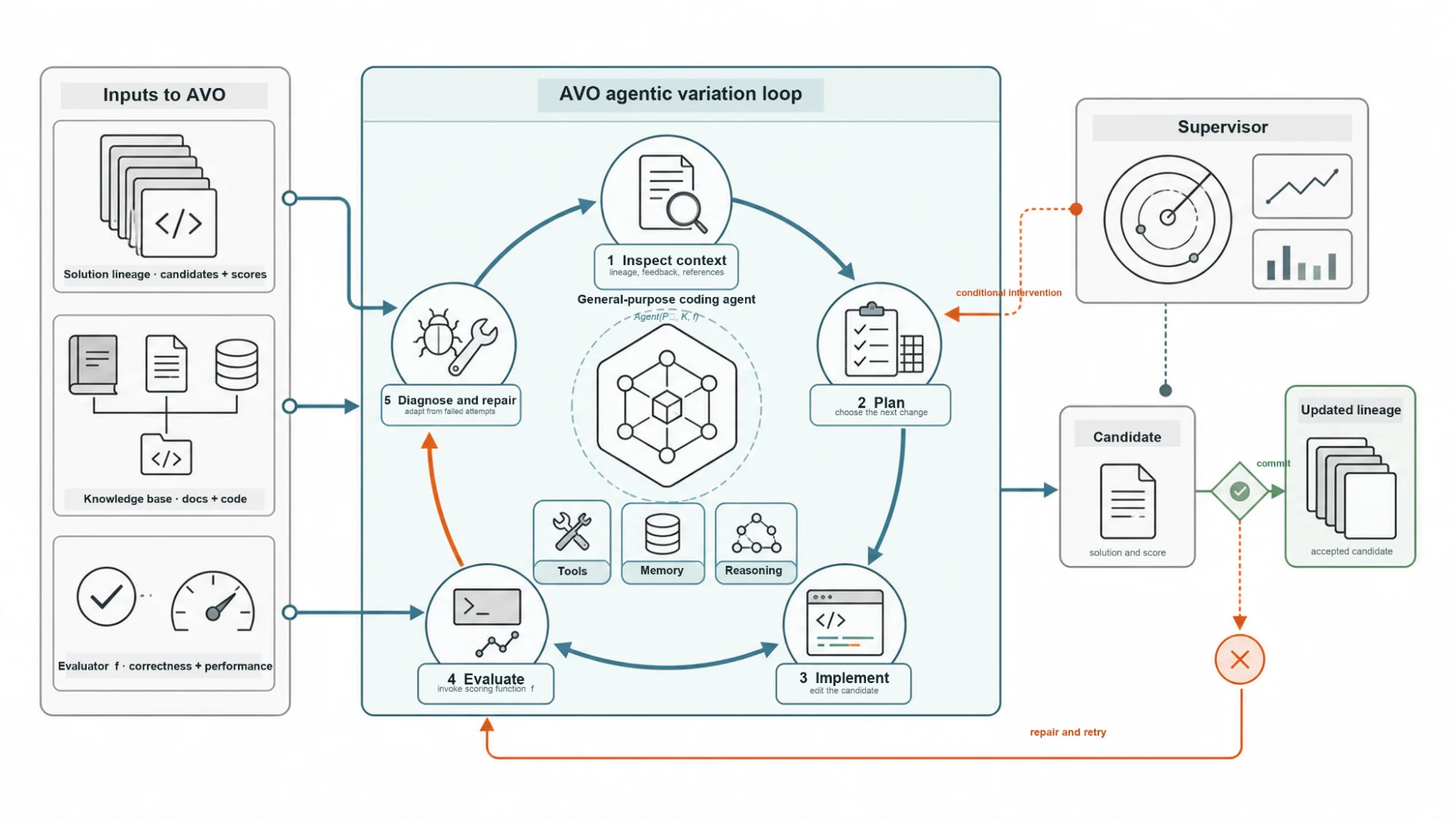
AVO, short for Agentic Variation Operators, is NVIDIA’s research project for building general-purpose coding agents that can work through difficult, multistep tasks over extended periods. The important distinction is that AVO is not simply using an LLM to generate code. It gives the model an environment in which it can inspect an existing implementation, modify it, run tests, evaluate the result, and use that feedback to determine its next move.
AVO uses the autonomous coding agent as the “variation operator” in an evolutionary search process. Instead of relying entirely on fixed heuristics to generate new solutions, the agent decides what to examine, what to change, and how to test the resulting candidate. The model therefore becomes part of an iterative search process rather than the endpoint of a single prompt-response interaction.
AVO uses an autonomous coding agent as the “variation operator” in an evolutionary search process. In a conventional evolutionary search system, fixed rules or hand-designed heuristics create new versions of a candidate solution. With AVO, the agent decides what to examine, what to change, and how to test the result.
The agent can work from previous versions, evaluation results, relevant technical documentation, and the tools available in its environment to develop and test a new approach. The outcome then informs the next iteration.
In NVIDIA’s kernel-optimization work, that meant working with source code, compilers, correctness checks, benchmarks, and profiler output. A candidate had to pass correctness checks before its performance could be measured, grounding the process in real hardware results rather than code that simply appeared efficient.
How AVO has improved GPU performance
CUDA kernel optimization is difficult because performance depends on several interacting factors, including memory access, numerical accuracy, GPU scheduling, and overall throughput. A change that appears faster in isolation can still slow the full workload on real hardware.
In NVIDIA’s tests on DGX B200 systems, AVO’s best multi-head attention kernels outperformed cuDNN by up to 3.5% and FlashAttention-4 by up to 10.5% across the evaluated configurations. The agent also adapted its evolved kernel for grouped-query attention in approximately 30 minutes of additional autonomous work.
One reported improvement involved a repeated step in the attention calculation. The earlier approach checked whether a group of parallel GPU threads needed to rescale intermediate values before taking that step, which can introduce synchronization and control-flow overhead. AVO instead used a more consistent execution path: it occasionally performed a small extra calculation, but reduced the amount of coordination required across parallel GPU operations.
That tradeoff reflects the nature of low-level optimization. Adding work in one part of a kernel can improve end-to-end performance when it removes a larger bottleneck elsewhere.
NVIDIA’s results reflect specific hardware, software, workloads, and benchmark conditions. They don’t establish that AVO will outperform every optimized kernel across other GPUs, applications, or AI models.
The infrastructure behind AVO
AVO’s most important lesson may be that the model is only one component of an autonomous agent. The surrounding system determines whether the model can actually pursue a problem over time.
AVO’s agent harness provides context, tools, persistent state, previous solution candidates, evaluation results, and a feedback loop. The agent can inspect what has already been tried, make a change, test it against correctness and performance criteria, and use the result to determine what to do next. A supervisor can also intervene when the process stalls or begins repeating unproductive patterns.
This architecture changes the role of the model. Instead of asking an AI to produce the best answer in one pass, the system gives it a structured environment in which it can generate hypotheses, act on them, observe the outcome, and iterate. That combination of model capability, tools, evaluation, memory, and guardrails is what makes long-horizon autonomy possible.
Image courtesy of NVIDIA, 2026.
What businesses can learn from AVO
For businesses, AVO’s significance is not that every enterprise needs an autonomous coding system. It is that the same architecture can change how organizations approach complex, multistep work.
An effective agent needs more than a capable model. It needs a defined objective, access to the right context and tools, persistent task state, measurable success criteria, automated evaluation, and clear limits on what it can change. Most enterprise workflows will be less specialized than GPU kernel optimization, but the underlying pattern is transferable: let the agent act, evaluate the result, and use that feedback to determine the next step.
In software engineering, for example, an agent investigating a production defect could review logs, trace relevant code paths, reproduce the issue in a sandbox, and draft a regression test and proposed fix. The sandbox and regression test provide evidence that the proposed change addresses the problem; a developer still reviews the work and approves any meaningful code change.
For this kind of workflow to be dependable in production, teams need:
Access to the relevant data, documentation, code, and tools.
Permissions that reflect the risk of the task.
Clear success measures, such as lower latency, fewer defects, reduced cloud spend, or faster resolution times.
Automated checks for correctness, quality, security, and compliance.
Persistent task context and logs of agent actions, intermediate results, and decisions.
Without those controls, an agent can still be useful for research, drafting, and routine support. However, it’s less likely to be reliable enough for work that changes production systems or affects customers.
Building your AI agent strategy with FullStack
NVIDIA’s AVO research shows what agent-based systems can do when they have the context, tools, feedback, and controls to work through a problem over time. For organizations, the priority isn’t unlimited autonomy, but rather identifying high-value workflows, defining how success will be measured, and building the integrations and safeguards needed for reliable use.
FullStack helps organizations design and deliver custom AI solutions and custom software development projects that bring those workflows into production. From AI-agent workflows and secure integrations to evaluation frameworks, software modernization, and governance controls, FullStack helps teams turn AI capabilities into practical systems.
Contact us today if you’re interested in seeing what we can offer your business.
Learn more
Frequently Asked Questions
What is NVIDIA AVO?
NVIDIA AVO, or Agentic Variation Operators, is a research system that uses an autonomous coding agent to explore, test, and refine possible solutions. It was initially developed to optimize CUDA kernels, with the agent using code, documentation, tools, benchmarks, and evaluation feedback to guide subsequent iterations.
How did NVIDIA AVO improve GPU performance?
In NVIDIA’s evaluated configurations on DGX B200 systems, AVO discovered multi-head attention kernels that outperformed cuDNN by up to 3.5% and FlashAttention-4 by up to 10.5%. The system explored more than 500 optimization directions during seven days of autonomous work.
What is the connection between NVIDIA AVO and Claude Opus 5?
NVIDIA used Claude Opus 5 as the underlying model in its ARC-AGI-3 experiment. AVO completed all 183 levels across the benchmark’s 25 public environments, earning a 100.00 RHAE score. ARC Prize separately reports an approximately 30% result for Claude Opus 5 at High reasoning effort, but NVIDIA notes that the figures are not a controlled comparison because the reasoning settings, agent systems, and evaluation setups differ.
What does NVIDIA AVO’s ARC-AGI-3 score mean?
ARC-AGI-3 tests whether an agent can explore unfamiliar interactive environments and infer how to make progress without being given explicit instructions or goals. AVO’s 100% result on the public set suggests that persistent context, tools, evaluation, and feedback loops can materially affect an agent’s ability to carry out multistep tasks. It does not establish performance on every benchmark, real-world workflow, or hidden test set.
What can businesses learn from NVIDIA AVO
The main lesson is to treat AI agents as operational workflows, not just models. For AI agents to support production work reliably, organizations need relevant context and tools, task-appropriate permissions, measurable outcomes, automated validation, activity logs, and human approval for consequential actions. These controls help make AI agent development and custom software development projects more reliable in practice.
How can you cut your AI coding costs without switching models?
This guide gives you the math, the meaningful benchmarks, and a six-step plan to cut spend without giving up capability.
Enjoyed the article? Get new content delivered to your inbox.
Subscribe below and stay updated with the latest developer guides and industry insights.
Thank you! Your submission has been received!
Oops! Something went wrong while submitting the form.
Iframe is blocked. Accept cookies to load it.
Thank you! Your submission has been received!
Oops! Something went wrong while submitting the form.
We use cookies to provide our services, to allow us to better understand our audience, and to provide and serve personalized ads or content. By using our website, you consent to the terms of our Privacy Policy and our Cookie Policy, and the use of cookies, pixels, and other technology as described more fully therein