As AI vendors combine data, infrastructure, security, and application capabilities, enterprises must decide what to adopt, what to integrate, and what to keep independent.
Enterprise AI vendors are expanding through acquisitions, strategic partnerships, infrastructure investments, and new cloud services. For enterprises, that can mean more capabilities from vendors they already use—but it can also create harder decisions about which tools to adopt, how they’ll connect to existing systems, and who’ll own the resulting environment.
Salesforce is bringing data management, governance, workflows, and Claude-enabled AI experiences closer together. AMD is adding system-design and inference capabilities around its AI infrastructure portfolio. Palo Alto Networks is combining security, observability, and agentic operations. Oracle is expanding cloud capacity, AI database services, enterprise applications, and multicloud delivery options.
The enterprise impact isn’t simply that buyers have more products to choose from. Consolidation can change where business data lives, how identities and permissions are enforced, which vendor controls critical workflows, how costs are managed, and what it takes to integrate or switch platforms later.
Choosing a delivery partner now requires broad experience across a changing vendor ecosystem. The right partner should be able to assess a changing vendor ecosystem, design integrations across it, and help the enterprise retain control over data, workflows, security, and future options.
What Oracle, Salesforce, AMD, and PANW mean for enterprises
Salesforce, AMD, Palo Alto Networks, and Oracle are expanding at different layers of the enterprise AI stack. Their strategies show how AI programs now require decisions that cut across data, workflows, infrastructure, security, observability, and multicloud operations.
Salesforce: More connected data and AI workflows
Courtesy of Salesforce, 2026.
Salesforce’s acquisition of Informatica adds data integration, governance, quality, privacy, metadata management, and master-data-management capabilities to its platform. That gives Salesforce a larger role in the enterprise data foundation behind Agentforce and other AI-enabled workflows.
Its Claudeforce partnership with Anthropic also brings Claude closer to Salesforce data, business logic, actions, workflows, and governance controls. Salesforce in Claude is initially providing select pilot customers with prebuilt sales skills for work such as meeting preparation, deal-health reviews, and pipeline updates.
For enterprises, Salesforce may become a more central layer for customer-data access, sales workflows, and AI-assisted actions. That can simplify a workflow that previously required several tools, but it also raises decisions about data ownership, permission inheritance, approval requirements, auditability, and integration with non-Salesforce systems.
AMD: More infrastructure choices and trade-offs
AMD’s acquisition of ZT Systems reflects a move beyond individual chips toward AI-system design and deployment. It retained rack-scale design and customer-enablement teams while selling the manufacturing business to Sanmina. AMD also acquired MK1 to strengthen AI inference performance and efficiency.
For enterprises, these developments bring hardware selection, deployment design, inference performance, capacity planning, and operating cost closer together. Teams need to assess model requirements, deployment location, latency, data residency, cloud commitments, on-premises constraints, and total cost—not just benchmark performance.
Palo Alto Networks: AI security and operations are converging
Courtesy of Palo Alto, 2026.
Palo Alto Networks’ acquisition of Chronosphere brought cloud-native observability into its portfolio, while its acquisition of Console added an AI-native platform for building agentic workflows and automating operational tasks.
For enterprises, these moves reinforce a practical reality: security, identity, observability, and operational response are becoming connected parts of the AI environment. Once an AI system can access business data, call applications, or take actions through connected tools, it needs governance controls in addition to model-level controls.
That includes source-system permissions, access boundaries, activity logging, telemetry, escalation paths, incident response, and human approval for higher-impact actions.
Oracle: More multicloud flexibility and operating complexity
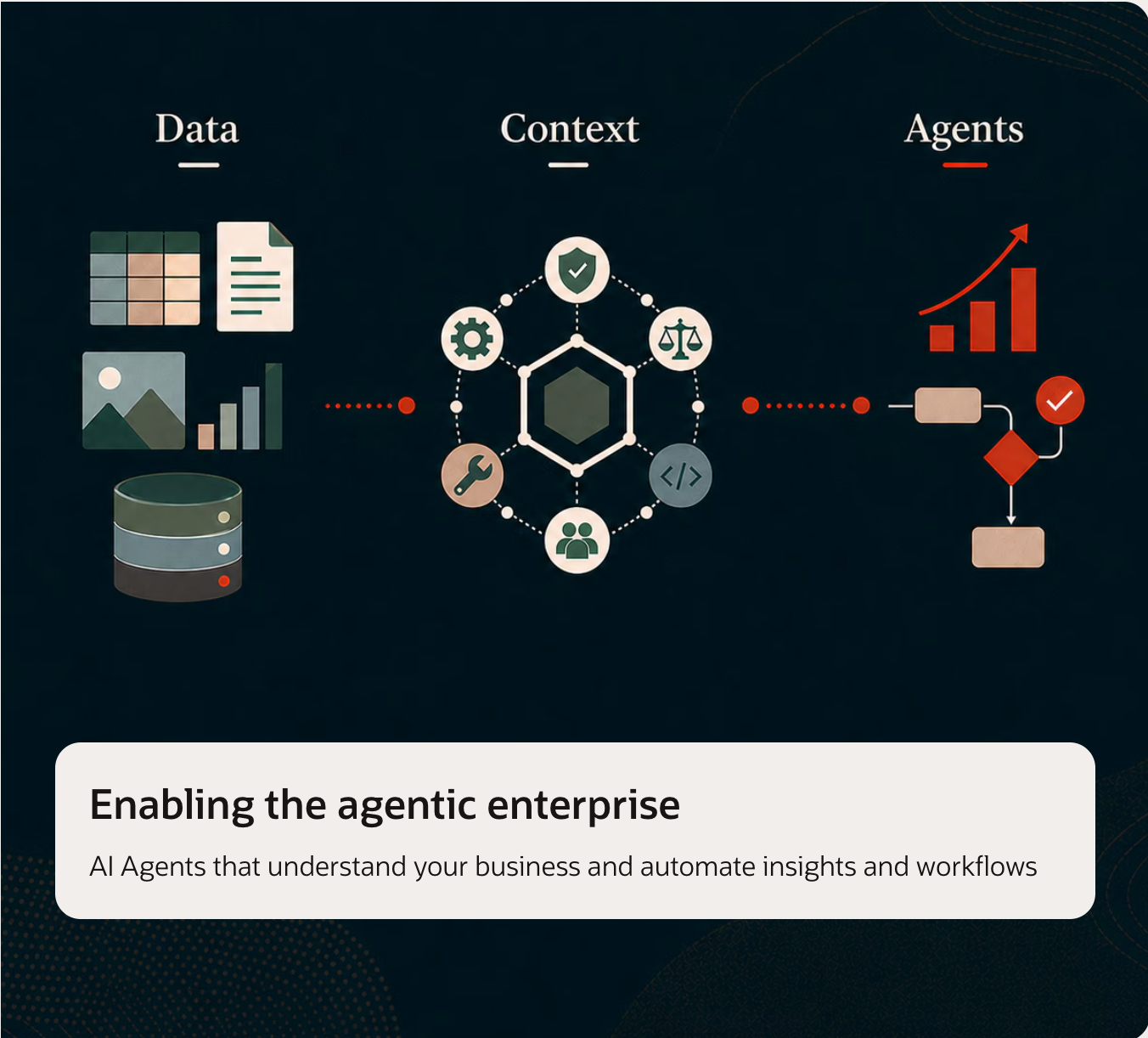
Courtesy of Oracle, 2026.
Oracle’s AI strategy centers on cloud infrastructure, database services, enterprise applications, and large-scale partnerships rather than the same acquisition pattern as Salesforce, AMD, and Palo Alto Networks.
Oracle is expanding Oracle Cloud Infrastructure, Oracle AI Database, and AI capabilities in its enterprise application portfolio. It’s also making database and cloud services available across multiple cloud environments, including Azure, Google Cloud, AWS, and Oracle Cloud Infrastructure, depending on the service and region.
For enterprises, that may create more flexibility when Oracle data supports applications and AI workloads across multiple clouds. But it can also add complexity across identity, networking, data movement, governance, cost allocation, support, and operating ownership.
What this means for choosing a delivery partner
Before adopting a newly available capability, enterprises should determine whether it solves a real business problem, fits the current architecture, and can be adopted without creating unnecessary dependency or security risk. A delivery partner should help answer those questions before implementation begins.
Look for platform expertise without platform bias
Experience with Salesforce, Oracle, AMD, Palo Alto Networks, or a major cloud provider can be valuable. The risk appears when a partner treats the platform it knows best as the answer to every requirement.
A strong partner should begin with the business process, current architecture, user needs, and operating constraints. It should explain why a platform capability is appropriate, what it’ll replace or integrate with, which dependencies it will create, and what ownership will look like after launch.
The partner should also be comfortable recommending against a vendor capability when it adds complexity without creating a meaningful business, security, or operational advantage.
Ask how the partner manages dependencies
Vendor switching rarely happens as a single, large migration. An enterprise might move an inference workload to another provider, replace an integration layer, adopt a capability added through an acquisition, or introduce a second platform to reduce dependency on one vendor.
Ask how the partner will document vendor dependencies, keep business logic separate from proprietary services where practical, preserve access to critical data, and prepare for changes in pricing, product availability, support terms, APIs, deployment models, and post-acquisition roadmaps.
That doesn’t mean every component needs to be vendor-neutral. Managed services and platform-specific features can be the right choice when they offer a clear technical, operational, or commercial advantage. Dependencies should be identified, along with why they’re accepted and what changing them would require.
Put integration and governance in the original scope
An acquired platform capability may need substantial work before it’s ready for a particular enterprise environment. Delivery teams may need to connect source systems, map data flows, configure role-based access, reconcile overlapping tools, update security controls, and train users and administrators.
Those requirements become especially important when an AI tool or agent can access CRM data, customer records, identity systems, knowledge bases, or operational applications. The system needs defined permissions, activity logs, approval rules, and oversight. Employees shouldn’t gain access to information or actions through an AI interface that they couldn’t access in the original system.
A delivery partner should account for this work in the original plan, timeline, and budget. It shouldn’t be treated as a future enhancement after the AI experience has been built.
Define ownership after launch
The implementation plan should identify who owns the system after go-live. That’s especially important when vendor acquisitions may lead to product consolidation, new technical dependencies, changed support structures, or revised roadmaps.
The operating model should assign responsibility for:
Vendor and product-roadmap changes
Model or platform updates
Integration failures and API changes
Identity and access reviews
Data-quality issues
AI evaluations and performance monitoring
Security patches and incident response
Cost management and usage controls
User support, training, and adoption
Some organizations will own most of these responsibilities internally. Others will rely on a delivery partner, managed-services arrangement, or hybrid model. The important part is agreeing on the operating model before launch instead of discovering gaps once the system is in production.
Questions to ask before choosing a delivery partner
A delivery partner should be able to answer detailed questions about how it’ll help the organization work through a changing vendor landscape.
How will you assess our current platform footprint?
Ask how the partner will map the CRM, ERP, data platforms, cloud providers, security tools, identity systems, APIs, and custom applications that support the proposed AI use case.
The answer should include discovery and architecture work before implementation recommendations. It shouldn’t begin with a predetermined platform choice.
Which vendor capabilities should we use now?
Ask the partner to distinguish among capabilities that are generally available today, those in pilot or early release, and those that depend on future product-roadmap commitments or post-acquisition integration.
This helps prevent a project from being designed around functionality that isn’t stable, broadly available, or suitable for the organization’s compliance, security, and operating requirements.
How will you keep data and workflows portable?
Ask where data, prompts, workflow definitions, model configurations, and business rules will reside. Ask which components depend on proprietary vendor services and what a transition would involve if the organization needed to change providers.
The answer should document trade-offs rather than promise universal vendor neutrality. Some proprietary capabilities may provide a clear advantage. Those choices carry a cost, timeline, and operational impact.
How will you integrate security and governance?
Ask how the partner will handle identity, access controls, source-system permissions, logging, sensitive data, approval workflows, and incident response. These requirements should appear in the proposed architecture and implementation plan, with clear ownership for implementation and ongoing operations.
A strong answer should explain how the partner will enforce least-privilege access, preserve existing permissions across connected systems, record AI and user activity for review, and establish approval or escalation paths for higher-impact actions. It should also explain how the team will respond if a model, integration, or user workflow behaves unexpectedly.
Ask who’ll own the service after implementation and how the partner approaches long-term support. The answer should cover training, documentation, integration maintenance, monitoring, product updates, and clear escalation paths.
A partner that can build an initial proof of concept isn’t necessarily the right partner to operate a production system over time. Delivery and operational responsibilities should be defined separately and explicitly.
Choosing for adaptability
Consolidation can make enterprise AI programs easier to buy, but it can make delivery decisions more complex. The vendors in an organization’s current stack may add new AI, data, infrastructure, security, and workflow capabilities faster than internal architecture standards and implementation plans can adapt.
The right delivery partner helps enterprises work across those changes. It should understand how to extend systems already in place, identify where vendor capabilities create a genuine advantage, and preserve flexibility where market or business requirements are still evolving.
The goal isn’t simply to launch an AI feature quickly, but to establish a delivery approach that supports the immediate use case without limiting future options. That requires architecture judgment, integration depth, security and governance experience, and a clear operating plan after launch.
At FullStack, we help enterprises build delivery teams with experience across AI, cloud, data, cybersecurity, and enterprise software integration.
How does AI M&A affect enterprise technology decisions?
AI M&A can give enterprises access to more data, infrastructure, security, and workflow capabilities through vendors they already use. It can also create new integration requirements, overlapping tools, vendor dependencies, and decisions about data ownership, access controls, operating costs, and long-term support.
What should enterprises consider before adopting an acquired AI capability?
Enterprises should determine whether the capability solves a specific business problem, fits their current architecture, and can be integrated without creating unnecessary security, data, or operational risk. They should also assess product maturity, vendor-roadmap dependencies, implementation effort, and how difficult it would be to change platforms later.
Why does vendor consolidation matter when choosing an AI delivery partner?
Vendor consolidation means a delivery partner may need to work across data platforms, cloud infrastructure, enterprise applications, identity systems, security tools, and AI workflows. The right partner won’t simply recommend the vendor it knows best. It should evaluate the enterprise environment, explain trade-offs, and design an approach that supports current needs without creating avoidable long-term dependency.
How can enterprises avoid vendor lock-in in an AI program?
Enterprises don’t need to make every AI component vendor-neutral. Instead, they should document where vendor-specific dependencies exist, keep business logic and critical data portable where practical, and understand the cost and operational impact of changing providers. A delivery partner should help make those trade-offs explicit before implementation begins.
What governance controls should an enterprise AI implementation include?
Enterprise AI implementations should include identity and access controls, source-system permissions, role-based access, sensitive-data protections, activity logging, monitoring, approval workflows, and incident-response processes. Employees shouldn’t be able to use an AI interface to access information or take actions they couldn’t access in the original business systems.
AI is changing software development.
The Engineer's AI-Enabled Development Handbook is your guide to incorporating AI into development processes for smoother, faster, and smarter development.
Enjoyed the article? Get new content delivered to your inbox.
Subscribe below and stay updated with the latest developer guides and industry insights.
Thank you! Your submission has been received!
Oops! Something went wrong while submitting the form.
Iframe is blocked. Accept cookies to load it.
Thank you! Your submission has been received!
Oops! Something went wrong while submitting the form.
We use cookies to provide our services, to allow us to better understand our audience, and to provide and serve personalized ads or content. By using our website, you consent to the terms of our Privacy Policy and our Cookie Policy, and the use of cookies, pixels, and other technology as described more fully therein
.svg)
.jpg)