Claude Fable 5 is Anthropic’s first Mythos‑class model built for everyday use. Here’s how it works, what it can do, and where it fits.
On June 9th, 2026, Anthropic announced its most powerful models to date: Claude Fable 5 and Claude Mythos 5. With Fable 5, Mythos‑class capability is suddenly available to any team building on the Claude stack.
The launch also marks a shift in how Anthropic is presenting its top‑end systems. Fable 5 is the company’s latest frontier model that teams are expected to run in real workloads, but it arrives with clearer controls over how it behaves and how it is used than earlier Claude generations.
When will Fable 5 be back online?
Update - July 1st, 2026: Anthropic announced that Claude Fable 5 is officially back online, and is available to users globally on the Claude Platform, Claude.ai, Claude Code, and Claude Cowork. The company worked closely with the US government to train an improved safety classifier to counter potentially harmful cybersecurity tasks.
Anthropic has said it disagrees with regulators regarding the underlying risk and that it is working with the US government to restore access, but so far it has only described the suspension as temporary and has not committed to a specific restoration timeline.
Update – June 27, 2026 As of June 27, 2026, US officials have granted Anthropic partial clearance to restore access to its Mythos 5 model and are working with the company on steps that would allow Claude Fable 5 to come back online, although no specific public relaunch date has been announced.
Update - July 1st, 2026 Anthropic announced that Claude Fable 5 is officially back online, and is available to users globally on the Claude Platform, Claude.ai, Claude Code, and Claude Cowork. The company worked closely with the US government to train an improved safety classifier to counter potentially harmful cybersecurity tasks.
What are Claude Mythos and Claude Fable?
Claude Mythos 5 is Anthropic’s latest model in its new Mythos‑class generation, a tier that outperforms earlier Opus‑class systems on coding, knowledge work, and security‑sensitive analysis. It’s powerful enough that Anthropic limits the less‑restricted Mythos configuration to a small group of vetted security, financial, and critical‑infrastructure customers rather than the general public.
Claude Fable 5 is the generally available configuration of that same Mythos‑class model. While it shares training and weights with Claude Mythos 5, it adds a dedicated safety layer that blocks or downgrades responses in high‑risk domains like cybersecurity and biology, and routes certain prompts to Claude Opus 4.8, a weaker model, instead. In practice, that makes Fable 5 Anthropic’s most capable model that enterprises can adopt as a default “frontier” option for demanding reasoning, software engineering, and long‑horizon agentic tasks.
Operationally, Fable 5 sits at the top of the Claude lineup—above Haiku, Sonnet, and Opus—and is exposed through the usual channels: the Claude API, Anthropic’s UI, and major cloud and data platforms. That lets teams plug Mythos‑class capabilities into existing stacks on AWS, Databricks, Snowflake, and similar environments while relying on Anthropic’s safety layer and platform‑level governance to handle access control, logging, and cost management.
A quick history of Mythos
Before Mythos 5, Anthropic had already spent several Claude generations pushing into higher‑risk territory: helping teams find software vulnerabilities, reason about complex systems, and work with sensitive cyber and bio content under tight constraints. As those capabilities improved, Anthropic began carving out a separate “Mythos‑class” tier for models that were powerful enough to require more limited access and heavier governance, rather than simply treating them as another Opus‑style upgrade.
The cache included more than 3,000 assets, including a draft blog post that referred to Mythos as “by far the most powerful AI model we’ve ever developed.” Anthropic later admitted that they were, indeed, working on a new and improved model, and that, “given the strength of its capabilities, [they’re] being deliberate about how [they] release it. “
Anthropic first released the Claude Mythos Preview on April 7th, 2026, as part of Project Glasswing, an initiative aimed at helping critical software and infrastructure providers harden their systems using Mythos‑class capabilities. Rather than a broad public launch, the company limited access to about 50 security and infrastructure partners that included Apple, Google, and NVIDIA, among others. On June 2nd, they expanded the program to roughly 150 organizations under closely managed terms.
Mythos would remain the less‑constrained configuration for trusted users, while Claude Fable 5, the safer, generally available version, was developed in parallel.
Capabilities and benchmarks
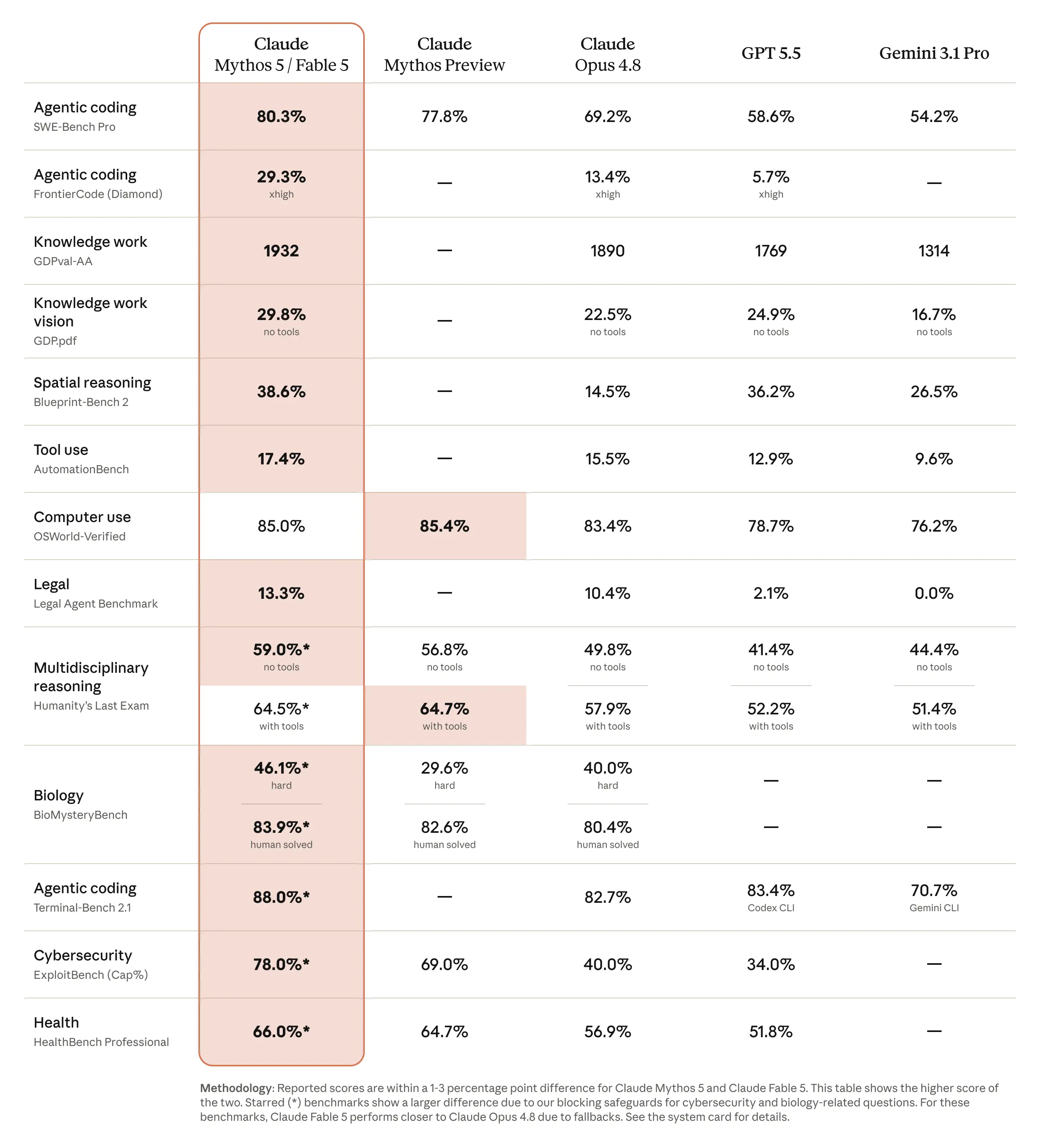
Chart courtesy of Anthropic, 2026.
Anthropic positions Fable 5 as state of the art on nearly all of its tested benchmarks, with the performance gap widening as tasks become longer and more complex.
Software engineering
Fable 5 is designed for long-horizon engineering work rather than short, chat-style assistance. According to Anthropic, Stripe used the model to complete a codebase-wide migration of a 50-million-line Ruby codebase in one day—work that would otherwise have taken a team more than two months. Anthropic also says that Fable 5 leads frontier models on Cognition’s FrontierCode evaluation, even at medium effort, while using tokens more efficiently than prior Claude models.
Knowledge work
Fable 5 boasts the highest score of any model on Hebbia’s finance benchmark for senior-level reasoning, with “substantial gains in document-based reasoning, chart and table interpretation, and problem solving.”
IMC Trading, a global proprietary trading firm and market maker, found Fable 5 especially strong on factual lookup, conceptual reasoning, root-cause analysis, and expected-value analysis in trading scenarios. This indicates that beyond being a coding model, Fable 5 is useful for high-complexity analytical work in finance and enterprise research.
Vision and multimodal work
Fable can extract precise values from detailed scientific figures, reconstruct a web app’s source code from screenshots, and handle multimodal tasks with less scaffolding than previous Claude models required.
In the announcement post for Fable 5, Anthropic demonstrated how, with its enhanced vision, it was able to breeze through Pokémon FireRed with a minimal harness, while other models floundered even with additional support.
Memory and long context
Anthropic says Fable 5 stays focused across millions of tokens and can improve outputs using its own notes in long-running tasks. In the company’s internal testing on the game Slay the Spire, persistent file-based memory improved Fable 5’s performance three times more than it improved Opus 4.8, and Fable reached the game’s final act three times more often.
Data retention, governance, and risk
Claude Fable 5 is not just a more capable model—it’s also a more heavily governed one. As Anthropic regards Mythos-class models as having a higher risk profile than earlier Claude generations, Fable 5 comes with stricter safeguards, fixed retention rules, and clearer limits. This makes governance part of the product itself, not just something teams add on afterward.
Safety classifiers and fallback routing
Fable 5 sits behind a set of safety classifiers that watch for potentially harmful prompts and jailbreak attempts. When the classifiers decide a request is too sensitive—for example, a detailed cyber attack, dangerous biological information, or instructions that “distill” harmful knowledge—Fable 5 does not answer directly.
Instead, those requests are either blocked or routed to Claude Opus 4.8, which is still capable but has a smaller risk profile. According to Anthropic, this fallback should only occasionally trigger, with the safeguards mistakenly reacting to harmless requests in less than 5% of all sessions.
Data retention and auditability
Alongside the model‑level safeguards, Anthropic has changed how it handles logs for Fable 5 and Mythos‑class traffic. For these models, the company now keeps logs for at least 30 days across both its own platform and partner surfaces, even for customers that could previously negotiate shorter retention.
Anthropic says this data is not used to train future Claude models, but instead supports security and safety work, such as spotting complex, multi‑step attacks or reducing false positives from the safety classifiers. The logs themselves are covered by additional access controls and are deleted after the retention window in almost all cases. For regulated teams, this means Fable 5 can be monitored more closely, but it also means data‑handling policies need to account for the fixed 30‑day window.
Pricing and access
Anthropic prices both Claude Fable 5 and Claude Mythos 5 at 10 dollars per million input tokens and 50 dollars per million output tokens. While it says that the pricing is less than half the price of Claude Mythos Preview, it still places Fable 5 firmly in premium territory relative to lower Claude tiers.
Fable 5 is fully available now on the Claude API and consumption-based Enterprise plans like Pro, Max, and Teams. While it’s currently being offered to these plans at no extra cost, after June 23rd, Anthropic will remove Fable and require usage credits instead.
Where should you apply Fable 5?
Fable 5 would likely work best for workflows where higher per-token costs can be offset by higher autonomy, fewer failed attempts, and faster completion on work that would otherwise consume expensive human time.
Some good fits for Fable 5 include:
Large codebase migrations and refactors, where the cost of human engineering time dominates model spend.
Analytics and finance workflows that involve long document chains, charts, tables, and multi-step reasoning.
Document-heavy knowledge work, especially when multimodal interpretation and long context matter.
Agentic workflows that benefit from self-verification and fewer correction turns.
Where cheaper models may be better:
Lightweight drafting and summarization.
Basic support workflows.
High-volume, low-complexity tasks where throughput matters more than peak reasoning quality.
While Fable 5 is the frontier option for hard problems, lower-cost Claude tiers remain a better fit for routine work that doesn’t need Mythos-class reasoning or long-horizon execution.
What Fable 5 means for the future
While Anthropic is cautious about Fable 5 and has gone to lengths to build safeguards, the company is also ultimately optimistic about it, Mythos 5, and the long-term benefits of both models.
“The capabilities of models like Fable 5 and Mythos 5 have the potential to do profound good for the world,” says Anthropic. “We’ve seen the beginnings of this in Project Glasswing, where the models have helped cyber defenders secure critically important software. We’ve also seen it in life sciences research, where the models are…speeding up the development of new therapeutics.”
For organizations looking at Fable 5 right now, the challenge is to turn that potential into something concrete and manageable. Teams need to decide which problems genuinely benefit from Mythos‑level capability, how to keep that use within security and compliance boundaries, and how to tell whether the extra spend is actually delivering better outcomes.
If your team is starting to experiment with Fable 5—or deciding how it should sit alongside the rest of the Claude family—it helps to have a plan. FullStack can work with you to pinpoint the specific workflows where a Mythos‑class model is worth the cost, set clear rules for how and when it’s used, and design the supporting processes, so Fable 5 becomes a dependable part of your production stack rather than an isolated experiment.
Contact us today to book a free consultation to understand where Fable 5 could fit in your business.
Learn more
Frequently Asked Questions
What is Claude Fable 5, and how is it different from Claude Mythos 5?
Claude Fable 5 is Anthropic’s most capable generally available Claude model, built on the same Mythos‑class generation as Claude Mythos 5. Mythos 5 is the less‑restricted configuration, reserved for vetted security, financial, and critical‑infrastructure customers, while Fable 5 is the version designed for broad enterprise use, with stricter guardrails on high‑risk domains like cybersecurity and biology.
What can Claude Fable 5 do better than earlier Claude models?
Fable 5 is optimized for long‑horizon, complex work rather than short chat exchanges. It performs especially well on large‑scale software engineering tasks, analytics, and finance workloads that involve multi‑step reasoning over documents, charts, and tables, and multimodal scenarios where it needs to interpret screenshots or scientific figures. It also maintains focus over very long contexts and can improve its outputs using its own notes in long‑running tasks.
How does Anthropic handle safety and data retention for Fable 5?
Fable 5 runs behind safety classifiers that watch for potentially harmful prompts and jailbreak attempts, and can either block responses or route some requests to Claude Opus 4.8 instead. Anthropic also keeps logs for at least 30 days for Fable 5 and Mythos‑class traffic to support security and safety work, such as detecting complex attacks and reducing false positives from the safety layer, while keeping those logs under stricter access controls.
How much does Claude Fable 5 cost, and how can teams access it?
Anthropic prices both Claude Fable 5 and Claude Mythos 5 at a premium rate per million input and output tokens, placing them above lower Claude tiers. Fable 5 is available through the Claude API and via consumption‑based enterprise plans, and it is also integrated into major cloud and data platforms so teams can reach it through existing environments like AWS, Databricks, and Snowflake.
When should enterprises use Claude Fable 5 instead of cheaper Claude models?
Claude Fable 5 makes the most sense for workloads where higher per‑token costs are offset by better autonomy and faster completion of work that would otherwise require expensive human effort. Typical fits include large codebase migrations, complex financial and analytical workflows, document‑heavy knowledge work with multimodal inputs, and agentic pipelines that benefit from self‑verification. For lighter tasks—such as basic drafting, summarization, and high‑volume, low‑complexity support flows—lower‑cost Claude models are usually a better economic choice.
AI is changing software development.
The Engineer's AI-Enabled Development Handbook is your guide to incorporating AI into development processes for smoother, faster, and smarter development.
Enjoyed the article? Get new content delivered to your inbox.
Subscribe below and stay updated with the latest developer guides and industry insights.
Thank you! Your submission has been received!
Oops! Something went wrong while submitting the form.
We use cookies to provide our services, to allow us to better understand our audience, and to provide and serve personalized ads or content. By using our website, you consent to the terms of our Privacy Policy and our Cookie Policy, and the use of cookies, pixels, and other technology as described more fully therein
The GPC signal has been honored.
Thank you! Your submission has been received!
Oops! Something went wrong while submitting the form.
.svg)