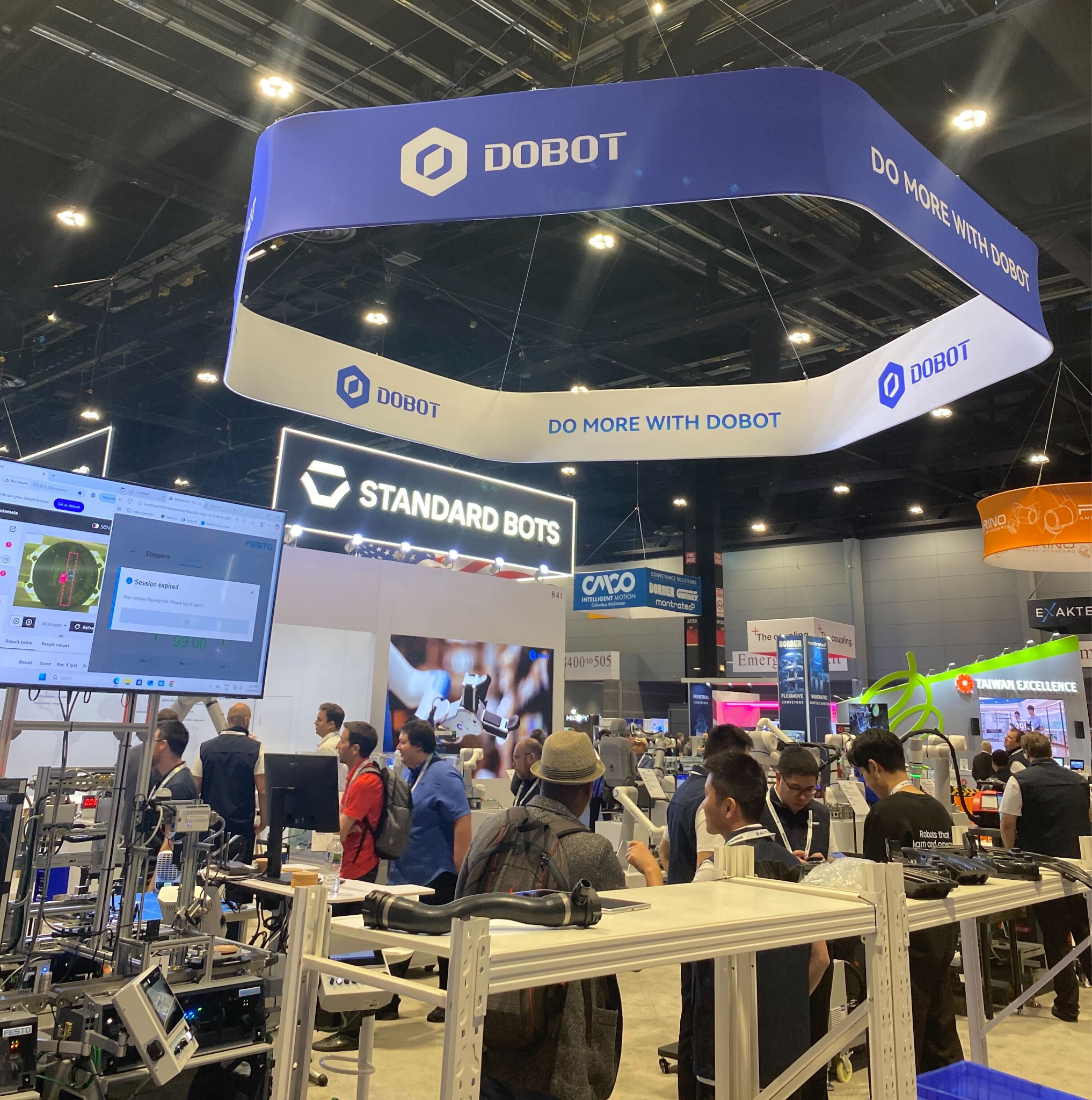
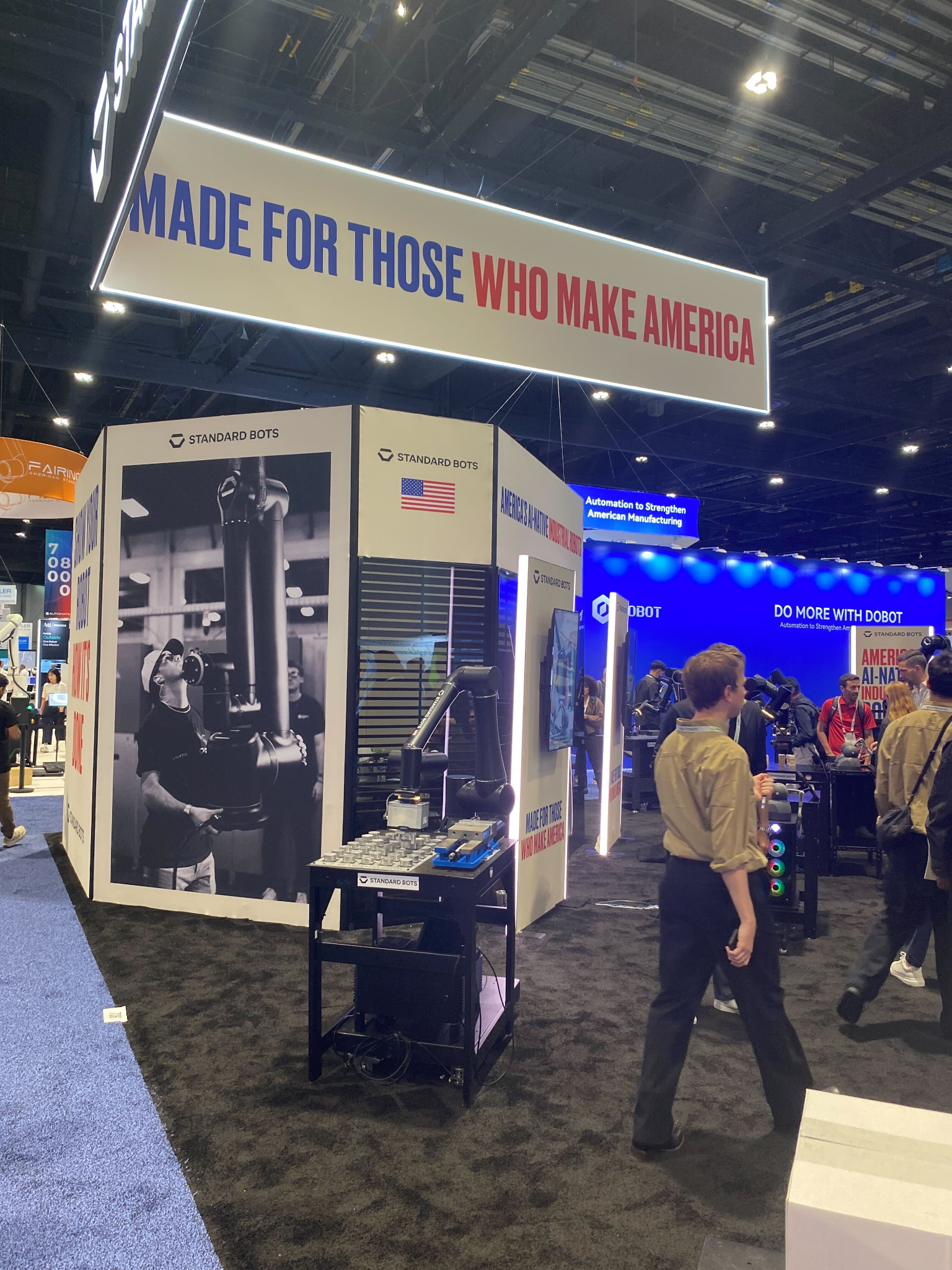
Automate 2026 revealed how industrial AI is being engineered to run on actual factory floors, not just in staged demos.
Automate 2026 took place last week at McCormick Place in Chicago, from June 22nd to the 25th, and showcased a range of robotics, controls, and industrial software across the show floor. FullStack was on-site, sitting in sessions and talking with teams about how AI is being used in real plants.
AI shows up in many familiar areas—agents, digital twins, vision systems, and robots—but most detailed discussions focus on how these systems behave in production: how they connect to equipment, what they depend on for data, and how operators stay involved when something fails or changes.
Industrial AI agents with Yaskawa Motoman
Sarah Andrzejewski from Yaskawa Motoman led two sessions on AI agents in industrial environments. Because Yaskawa ships the cobots and motion systems these agents run on, the sessions stayed close to plant-floor situations rather than abstract diagrams. Topics included how agents coordinate tasks between robots, how they hand off work without introducing new risks, and how they report state and errors in ways operators can use.
Once agents influence motion or routing, they are part of the control stack. They need clear states, defined fallback behavior, and interfaces that let operators understand and override decisions. Engineering work here covers both agent behavior and the surrounding control logic, so the combined system stays within plant constraints.
Digital twins and alignment with the floor
Digital twins were prominent at Automate, with Siemens, ABB, and others showing models of lines and plants. Conversations with Hugo Roquero and Gunter Krenz from Bosch Manufacturing Solutions focused on the gap between what a twin shows and what the floor does on a typical day.
Plants change regularly. Equipment is updated, schedules are adjusted, and processes are tuned. A twin that doesn’t reflect those changes becomes a view of how the plant used to work. Keeping a twin useful requires steady data integration—ingesting signals from controls and historians, normalizing them, and reconciling them against assumptions in the model so the twin stays aligned.
Software-defined automation from Bosch Rexroth
Bosch Rexroth’s ctrlX AUTOMATION and ctrlX OS highlight a move toward software-defined control systems. In discussions with Jon Frey and Holger Lutzler, control logic was presented more like deployable applications than fixed ladder logic. ctrlX OS exposes APIs and supports containerized workloads.
This approach makes it possible to apply familiar software practices to factory controls. Logic can be versioned, changes can be monitored, and interfaces can be secured at the API level. Safety and uptime remain central, but update and observability mechanisms follow patterns that teams already use in other production systems.
OT/IT security with Wibu-Systems and AMDT
Security appeared across the Automate agenda. Marcellus Buchheit of Wibu-Systems spoke about preparing industrial software for the EU Cyber Resilience Act, looking at licensing, IP protection, and secure updates as design topics that need attention early in development. Riley Groves from AMDT, in his “Not on Your Watch” session, focused on operational resilience when plants face active attacks.
Identity, access, logging, update paths, and recovery strategies are described as system-level concerns. They sit alongside control and data decisions and are considered when systems are designed, not only when they are audited.
Vision AI and physical AI at the edge
Teledyne FLIR and Allied Vision sessions in the advanced vision track looked at moving models from lab setups to live production lines. Alex Finkelstein and Matthew Hori described how vibration, changing light, and throughput requirements affect models that performed well in controlled tests. Thermal and infrared imaging are now widely used for inspection and maintenance, but they have to run on embedded hardware under line conditions.
Physical AI and demo-based programming appeared in talks from Marc Fuentes at Eclipse Automation, Chris Matthieu at Intel RealSense, and Josh Leath at Yaskawa. Robots are taught tasks through examples, voice, and vision instead of fully scripted programs. The engineering effort in these projects goes into collecting and structuring data, validating learned behavior, and managing how models move into production, in a way that is similar to other AI product lifecycles.
Open standards and plant data connectivity
Plant connectivity is another steady theme. Yuta Inoue from Nidec DTC talked about drives and motors that now provide data for predictive maintenance and control. Andrew Sollecito from AutomaTech described connecting SCADA, MES, ERP, and IIoT systems that were built at different times by different vendors.
AI efforts in manufacturing rely on those connections. Without well-designed interfaces, schemas, and data pipelines, the information AI systems need remains fragmented across equipment and platforms, and it is harder to train and deploy models that do useful work.
Robots doing more than demos
Automate’s robot booths showed AI in concrete tasks. Boston Dynamics’ Spot ran inspection routes on the Automate floor, coordinated by Orbit, its fleet management software. Atlas has begun shipping units into industrial and research environments. Mech-Mind Robotics demonstrated 3D vision systems that attach to existing arms and let them handle unfamiliar parts. Dobot highlighted Atom-W, where embodied AI watches parts on a line and routes them without each shape being explicitly scripted.
The hardware in these examples is well known. The newer work is in vision, coordination, and the software that ties those capabilities into everyday workflows.
Our takeaway from Automate 2026
Automate 2026 may be over, but the innovation shows no signs of slowing. AI is present across agents, twins, robots, and edge systems. The questions that come up most often are about systems: how these tools connect to the plant, how they use data, how they are observed, and how failure is handled.
FullStack’s teams work on those system questions in AI projects, and it was incredible getting to learn and share with the manufacturers addressing them on the ground. If you’re working through similar issues—moving from a demo to something that fits into your production stack—let’s get in touch to explore your opportunities.
Learn more
Frequently Asked Questions
What is Automate 2026, and why does it matter for industrial AI?
Automate 2026 was a major robotics and automation conference held at McCormick Place in Chicago, featuring vendors and manufacturers across robotics, controls, and industrial software. The 2026 event is a useful lens on industrial AI because it focuses on deployed systems—agents, digital twins, vision models, and robots—rather than only future concepts. For teams building or buying industrial AI, Automate showed how leading companies are integrating AI into existing plants, and which engineering problems still slow down adoption.
How are AI agents being used in industrial automation at Automate 2026?
At Automate 2026, AI agents were discussed in the context of real cobots and motion systems, not just as standalone software. Sessions from Yaskawa Motoman highlighted agents that coordinate tasks between robots, manage handoffs, and expose clear state and error information to operators. Once agents influence motion or routing, they become part of the control stack, which means they need defined states, fallback behavior, and operator-facing interfaces so the overall system remains safe and understandable.
What are manufacturers learning about digital twins from Automate 2026?
Digital twins were widely showcased at Automate 2026 by vendors such as Siemens and ABB, modeling lines and entire plants. The key lesson from in-depth conversations is that a twin’s value depends on its alignment with current operations, not just its visual quality. Plants change frequently—equipment updates, schedule shifts, process tuning—so keeping a twin useful requires ongoing data integration from controls and historians, normalization of signals, and regular reconciliation against the model’s assumptions to avoid drift.
How is software-defined automation changing factory control systems?
Bosch Rexroth’s ctrlX AUTOMATION and ctrlX OS were strong examples of software-defined automation at Automate 2026. Control logic is treated more like deployable applications that run on an open platform, with APIs and containers, rather than fixed ladder diagrams inside proprietary hardware. This makes it easier to apply familiar software practices—versioning, monitoring, and secure interfaces—to factory controls while still respecting safety and uptime requirements, giving engineering teams more flexible ways to update and observe their automation stack.
What role does FullStack play in industrial AI at Automate 2026?
FullStack attended Automate 2026 to see how manufacturers and vendors are tackling system-level questions in industrial AI. Across agents, twins, robots, and edge vision systems, the recurring issues were integration into existing plants, data pipelines, observability, and failure handling. FullStack’s work with manufacturing clients focuses on these layers, helping teams move from promising demos to production-ready AI systems that fit into real control, data, and operations environments.
How to cut your AI coding costs without switching models?
This guide gives you the math, the meaningful benchmarks, and a six-step plan to cut spend without giving up capability.
Enjoyed the article? Get new content delivered to your inbox.
Subscribe below and stay updated with the latest developer guides and industry insights.
Thank you! Your submission has been received!
Oops! Something went wrong while submitting the form.
Iframe is blocked. Accept cookies to load it.
Thank you! Your submission has been received!
Oops! Something went wrong while submitting the form.
We use cookies to provide our services, to allow us to better understand our audience, and to provide and serve personalized ads or content. By using our website, you consent to the terms of our Privacy Policy and our Cookie Policy, and the use of cookies, pixels, and other technology as described more fully therein


.jpg)