The Missing Middle: Why Enterprise AI Programs Die Between Capability and Outcomes
Written by
Yury Trushkov, Chief Technology Delivery Officer
Last updated on:
July 28, 2026
Written by
Last updated on:
July 28, 2026
Most enterprise AI programs can rent model capability and name the outcomes they want. What they lack is the control layer between them: the evals, observability, identity, guardrails, telemetry, kill switches, and attribution needed to make AI work safely in production.
FULLSTACK FIELD NOTES · PART 1 OF 7
I’ve spent the last year inside roughly forty enterprise AI conversations, and the same pattern keeps showing up.
The programs that stall usually don’t do so because the model is bad or the use case is unclear. They stall in the layer between capability and outcome, where no vendor is selling a clean answer, and no enterprise function clearly owns the problem.
That layer is the control layer.
Most companies can now rent AI capability from OpenAI, Anthropic, Google, Nvidia, and the open-source ecosystem. Most companies can also name the outcomes they want: faster support resolution, lower operating cost, better sales conversion, cleaner underwriting, and fewer manual finance processes.
What they cannot yet do reliably is connect the rented capability to the owned outcome in a way that is observable, governed, measurable, reversible, and trusted.
That is why so many AI programs get stuck.
The Conventional AI Stack is Misleading
Most enterprise AI conversations still borrow the old cloud map: infrastructure, platform, application. While that map worked well enough for cloud, it isn’t suited to AI.
In cloud, the platform layer matured into a fairly legible category. You knew what you were buying, which teams owned it, and which vendors lived there. The platform connected infrastructure to applications.
In enterprise AI, that connective layer is still underbuilt.
The things being called “AI platforms” today are often not neutral control layers. Many are application surfaces with AI features added on: Salesforce, ServiceNow, Palantir, and other enterprise platforms can be enormously useful, but they do not eliminate the need for a company-specific control layer. They extend from their existing footholds. They do not give every enterprise a turnkey operating model for AI.
That is the missing middle.
A Better Cut: Capability, Control, Outcomes
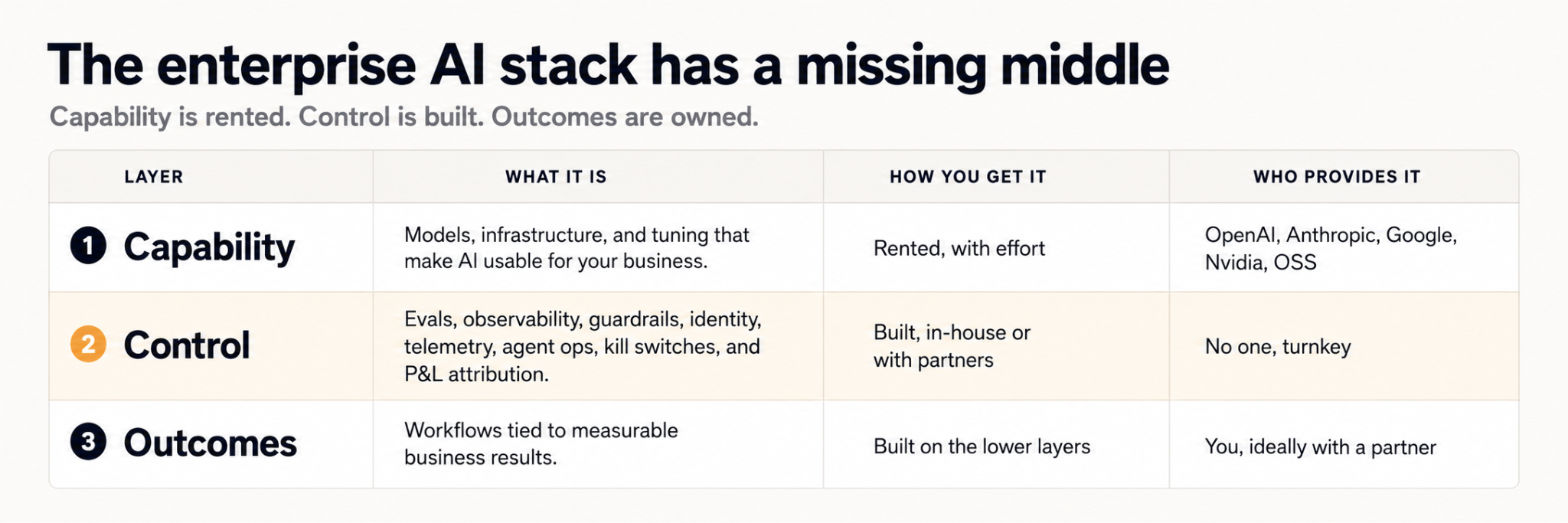
A more useful map has three layers:
Capability is the model layer, plus the work required to make that model usable for your problem. That includes model selection, fine-tuning, RAG, prompts, retrieval, and the surrounding infrastructure. You rent this layer, but renting it well still takes effort.
Control is the operational layer that makes AI safe, measurable, and governable in production. It includes evals, observability, guardrails, identity, telemetry, agent operations, kill switches, and attribution to P&L. This layer is built in-house or with partners. There is no obvious SaaS you can buy your way out of.
Outcomes are the workflows tied to business results. This is where AI touches a P&L line item: a claims process, a customer support motion, a sales workflow, a finance operation, a procurement cycle. You own this layer, ideally with a partner who can help configure and build on top of the layers below.
A simple way to say it:
Capability is rented. Outcomes are owned. Control is built.
And most enterprises do not yet know how much control they need to build.
Why Programs Die at the Control Layer
The graveyard of AI POCs is mostly populated by control-layer failures, not capability failures.
A model gets upgraded, and the workflow quietly starts behaving differently because there is no eval pipeline to catch the drift.
An agent produces a bad answer and escalates it to a customer because there is no observability layer that shows what happened, where it happened, or why.
A multi-agent workflow breaks because one agent calls another system with the wrong permissions, and identity was treated as an implementation detail instead of a core design constraint.
A promising workflow saves time, but nobody can attribute the savings to a line item finance trusts, so the program gets defunded.
Something goes wrong once, but there is no rollback path, no kill switch, and no operating procedure. The organization develops permanent risk aversion.
None of these is a model problem. They are control problems.
This is also why the middle layer is difficult to buy turnkey. The discipline is too new. The implementation is too company-specific. The control requirements depend on your systems, your risk tolerance, your data, your workflows, your users, and your definition of business impact.
The incumbents are moving into pieces of it. Datadog can extend into observability. Okta can extend into identity. ServiceNow can extend into workflow governance. But no single vendor is going to hand you a complete AI control layer that fits your business out of the box.
That is the work.
The Budget Problem
A useful exercise this quarter: take your AI budget and split it across the three layers.
How much is going to capability?
How much is going to outcomes?
How much is going to control?
In many enterprise programs, the split looks roughly 70/25/5 across capability, outcomes, and control. Most of the energy goes into model access, tooling, pilots, and use-case exploration. Very little goes into the connective layer that makes those use cases reliable in production.
The leaders we are seeing in 2026 are moving toward a more balanced model: closer to 35 / 30 / 35 across capability, outcomes, and control. Those numbers are directional, not universal. But the shift matters.
Control-layer investment compounds. The first eval pipeline is hard. The first observability model is hard. The first identity pattern for agents is hard. The first attribution model is hard.
However, once those pieces exist, every future workflow benefits from them.
If you underinvest in control, every new AI use case will pay the same tax again. If you do invest control, and the organization gets faster with every workflow it ships.
The Layer Most Enterprises Have to Build
The capability layer will keep improving. The models will get cheaper, faster, and more capable.
The outcomes layer will keep expanding. Every function will find workflows worth automating, augmenting, or redesigning.
But the control layer is where enterprise AI becomes an operating discipline instead of a sequence of disconnected experiments.
That is the layer most companies are missing. And it is the layer this series is about.
Next, we’ll unpack the first piece of the control layer: evals as the new test suite.
Learn more
Frequently Asked Questions
What is the missing middle in enterprise AI?
The missing middle is the control layer between AI capability and business outcomes. It includes the evals, observability, guardrails, identity, telemetry, agent operations, kill switches, and attribution needed to make production AI safe, measurable, and governable.
Why do enterprise AI programs stall?
Most enterprise AI programs do not stall because the model is incapable or the use case is weak. They stall because the organization cannot reliably connect AI capability to a measurable workflow with enough control, visibility, and accountability to move into production AI.
What is the difference between capability, control, and outcomes?
Capability is the model and infrastructure layer. It is usually rented from providers like OpenAI, Anthropic, Google, Nvidia, or open-source ecosystems. Control is the operating layer that makes AI trustworthy in production. Outcomes are the business workflows tied to revenue, cost savings, quality, cycle time, or customer experience.
Can enterprises buy the control layer from a vendor?
Not turnkey. Vendors can provide pieces of the control layer, such as observability, identity, governance, or workflow tools, but the full control layer is too company-specific to buy off the shelf. Production AI depends on your systems, data, users, workflows, risk tolerance, and P&L priorities.
Why does the control layer matter for production AI?
The control layer is what turns AI from a pilot into an operating discipline. Without it, teams struggle to catch model drift, monitor agent behavior, manage permissions, prove business impact, or roll back workflows when something goes wrong. With it, each new production AI workflow becomes safer, faster, and easier to scale.
How can you cut your AI coding costs without switching models?
This guide gives you the math, the meaningful benchmarks, and a six-step plan to cut spend without giving up capability.
Enjoyed the article? Get new content delivered to your inbox.
Subscribe below and stay updated with the latest developer guides and industry insights.
Thank you! Your submission has been received!
Oops! Something went wrong while submitting the form.
Iframe is blocked. Accept cookies to load it.
Thank you! Your submission has been received!
Oops! Something went wrong while submitting the form.
We use cookies to provide our services, to allow us to better understand our audience, and to provide and serve personalized ads or content. By using our website, you consent to the terms of our Privacy Policy and our Cookie Policy, and the use of cookies, pixels, and other technology as described more fully therein