When teams talk about the cost of hiring, they usually mean employee costs: They think salary, benefits, and possibly recruiting expenses. However, that’s not the only expense.
As an engineering leader, you probably have a morning routine: You wake up, check your phone, and see that notifications are already stacked. Something broke in production, a deadline moved up, and someone just added another initiative to your plate.
Everyone needed something a week ago, and they just told you last night.
None of that is surprising; leadership has always come with a certain level of chaos. What’s new, however, is the added pressure of the AI push.
Suddenly, every product roadmap includes a new model somewhere. Retrieval systems, agents, and evaluation pipelines crop up mid-sprint. Everyone wants “something that uses AI” and only ten percent of them know what they mean by that.
All of it requires engineers who can actually build the thing. The obvious answer is to hire more engineers.
That’s where the trap starts.
The Hidden Cost of Hiring AI Engineers
When teams talk about the cost of hiring, they usually mean employee costs: They think salary, benefits, and possibly recruiting expenses. However, that’s not the only expense. The real cost is what your team didn’t ship while you were busy hiring, adding up to about $40K a month in lost work.
Every AI role you’re hiring for pulls senior engineers away from critical work and into the hiring loop: Reviewing portfolios, designing technical assessments, running interviews, and debating tradeoffs between candidates. None of this is trivial work, and it’s even more technically intensive for AI engineering roles.
Your best evaluators are your best engineers, which means the people you most need shipping products are now spending hours building pipelines instead.
Multiply that across a few open roles and something predictable happens: The backlog piles up, the roadmap slips, and the team loses a few sprints due to the burden of the hiring process.
This yields an unavoidable situation: Time is finite, and your engineers cannot be in two places at once.
The Catch-22
You need more engineers to move faster, but hiring them slows your team down. You can delegate parts of the process, but technical vetting isn’t something you can outsource to someone without engineering context. However, forward-thinking teams are starting to step outside that loop.
Instead of running a full hiring cycle every time they need AI expertise, they’re tapping into outsourced and nearshore networks to augment their teams. It’s an alternative way of working, allowing them to leverage networks of engineers who have already been vetted for the technical skills needed to build, ship, and iterate on real products.
Engineering networks have already done all the up-front work before candidates are ever put in front of a product team. Engineering leaders working with these networks don’t have to spend weeks running a technical hiring pipeline just to get someone capable in the door.
FullStack is one of those networks. Our engineers go through structured technical assessments focused on real-world AI implementation. By the time they join a client team, the core vetting is already done.
The impact is huge: Instead of spending weeks reviewing candidates, teams can bring experienced AI engineers on board in about 48 hours—and get back to the work they were trying to hire for in the first place.
Not every team needs this model. But if your roadmap is already gated by hiring cycles, it’s worth asking: Is recruiting AI engineers really the best use of your team’s time?
Learn more
Frequently Asked Questions
What is the real cost of hiring AI engineers?
The real cost of hiring AI engineers isn’t just salary and recruiting fees—it’s the lost productivity when your best developers stop shipping features to review portfolios, design assessments, and run interviews instead.
How does hiring AI engineers slow down my roadmap?
Hiring AI engineers slows down your roadmap because senior engineers must divert time from building and debugging production systems to screening candidates, leading to backlog growth and slipped sprints.
Why is technical vetting for AI roles so time-consuming?
Technical vetting for AI roles is time-consuming because evaluators need deep context in models, data pipelines, and production AI systems, and that expertise usually sits with your most critical, hard-to-replace engineers.
How can engineering networks reduce the cost of hiring AI engineers?
Engineering networks reduce the cost of hiring AI engineers by doing the heavy lifting up front—running structured technical assessments and background checks—so leaders can bring on proven AI talent quickly without weeks of in-house interviews.
When should I consider outsourced or nearshore AI engineers instead of traditional hiring?
You should consider outsourced or nearshore AI engineers when your roadmap is gated by hiring cycles, your senior developers are overloaded with interviews, or you need AI features in production faster than a full hiring loop will allow.
How to cut your AI coding costs without switching models?
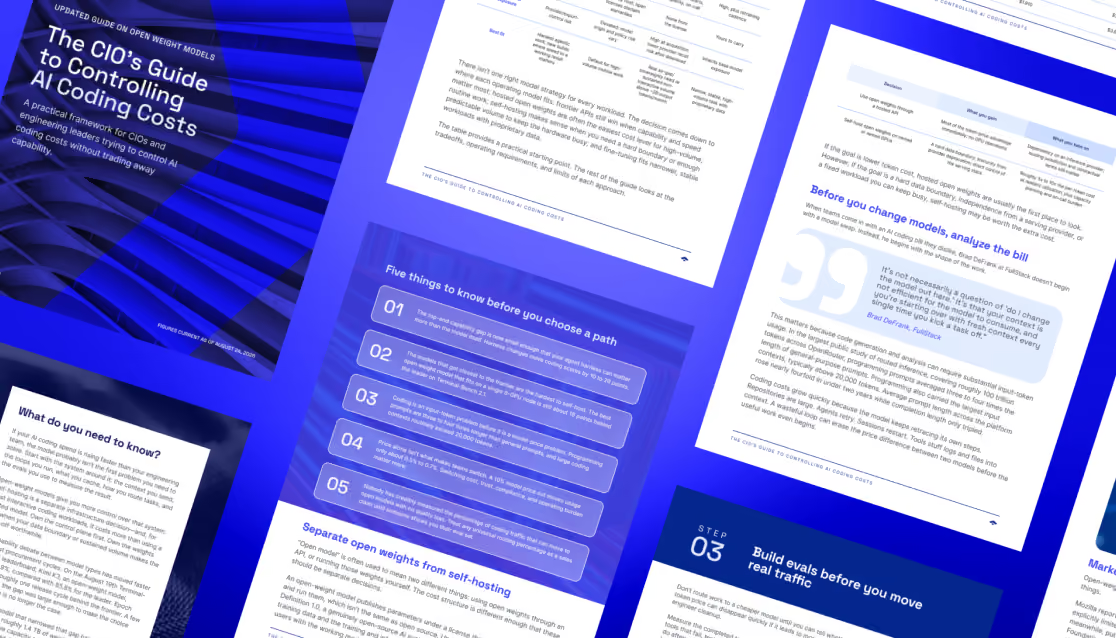
This guide gives you the math, the meaningful benchmarks, and a six-step plan to cut spend without giving up capability.
Enjoyed the article? Get new content delivered to your inbox.
Subscribe below and stay updated with the latest developer guides and industry insights.
Thank you! Your submission has been received!
Oops! Something went wrong while submitting the form.
Iframe is blocked. Accept cookies to load it.
Thank you! Your submission has been received!
Oops! Something went wrong while submitting the form.
We use cookies to provide our services, to allow us to better understand our audience, and to provide and serve personalized ads or content. By using our website, you consent to the terms of our Privacy Policy and our Cookie Policy, and the use of cookies, pixels, and other technology as described more fully therein


.svg)

.png)