The right modernization partner does more than move aging software to the cloud. It helps enterprises preserve critical business logic, reduce risk and build the technical foundation for AI-enabled products.
AI is changing application modernization in two ways: it’s accelerating the work of understanding and transforming legacy systems, while also creating new capabilities that modernized applications can support. AI-assisted code analysis, test generation, documentation, and regression detection can shorten parts of the modernization process, while modern APIs, cloud infrastructure, and cleaner data architectures create a foundation for AI-enabled products and operations.
When evaluating a modernization partner, therefore, look beyond traditional migration expertise and consider whether the team can use AI as part of the engineering process itself—and translate that capability into practical, production-ready systems.
Key Takeaways
Choose architecture expertise over generic cloud credentials. Modernization requires deep experience with monoliths, microservices, and event-driven systems.
Modernize for the business, not just the technology. The right partner balances architecture decisions with business goals, uptime requirements, and regulatory constraints.
Don’t just lift and shift. Moving legacy problems to the cloud doesn’t eliminate them—it can simply make them more expensive.
Bring in engineers who own the outcome. The strongest partners embed with your team, make architectural decisions, and stay accountable through production rollout.
Look for AI-native engineering capability. Modernization teams should be equipped to use AI as part of how software is designed, built, and delivered.
Pick a partner that can stay with you through production. Strategy matters, but modernization succeeds when architectural decisions translate into a working, production-ready system.
What is Application Modernization?
Application modernization means updating and transforming legacy software using modern technologies, cloud infrastructure, and DevOps practices—without necessarily replacing everything. The transformation may include refactoring, rearchitecting, replatforming, or retiring components. Application modernization includes assessment, design, migration, and optimization, and common strategies include lift-and-shift, replatforming, refactoring, and rebuilding.
Legacy application modernization targets systems written in outdated languages, built before current CI/CD practices, or running in on-premises data centers. A COBOL payroll system from the 1990s and an on-prem CRM built in 2005 both qualify. Application reengineering implies bigger changes in behavior or architecture, while mainframe modernization focuses on migrating or decoupling workloads from mainframes to cloud or newer runtimes. These are related but distinct activities.
The spectrum ranges from light-touch changes to deep structural work. Rehosting, also known as the lift-and-shift strategy, moves VMs or containers with minimal code change. Replatforming involves updating applications to run on cloud infrastructure, often with minimal code changes.
Refactoring restructures code—modularizing, adding API layers—while preserving business logic. Rearchitecting materially changes an application’s structure or operating model and may be performed incrementally or through a larger replacement. Application modernization can involve refactoring, replatforming, and rebuilding software applications, but the right approach depends on the system.
The phrase "modernize legacy applications" doesn’t automatically mean rewrite. It can mean encapsulating legacy mainframe logic via APIs, incrementally refactoring high-maintenance modules, or offloading data into modern platforms. API enablement allows legacy applications to communicate with modern systems, and that alone can unlock significant value. Stable, well-behaved components may be left intact if cost-benefit analysis doesn't justify a full replacement.
Why Enterprises Modernize
Enterprises modernize when converging technical risks meet strategic business needs. Performance degradation, recurring outages, inability to support mobile or AI-driven channels, and escalating licensing costs eventually make the status quo more expensive than change. The goal is to improve performance, reduce operational costs, enable analytics and AI capabilities, and support new digital products.
The specific pressures vary, but common triggers include:
End-of-support deadlines for operating systems or middleware arriving in 2027
Rising database licensing and support costs
Inability to launch mobile applications because backends are locked in mainframes or tightly coupled monoliths
Rising security audit findings related to unpatched frameworks, since legacy systems often lack vendor support and stop receiving security patches, making them vulnerable
Legacy systems accumulating technical debt, increasing operational costs and limiting product scalability
Modernization can lower infrastructure and operating costs, but results vary by workload and depend on rightsizing, licensing, architecture, and decommissioning. Cost efficiency is a key benefit of application modernization by reducing long-term maintenance costs.
Modern applications can improve user experience by integrating seamlessly with modern interfaces and devices. Enhanced security is achieved in modern applications by integrating up-to-date security protocols and compliance standards.
There's also the opportunity to embed AI and agentic systems into modernized apps—for example, AI document processing on top of a newly API-ified policy admin system, or intelligent call auditors running on modern cloud environments.
A credible modernization services partner will ask "what business metrics must move?" before proposing a modernization approach. If they lead with technology before understanding business objectives, then it’s best to keep looking.
Common Modernization Approaches
A mature partner uses a portfolio of strategies at the application and component level, not a single approach applied wholesale. Application modernization services assess multi-layer applications for migration, and the right strategy depends on each system's risk profile, change rate, and business value.
Organizations can assess their application portfolios to determine modernization strategies based on risk and business impact. Even retaining unnecessary applications can be a deliberate part of a migration strategy when the cost of change outweighs the benefit.
The main patterns work across a risk-reward spectrum. Rehosting to IaaS delivers quick wins with minimal disruption. Replatforming involves migrating applications with minimal code changes, often shifting to managed databases or container platforms. Refactoring restructures code for maintainability—containerization packages applications and their dependencies to ensure consistent performance across environments.
The strangler-fig pattern, coined by Martin Fowler, intercepts legacy behavior and gradually routes traffic to new services while decommissioning old code.
A blanket "rewrite everything" recommendation is often a red flag. Full rebuilds cost 2–4× more than partial modernization, with timelines stretching 9–18 months and value delivered only at the end. They carry enormous risk: loss of tested business logic, rediscovery costs for undocumented behavior, and threats to business continuity. Technical debt impacts product scalability and performance, but the answer isn't always a clean-room rewrite.
For example, a pricing engine lives on a mainframe and changes frequently for promotions. The first option would be to encapsulate it with APIs, keep the logic intact, route traffic gradually to new services. The second would be to rewrite the engine from scratch in Java or Go, revalidate every business rule. Option A reaches production faster with less risk.
Option B may offer performance improvements but carries the danger of missing subtle logic and delayed delivery. For most revenue-critical systems, incremental approaches win.
Selection Criteria #1: Deep Architecture Experience
Architecture is the single most important capability to evaluate in a modernization partner. Every other decision—cloud platform, data migration tooling, testing strategy—flows from the architectural approach.
Deep architecture experience means hands-on design of large monolith decompositions, event-driven architectures, domain-driven design, and API-first systems across industries. The partner should demonstrate familiarity with the trade-offs between microservices and modular monoliths, synchronous versus asynchronous communication, and single versus multi-cloud infrastructure.
Microservices architecture allows applications to scale independently, improving efficiency and maintainability, but microservices aren't the answer to every problem.
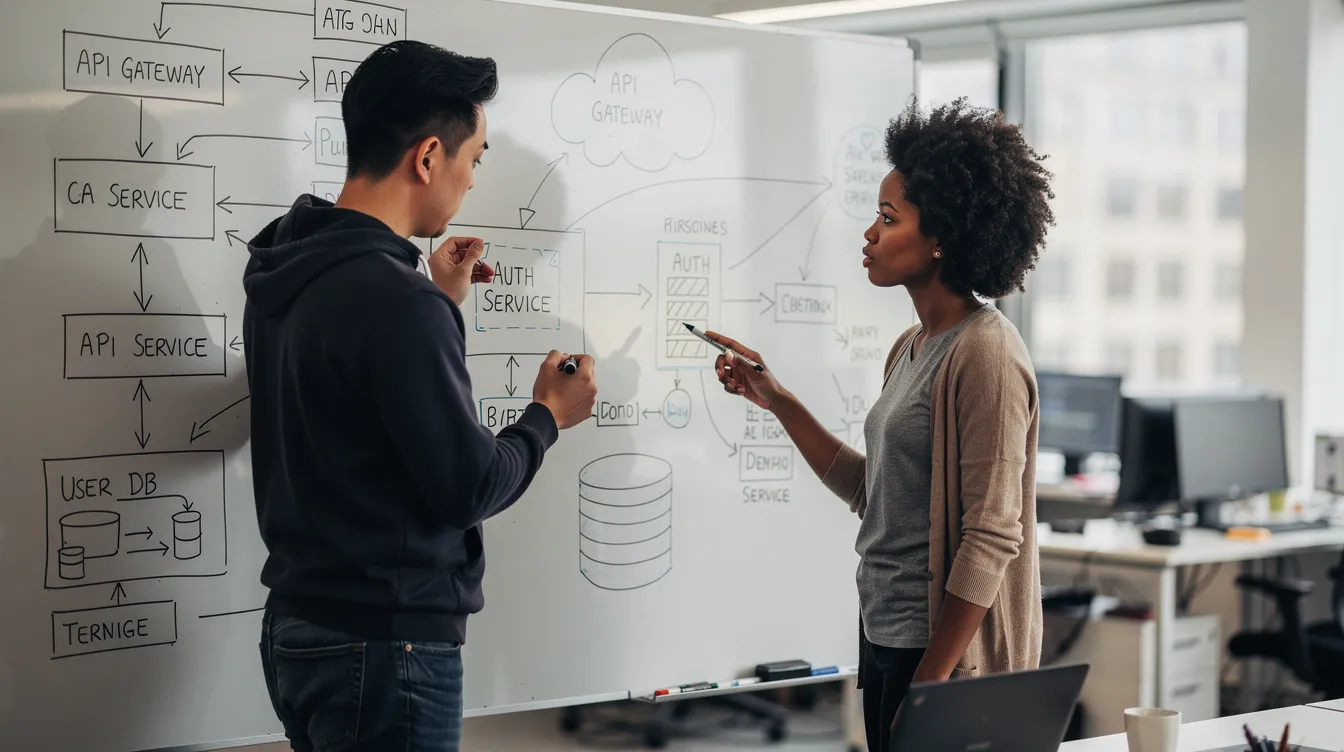
Ask for concrete artifacts: before-and-after architecture diagrams, sequence diagrams, domain boundary definitions, and reference implementations—not only slideware. Look for past clients in regulated industries where architecture decisions had to balance compliance, latency, and scalability.
FullStack's modernization architects embed with client teams, take ownership from architecture design through production rollout, and stay accountable for decisions. They participate in technical decision gating and enforce architecture quality and business alignment throughout the modernization process.
Selection Criteria #2: Cloud and Infrastructure Modernization Capabilities
Cloud infrastructure is the runtime foundation of any enterprise application modernization effort. A partner should have hands-on experience with the cloud platforms and hybrid environments relevant to your current estate and target architecture.
What to look for: experience with managed databases, container platforms like Kubernetes, serverless computing, and IaC tools like Terraform or AWS CloudFormation. Application modernization allows organizations to leverage cloud infrastructure for improved scalability, but the details matter—container sizing, networking, and cost management all affect outcomes.
Cloud networking, security groups, identity integration (Azure AD, Okta), and FinOps practices are essential in large-scale migrations. One documented case achieved a 30% cost reduction after migrating 60+ BSS apps to multi-cloud. Ask partners how many line-of-business apps they've migrated, what downtime windows they typically achieve, and whether they use blue-green or canary deployments to minimize risk.
A forward-looking partner should also understand AI-native infrastructure needs - GPU pools, vector databases, streaming ingestion—if your roadmap includes AI-enabled product engineering. Cloud technology is evolving fast, and your modernization partner's cloud expertise should extend beyond basic migration services to modern cloud environments.
Selection Criteria #3: Data Migration and Integration Capabilities
The data layer is often one of the most technically demanding and failure-prone parts of modernization, not the UI. Schema mismatches, data integrity issues, performance degradation during cutover, and multi-terabyte volumes make data migration the most technically demanding phase of any modernization project.
Demand these data migration capabilities:
Schema evolution planning with versioning and backward compatibility
Data quality checks and validation at every migration stage
Rollback plans for every cutover
Experience with change data capture tools, message buses like Kafka, and cloud-native integration services
Patterns like dual-write, read-only shadows, and phased cutovers
Strong integration capabilities are equally critical. Existing systems need to communicate with new ones during transitional states. APIs facilitate integration with cloud platforms and mobile applications. Well-designed API layers can reduce point-to-point coupling and improve developer productivity, although they introduce governance, security, versioning, and lifecycle requirements of their own. One mainframe modernization project made 70+ new datasets available from a mainframe-based system by building modern data pipelines alongside API facades.
FullStack's data and analytics engineers support both transactional migration and the creation of modern data platforms for BI and AI use cases. Our Databricks migration work demonstrates the kind of hands-on data engineering expertise that modernization projects require.
Selection Criteria #4: DevOps, Automated Testing, and Release Engineering
DevOps maturity determines whether modernization proceeds safely through frequent, low-risk releases or collapses into a "big bang" cutover that threatens business operations. Incremental delivery enables early value realization in modernization projects, but only if the release engineering supports it.
Look for proven CI/CD pipelines, infrastructure as code, and automated quality gates covering unit, integration, contract, and performance testing. Automated CI/CD pipelines speed up the delivery of software updates and new features. Continuous integration practices catch regressions early. Feature flags, synthetic monitoring, and iterative development cycles let teams ship changes to production without disrupting business users.
Automated testing is non-negotiable for legacy modernization. When subject-matter experts are the only reliable source of expected behavior, regression suites and contract tests become the safety net.
FullStack's engineering pods are DevOps-first teams that include QA automation and SRE skills from day one. We work with automation tools and modern software development practices, including GitHub Actions, GitLab CI, and Azure DevOps, to maintain release velocity throughout modernization efforts.
Selection Criteria #5: Security, Compliance, and Risk Management
Modernization heightens security expectations. Outdated systems often harbor hard-coded credentials, weak network isolation, and unpatched frameworks. Moving to modern systems without addressing these gaps just migrates the vulnerabilities to a more visible environment.
Require these security capabilities from any partner:
Secure SDLC with threat modeling integrated into sprint cycles
Static (SAST) and dynamic (DAST) code analysis
Secrets management and zero-trust-aligned architectures
Encryption in transit and at rest, designed from day one
Robust audit logging and least-privilege access
Legacy application assessments identify technical debt and security risks. Assessments evaluate architecture, code quality, and dependencies. A holistic assessment maps technical debt on three levels: code, architecture, and impact. These assessments provide a clear overview of prioritized risks, ensuring that security gaps don't survive the migration.
Relevant regulatory, standards, and assurance experience may include HIPAA, GDPR, PCI DSS, SOC 2, and sector-specific requirements. Approximately 50% of decision makers say security and compliance risks are among the major barriers to modernization initiatives. Ask for anonymized case studies where the partner modernized highly regulated workloads without violations or fines. A partner with specialized expertise in your industry's compliance regime will save months of remediation.
Selection Criteria #6: Legacy Languages, Mainframe Modernization, and API Architecture
Many mission-critical business applications still run on COBOL, RPG, VB6, Classic ASP, or early .NET versions, often on mainframe or Unix hardware. These aren't relics—they process transactions, manage policies, and run payroll for some of the largest enterprises in the world.
Familiarity with these legacy stacks matters because the partner must read and safely refactor old code, interpret batch jobs, and avoid breaking deeply embedded business rules. AWS's mainframe modernization guidance recommends decoupling programs, migrating data and code to containers, and maintaining data stores until cutover.
API architecture capabilities are equally important. Modernized applications expose standardized APIs for better connectivity. APIs facilitate integration with cloud platforms and mobile applications, enabling seamless integration with partner ecosystems. Look for experience designing consistent REST or GraphQL APIs, API gateways, versioning strategies, and rate-limiting.
Legacy app modernization services should bridge old and new: understanding legacy languages while designing future-proof API-first interfaces. For teams working with Microsoft technologies and .NET stacks, the partner should understand both legacy and modern .NET ecosystems.
Selection Criteria #7: Incremental Migration and Business Continuity Focus
A modernization partner's philosophy on risk and continuity is a key differentiator. The safest path to successful modernization is almost always incremental—and vendors who disagree should explain why with specifics, not confidence.
Incremental migration strategies like the strangler-fig pattern, domain-by-domain rollout, and parallel run periods keep critical business processes running while modernization proceeds. Legacy application modernization helps reduce technical debt and improve scalability, but only if the existing app keeps working throughout the transition. Technical debt analysis helps prioritize systems for modernization so that high-risk, high-value modules move first.
Concrete continuity practices to require:
Rollback plans for every release
Shadow systems for validation before cutover
Data synchronization between old and new applications
Clear runbooks for incidents during migration windows
Scheduling cutovers around fiscal closes, seasonal peaks, and regulatory deadlines
Vendors who push "rewrite everything, switch over in 18 months" without a detailed interim-state architecture often underestimate complexity. Strangler-fig approaches deliver first capabilities in 8–14 weeks with bounded risk, while full rebuilds deliver value only at the end of a 9–18 month timeline with minimal disruption only if everything goes perfectly.
FullStack's Forward Deployed Engineers embed with business and operations teams to choreograph cutovers around real-world constraints—not just technical readiness, but organizational readiness.
How AI-Native Engineering Changes Modernization Services
AI, code assistants, and agentic systems are reshaping both how modernization happens and what enterprises modernize toward. This isn't a future trend - it's changing modernization projects right now.
AI tools accelerate the modernization process itself. Code understanding across millions of lines, test generation, regression detection, and documentation of legacy logic can all be AI-assisted. Discovery and documentation phases that once took months now take weeks, with some platforms reporting 4–8× acceleration in discovery-to-build readiness. Modernization reduces technical debt and improves developer productivity, and AI amplifies that effect. One AI-assisted migration of PL/SQL to Java used a multi-agent framework to process approximately 2.5 million lines of code.
Beyond the modernization process, there are opportunities to embed AI agents into modernized applications: intelligent search on policy documents, call auditors for compliance, or agentic assistants for HR and benefits platforms. These capabilities require modern architectures, cloud native infrastructure, and clean APIs - which is exactly what modernization delivers.
A forward-looking partner treats modernization as a bridge to AI-native products and operations, not just an IT modernization cost-reduction exercise. FullStack specializes in AI-augmented legacy modernization, with production examples including AI document processing and call auditing systems built on modern cloud infrastructure. Our AI-native workflows have cut modernization time by 30%+ on real enterprise engagements.
How FullStack Engages: Our Legacy Application Modernization Services
FullStack is an engineering-as-a-service partner providing modernization architects and nearshore engineering pods. Our model is built around accountability: architects and engineers embed with your team and stay through production, not just through discovery.
Our engagement follows a concrete modernization process:
Discovery and architecture assessment: Architecture reviews, technical debt assessment, cloud readiness evaluation, and alignment with business objectives and KPIs. This phase maps modernization priorities and identifies quick wins.
Pilot project: A bounded first module—often delivered in 8–14 weeks—that validates the architecture, tooling, and team dynamics before scaling.
Incremental rollout: Domain-by-domain migration with parallel runs, rollback plans, and continuous testing against both existing systems and modern platforms.
Long-term optimization: Performance tuning, cost optimization, and readiness for AI and agentic use cases as the digital transformation journey continues.
Cross-functional teams—architect, backend, frontend, DevOps, QA, and data engineer—deploy in as little as 48 hours via the FullStack Connect platform. Our focus is on measurable outcomes: improved performance, reduced incident rates, faster release cycles, and readiness for revenue growth through AI-enabled business capabilities. Application modernization consulting from FullStack covers enterprise application modernization end-to-end, from legacy apps to modern applications running in hybrid cloud environments.
Application modernization is the process of updating and transforming legacy software using modern technologies, cloud infrastructure, and DevOps practices. It can include rehosting, replatforming, refactoring, rearchitecting, rebuilding, or retiring components, depending on the application's business value and technical condition.
How do I choose an application modernization partner?
Look for a partner with hands-on experience across architecture, cloud infrastructure, data migration, DevOps, security, legacy technologies, and incremental migration. Evaluate concrete evidence such as architecture diagrams, reference implementations, relevant case studies, and experience with systems similar to yours—not just generic cloud migration credentials.
Should I rewrite or incrementally modernize a legacy application?
It depends on the application's architecture, business value, risk profile, and technical debt. Incremental approaches such as refactoring, replatforming, API enablement, and the strangler-fig pattern can reduce disruption while preserving existing business logic. A full rewrite may make sense in some cases, but it should not be the default recommendation.
What are the most important capabilities to look for in a modernization partner?
Key capabilities include deep architecture expertise, cloud and infrastructure modernization, data migration and integration, DevOps and automated testing, security and compliance, legacy-language expertise, API architecture, and incremental migration with strong business-continuity practices.
How long does application modernization take?
Timelines vary significantly by application complexity, modernization strategy, and business requirements. The post describes bounded pilot projects that can be delivered in 8–14 weeks, while full application rebuilds can take 9–18 months before delivering value. Incremental modernization can deliver usable capabilities earlier while the broader transformation continues.
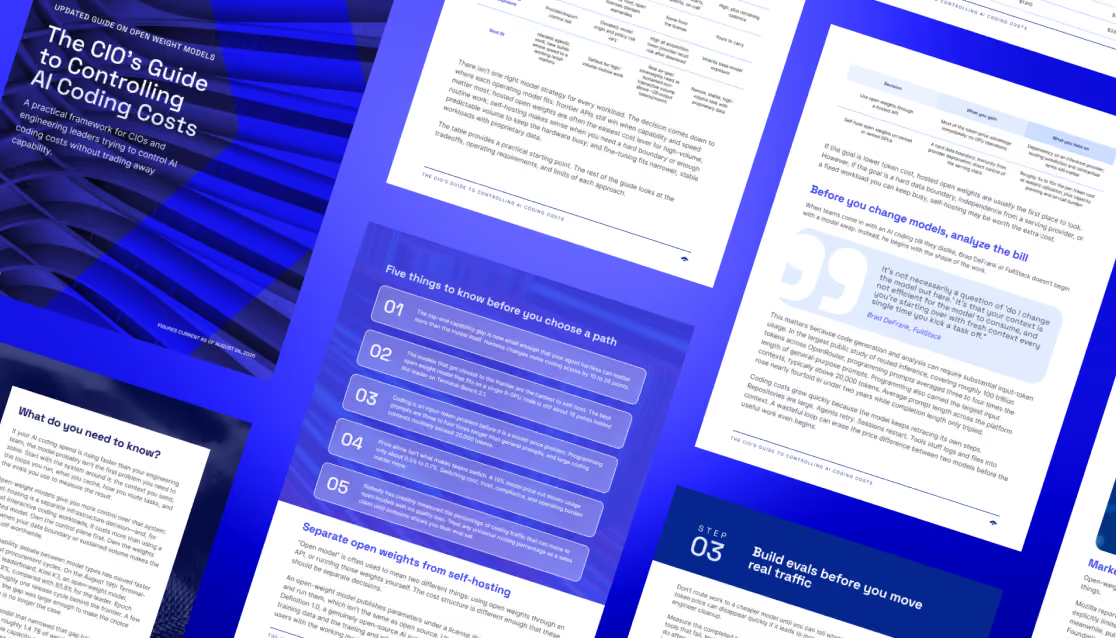
How to cut your AI coding costs without switching models?
This guide gives you the math, the meaningful benchmarks, and a six-step plan to cut spend without giving up capability.
Enjoyed the article? Get new content delivered to your inbox.
Subscribe below and stay updated with the latest developer guides and industry insights.
Thank you! Your submission has been received!
Oops! Something went wrong while submitting the form.
Iframe is blocked. Accept cookies to load it.
Thank you! Your submission has been received!
Oops! Something went wrong while submitting the form.
We use cookies to provide our services, to allow us to better understand our audience, and to provide and serve personalized ads or content. By using our website, you consent to the terms of our Privacy Policy and our Cookie Policy, and the use of cookies, pixels, and other technology as described more fully therein


.svg)







.jpg)