Anthropic’s Claude Fable 5.1 arrives with stronger long-running coding and research performance, lower cache-read costs, and updated safeguards for enterprises building AI agents.
Anthropic’s Claude Fable 5.1 brings a set of practical updates to the company’s frontier model lineup: stronger long-running coding and research performance, less expensive prompt caching, and more targeted safeguards for cybersecurity and life-sciences work. Released on September 1st, 2026, alongside Claude Mythos 5.1, the update is aimed at organizations building AI agents and other applications that need to hold context, use tools, and work through complex tasks over multiple steps.
Fable 5.1 is Anthropic’s generally available configuration, while Mythos 5.1 is available through trusted-access programs for eligible cybersecurity and life-sciences organizations. The two models are the same underlying system, but Anthropic applies different safeguards and access requirements to each.
What Are Claude Fable 5.1 and Mythos 5.1?
Claude Fable 5.1 is Anthropic’s most capable generally available model. It supports a 1 million-token context window, can generate up to 128,000 output tokens, and uses adaptive thinking for demanding reasoning and long-horizon agentic work. Anthropic positions Claude Opus 5 as its starting point for most workloads and Fable 5.1 as the option for teams whose evaluations require a higher level of performance.
The model is intended for complex software engineering, codebase research, multi-step automation, document-heavy analysis, and AI agents that need to retain context, use tools, evaluate results, and work through a task across multiple steps.
Claude Fable 5.1 is an update aimed at making Anthropic’s frontier-model capabilities more useful in real working environments. The release focuses on situations where AI needs to handle a complex task over many steps, such as investigating a bug across a large codebase, assembling a research brief from lengthy source material, navigating a computer interface, or carrying out a structured business workflow.
Anthropic reports improvements in agentic coding, research and knowledge work, computer use, and workflow automation. The company also reduced prompt-cache read pricing, which can make long-running applications more economical when they repeatedly rely on the same context.
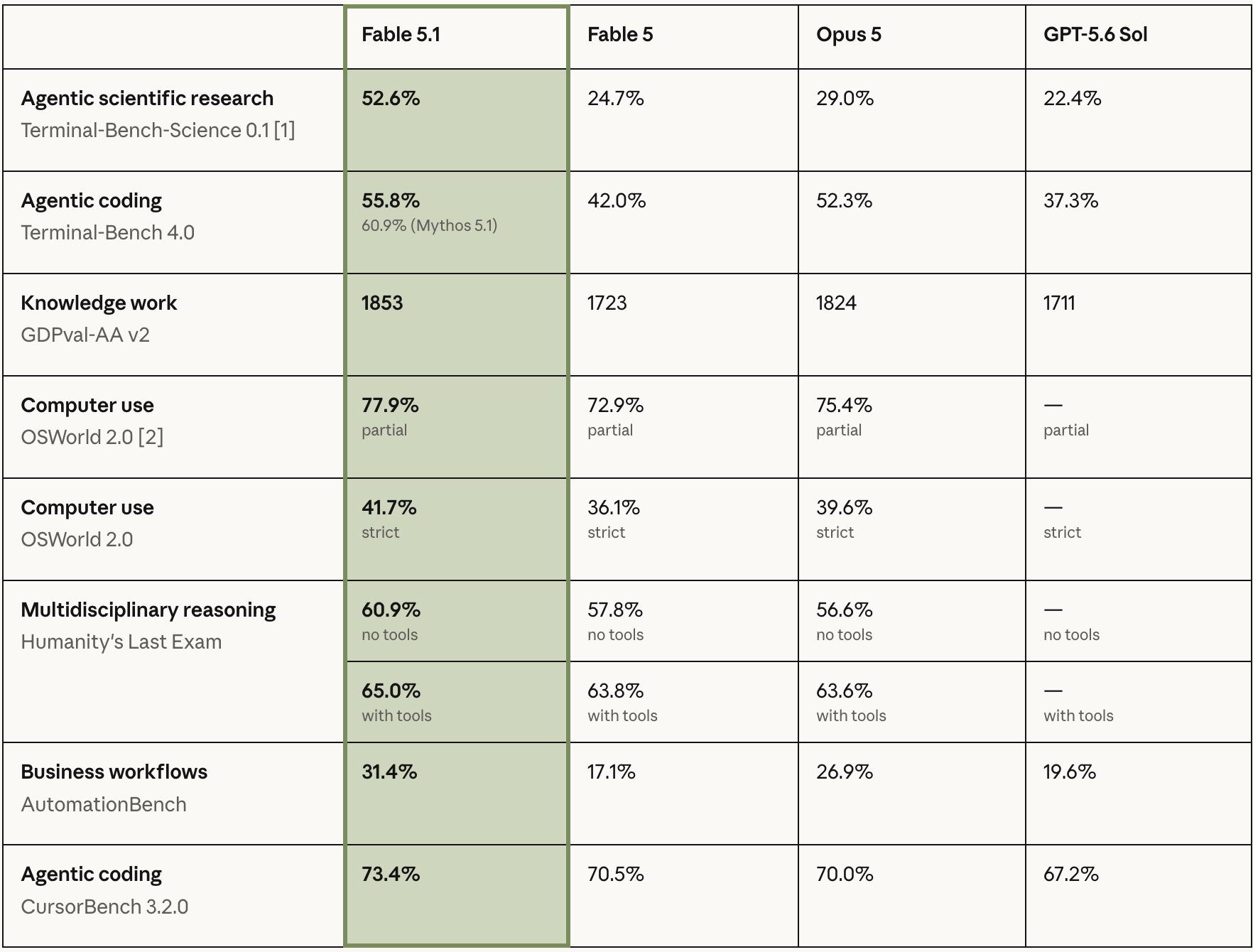
The following figures show Anthropic’s reported progress compared with Fable 5. They’re useful for evaluating the direction of the release, but enterprises should also test Fable 5.1 against their own codebases, internal documentation, systems, tools, workflows, and quality requirements before deploying it to production.
Fable 5.1 scored 55.8% on Terminal-Bench 4.0, compared with 42.0% for Fable 5, on agentic coding tasks.
It scored 52.6% on Terminal-Bench-Science 0.1, compared with 24.7% for Fable 5, on agentic scientific research.
It scored 1853 on GDPval-AA v2, compared with 1723 for Fable 5 and 1824 for Opus 5, on professional knowledge work.
It reached 77.9% on OSWorld 2.0's partial computer-use evaluation, compared with 72.9% for Fable 5 and 75.4% for Opus 5.
It scored 31.4% on AutomationBench, compared with 17.1% for Fable 5 and 26.9% for Opus 5, on end-to-end business workflows.
Taken together, the results suggest that Fable 5.1 is designed for workflows where a model must maintain context and work through a problem instead of simply generating a one-time answer. For enterprise teams, that capability is most relevant to complex software development, document-heavy research, and AI agents that reuse the same information as they plan, execute, test, and refine their work.
Better Long-Horizon Coding
Fable 5.1 is designed for engineering work that involves more than generating a code snippet or answering a developer question. Anthropic highlights improvements in root-cause analysis, codebase exploration, multi-step planning, tool use, test execution, verification, and iterative revision.
These capabilities could support engineering workflows such as:
Diagnosing CI/CD failures and broken builds
Investigating complex production issues
Mapping dependencies across large applications
Preparing proposed code changes across multiple repositories
Writing and improving test suites
Modernizing legacy systems in controlled phases
Reviewing pull requests for implementation risks
Drafting technical documentation from approved sources
Anthropic cited several early-access examples. Millennium reported that Fable 5.1 identified the cause of a rare crash in an external vendor library after previous investigations had failed to isolate the issue. Anthropic says the model disassembled the library, compared it with a core dump, and identified a library bug.
MongoDB reported that Fable 5.1 researched code and documentation across services, designed a prototype, and ran verification loops for hours while implementing the work. Red Hat reported that the model correctly identified the root cause of every broken build it tested. These are customer-reported results rather than independent performance guarantees, but they illustrate the type of extended engineering work Anthropic expects Fable 5.1 to handle.
Development teams should treat Fable 5.1 as an increasingly capable collaborator rather than an autonomous production engineer. Engineers should remain responsible for architecture, code review, test validation, security review, and release approval.
Research and Knowledge Work
Anthropic also positions Fable 5.1 as a high-end model for document-heavy research, analysis, and professional knowledge work. Its GDPval-AA v2 score suggests that the model is intended to handle complex source material, multi-part assignments, structured deliverables, and reasoning over business information.
Potential enterprise applications include:
Financial research and due diligence
Contract analysis and legal operations
Regulatory and policy review
Enterprise search and knowledge management
Competitive intelligence
Product and market research
Technical research and architecture analysis
Operations analysis and process documentation
Financial research company Samaya reported that Fable 5.1 scored 55.9% on its FrontierFinance benchmark, compared with 49.2% for Fable 5. Samaya said the model’s improved use of primary-source materials, including earnings-call transcripts, contributed to the result.
A research assistant built with Fable 5.1 can help teams gather evidence, structure findings, compare documents, identify open questions, and prepare a first draft. Human reviewers should continue to validate sources and conclusions, particularly for work that informs financial, legal, regulatory, medical, security, or operational decisions.
Lower Cost for Cached Context
Claude Fable 5.1 has the same base list price as Fable 5: $10 per million input tokens and $50 per million output tokens. Anthropic reduced prompt-cache read pricing to $0.25 per million tokens.
According to Anthropic, the cache-read price is 75% lower than Fable 5’s rate. The company estimates that the reduction can lower total costs by about 25% for typical workloads and up to 45% for highly agentic or coding-heavy workflows.
Prompt caching is useful when an application repeatedly works with a large set of shared context. A software agent may need continued access to architecture documentation, repository maps, coding standards, source files, tool definitions, prior analysis, and test results throughout a task.
When that information is cached, the application can reuse it at a lower rate rather than paying to process the complete context on every turn. This can make extended, iterative workflows more viable, particularly when an agent must investigate an issue, propose a change, run tests, interpret the results, and revise its approach.
Fable 5.1 remains a premium model, so pricing should be assessed at the workflow level. Teams should account for token usage, response length, cache-hit rate, latency, the time required for human review, and the business cost of an incorrect or incomplete outcome.
Updated Cybersecurity Safeguards
Anthropic says Fable 5.1 can now help identify vulnerabilities in source code. This capability can support authorized defensive security work, including secure code review, vulnerability triage, remediation planning, application-security analysis, threat modeling, and security documentation.
The model continues to restrict or redirect more sensitive cyber requests, however. Anthropic lists penetration testing, exploit generation, binary-based vulnerability scanning, and other potentially dual-use activities among the areas that remain subject to safeguards.
Anthropic also adds that the updated controls result in approximately 60% fewer interventions per Claude Code session than the safeguards used with Fable 5.
Security teams should still establish their own operating boundaries. A deployment should define authorized activities, limit permissions, isolate sensitive testing in controlled environments, maintain activity logs, and require human approval for changes that could affect production systems, customer data, or external infrastructure.
Biology and Life Sciences Access
Anthropic says Fable 5.1’s safeguards intervene 85% less often on benign elementary biology and medical questions than the earlier Fable 5 safeguard system.
The company continues to direct professional biology and drug-development research requests to Opus-class models when those requests fall outside the scope of Fable 5.1’s general-access safeguards. It’s also worth noting that Anthropic offers broader access to vetted professionals through the Life Sciences Verification Program and Claude Mythos 5.1.
Organizations in healthcare, biotechnology, pharmaceuticals, medical technology, and life sciences should assess AI use cases at the workflow level. An internal knowledge assistant, a general medical-information tool, a customer-support workflow, and a research-and-development agent each create different requirements for privacy, evaluation, expert oversight, and regulatory review.
What Are Enterprise Frontier Safeguards?
Anthropic introduced Enterprise Frontier Safeguards, or EFS, as part of the Fable 5.1 release. By default, Anthropic says Fable 5.1 retains activity data for 30 days to support safety monitoring and detect potential misuse patterns. The company says this information is not used to train its models.
EFS is designed to give eligible organizations privacy equivalent to a zero-data-retention policy, according to Anthropic, while still allowing state-of-the-art misuse detection. Under the program, customers store safety-monitoring data in cloud infrastructure they control rather than on Anthropic's systems, using their own encryption keys, access policies, and audit logs. Automated monitoring can flag potential misuse signals to the customer, and by default, any human review of those signals is handled by the customer rather than Anthropic.
Anthropic says EFS was developed with more than 100 organizations across sectors including financial services, healthcare, manufacturing, telecommunications, law, retail, and the public sector. The company says AWS, Google Cloud, and Microsoft Azure also participated in its development.
The program is expected to support Claude Code, Claude Enterprise, the Claude Platform, Amazon Bedrock, Claude Platform on AWS, Google’s Agent Platform, and Microsoft Foundry. Anthropic says it will roll EFS out in phases beginning in fall 2026, and eligible customers can use Fable 5 and Fable 5.1 with zero data retention until EFS is available.
Organizations should verify which retention terms, cloud environments, storage costs, encryption controls, contract provisions, and availability conditions apply to their own deployment before relying on EFS for a regulated or sensitive workload.
Pricing, Availability, and API Considerations
Claude Fable 5.1 is available through Anthropic’s API, Amazon Bedrock, Claude Platform on AWS, Google Cloud, and Microsoft Foundry. Anthropic lists pricing at $10 per million input tokens, $50 per million output tokens, and $0.25 per million prompt-cache read tokens.
Claude Mythos 5.1 uses the same base pricing, but it is not generally available. Anthropic limits access to eligible organizations through its trusted-access programs and says its initial access includes a set of US organizations.
Organizations already using Claude should test Fable 5.1 against their existing workflows before moving it into production. Model upgrades can affect output quality, latency, tool-use behavior, prompting patterns, and the way an agent handles long-running tasks. A staged evaluation helps teams identify where Fable 5.1 delivers enough improvement to justify the change.
Fable 5.1 also introduces a security-motivated change to how it handles preserved thinking blocks in multi-turn conversations. Anthropic says new API accounts can no longer manually edit Claude's prior context in a conversation while preserving the transcript of its earlier thinking—a change designed specifically to close off a publicly documented technique used for distilling Claude's capabilities into other models. While existing accounts aren't affected yet, Anthropic says the restriction will apply to all users with future model releases.
These details are particularly relevant for teams building complex agents that dynamically change tools, system instructions, context, or model settings during a workflow. Migration testing should cover prompt handling, cached context, tool orchestration, error behavior, retries, model fallback, and conversation-state management.
Where Does Fable 5.1 Fit?
Claude Fable 5.1 is most suitable for high-value tasks where stronger reasoning and extended agent execution can reduce costly manual effort or improve the likelihood of reaching a correct result.
Potential enterprise use cases include:
Multi-repository engineering work and legacy modernization
Complex bug investigation and incident analysis
Build, test, and deployment-failure diagnosis
Secure development workflows and source-code vulnerability review
Research over long technical, financial, legal, or regulated documents
Due diligence and financial-document analysis
Contract analysis, policy comparison, and regulatory review
Internal workflow agents with carefully scoped access
Supervised agents that plan, execute, test, and report on multi-step work
Anthropic recommends starting with Claude Opus 5 for most workloads, then evaluating Fable 5.1 when a task requires more demanding reasoning or longer-horizon agentic behavior.
A practical deployment strategy is to route workloads by complexity. Lower-cost models can handle routine drafting, classification, extraction, and simple support tasks. Opus 5 can cover many advanced reasoning and coding workflows. Fable 5.1 can be reserved for work where internal evaluations show that the higher-capability model delivers a meaningful improvement in quality, reliability, or time savings.
Building AI Systems With FullStack
Claude Fable 5.1 gives organizations new options for building advanced coding assistants, research systems, secure development workflows, and enterprise agents. However, the value of the model depends on the system around it: data quality, workflow design, tool permissions, testing, human review, security controls, and governance.
FullStack helps organizations evaluate frontier models, identify high-value AI use cases, build custom AI-powered software, and create the technical and governance foundations required for production AI deployments.
Whether you’re developing an AI-enabled product, an internal knowledge system, a document-intelligence workflow, an engineering copilot, or a controlled enterprise agent, FullStack can help you define the right approach and move from experimentation to implementation.
Claude Fable 5.1 is Anthropic’s generally available frontier AI model for demanding coding, knowledge-work, research, and long-running agentic tasks. It is designed for workflows where an AI system needs to work with extensive context, use tools, plan and complete multiple steps, and verify its output before returning results for human review. Anthropic released Fable 5.1 on September 1, 2026, alongside Claude Mythos 5.1.
How much does Claude Fable 5.1 cost?
Anthropic lists Claude Fable 5.1 at $10 per million input tokens and $50 per million output tokens. Prompt-cache reads cost $0.25 per million tokens, which Anthropic says is 75% less than Fable 5’s prior cache-read price. Anthropic estimates the lower rate reduces total cost by about 25% for typical token-billed workloads and by up to about 45% for highly agentic or coding-intensive workflows.
What is the difference between Claude Fable 5.1 and Claude Mythos 5.1?
Claude Fable 5.1 and Claude Mythos 5.1 are the same underlying model with different safeguard configurations. Fable 5.1 is broadly available and includes cybersecurity and biology safeguards. Mythos 5.1 is available only to vetted organizations through Anthropic’s trusted-access programs, where its more permissive safeguards are intended to support approved cybersecurity and life-sciences work.
Can businesses use Claude Fable 5.1 for cybersecurity work?
Yes, within Anthropic’s safeguards. Fable 5.1 can help identify software vulnerabilities and support defensive security work such as source-code review, vulnerability triage, remediation planning, and application-security analysis. Anthropic says it continues to redirect requests involving penetration testing, exploit generation, and binary-based vulnerability scanning to its Opus models. The company also says its updated cyber safeguards lead to around 60% fewer interventions per Claude Code session than the safeguards used with Fable 5.
Is Claude Fable 5.1 available with zero data retention?
Eligible customers can use Claude Fable 5.1 with zero data retention while Anthropic rolls out Enterprise Frontier Safeguards, or EFS, in phases. Anthropic says EFS will provide privacy equivalent to a zero-data-retention policy by keeping monitoring data in infrastructure controlled by the customer, rather than on Anthropic’s systems. The company says EFS will support Claude Code, Claude Enterprise, the Claude Platform, Amazon Bedrock, Claude Platform on AWS, Google’s Agent Platform, and Microsoft Foundry.
AI is changing software development.
The Engineer's AI-Enabled Development Handbook is your guide to incorporating AI into development processes for smoother, faster, and smarter development.
Enjoyed the article? Get new content delivered to your inbox.
Subscribe below and stay updated with the latest developer guides and industry insights.
Thank you! Your submission has been received!
Oops! Something went wrong while submitting the form.
We use cookies to provide our services, to allow us to better understand our audience, and to provide and serve personalized ads or content. By using our website, you consent to the terms of our Privacy Policy and our Cookie Policy, and the use of cookies, pixels, and other technology as described more fully therein
The GPC signal has been honored.
Thank you! Your submission has been received!
Oops! Something went wrong while submitting the form.
.svg)