Grok 4.5 is xAI’s latest model for software engineering, agents, and long‑form analysis, aimed at teams weighing Claude, GPT, and cost. Here's what you need to know.
Grok was first known as “the chatbot on X,” built to answer questions using recent activity on the platform. With the 4.5 release, xAI is presenting Grok as a broader system for coding, agent workflows, and knowledge‑heavy tasks, not just for conversational use.
SpaceXAI announced Grok 4.5 on July 8th, 2026 as its most capable model so far, with a clear focus on coding, agents, and knowledge work. It runs on a new large-scale foundation model, incorporates data from real developer activity, and is being positioned as a model teams can use inside tools and systems they already rely on.
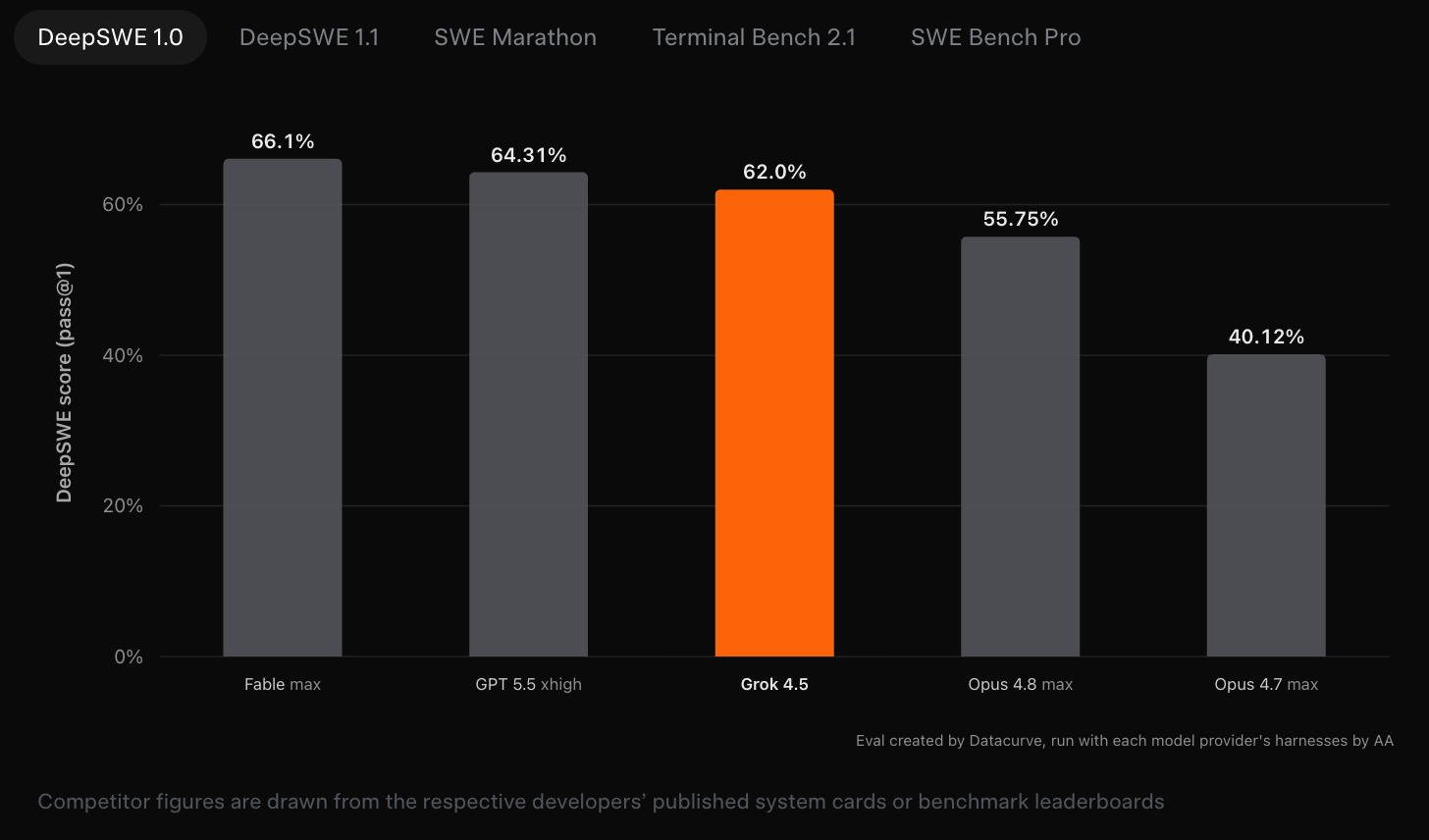
In his launch posts on X, Elon Musk, CEO of SpaceXAI, described Grok 4.5 as “roughly comparable to Opus 4.7, but much faster” and “more token-efficient and lower cost," framing it as a potential competitor to Anthropic’s Claude models.
Update, August 2026:xAI has since released Grok 4.6, which builds on Grok 4.5 with an emphasis on long-running agents, visual and interactive projects, and multi-step execution. This article continues to focus on Grok 4.5, with 4.6 included as the latest step in the model’s evolution.
What is Grok 4.5?
Grok 4.5 is one of xAI’s recent large language models, designed to run inside tools and systems that handle code and long documents. It emphasizes long‑context reasoning, tool use, and stable behavior over real repositories and internal knowledge sources.
In practice, that means it can read and modify large repositories, coordinate multi‑step plans through tools or APIs, and work over long runs of emails, PDFs, or internal documents without losing track of details or constraints.
A quick history of Grok
The first iteration of Grok was launched on November 23rd, 2023, as the model behind an X-based chatbot built to answer questions using recent activity on the platform. In its early days, Grok was mostly treated as a novelty on X, not as something teams would evaluate for production use.
Over the following releases, xAI increased Grok’s capability for reasoning, coding, and longer-context tasks. By mid‑2025, with the launch of Grok 4, xAI was positioning Grok as a frontier‑class model intended to compete with systems from OpenAI and Anthropic, even though most usage still centered on chat-style interfaces.
In late June 2026, Elon Musk said Grok 4.5 had entered private testing at SpaceX and Tesla, focused on internal workflows and coding-heavy tasks. Its public release in early July marked the next step in that evolution: Grok 4.5 was introduced as a model aimed at coding, agents, and knowledge work, rather than conversational use alone.
In August 2026, xAI released Grok 4.6, extending that focus to long-running agents and more ambitious interactive and visual work. According to xAI, the model is designed to sustain complex tasks across many steps—from researching and analyzing information to working across a codebase or turning a product idea into a functioning application. It is available through the API, Cursor, Grok Build, and partners including OpenRouter, Vercel, and Cloudflare.
Model and training
According to xAI, Grok 4.5 was trained across tens of thousands of NVIDIA GB300 GPUs, using training and stability techniques designed for large‑scale runs. xAI also says it used data filtering and curation—deduplication, quality scoring, and domain‑focused selection—to improve the overall quality of its training data, rather than relying solely on volume.
On top of that base training, xAI scaled reinforcement learning with a focus on “per‑token intelligence,” covering hundreds of thousands of tasks centered on multi‑step software engineering and other technical work. These RL runs use automated and model‑based grading and are set up for asynchronous training, so agentic rollouts can run for many hours while learning continues across the GPU fleet.
xAI aims to make Grok 4.5 better at reasoning through real engineering and agentic tasks, rather than optimizing only for general chat.
Capabilities and use cases
Software engineering
Software engineering is the clearest part of Grok 4.5's pitch. According to xAI, the model is built to excel at coding, and launch coverage consistently highlights code generation, editing, and multi-step engineering work.
Grok 4.5 is positioned for work across multiple files, longer repository context, and more complex engineering tasks such as refactors, migrations, and code review support. If those claims hold up in practice, Grok 4.5 could be useful in places where teams need a model that can follow the structure of a real codebase rather than generate isolated snippets.
Agentic work
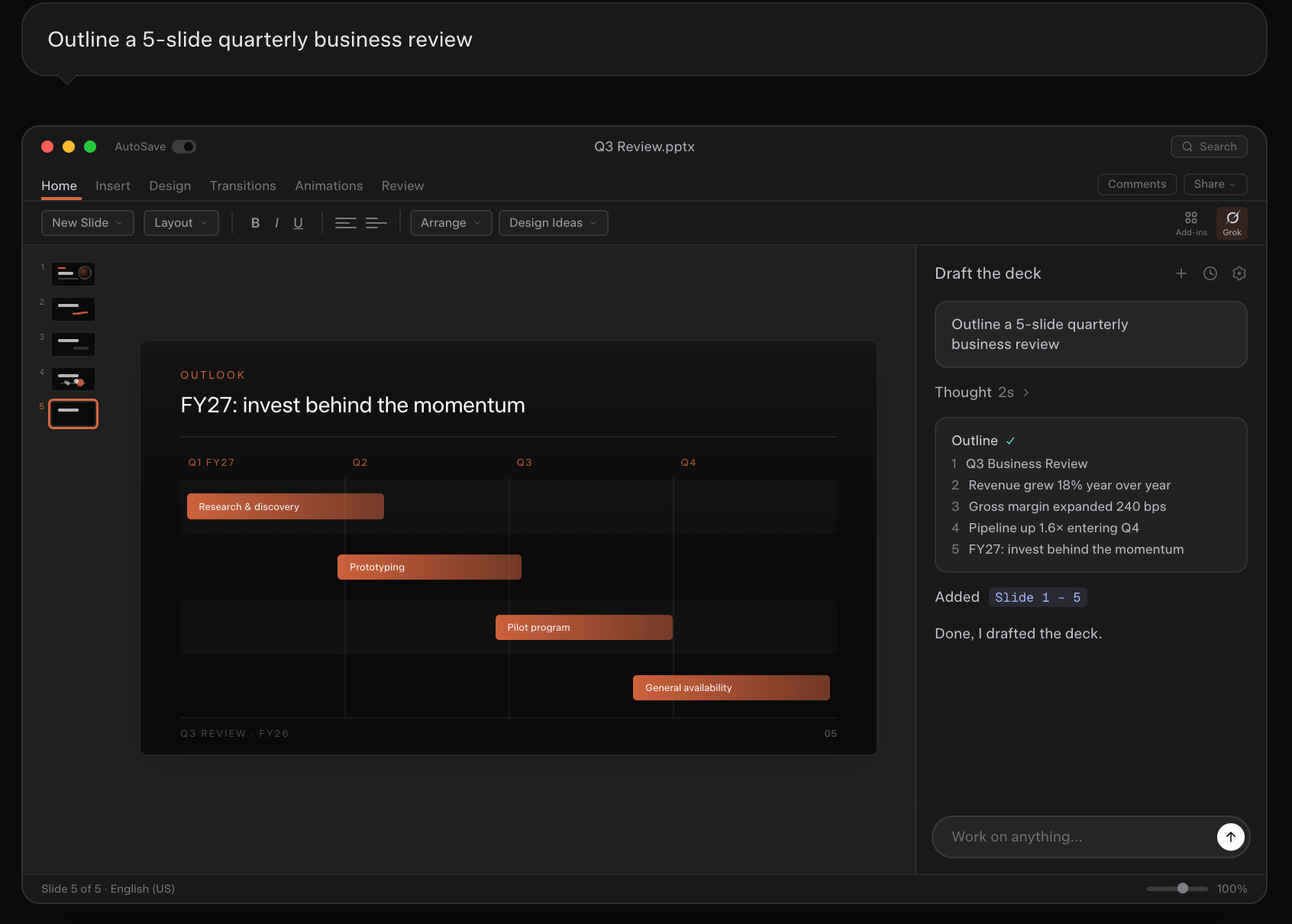
Grok 4.5 is framed as a model for agentic systems: setups where a model plans steps, calls tools, and carries work forward instead of returning a single answer. In that context, it is meant to inspect code, call APIs, retrieve documents, and move between steps in a workflow.
That kind of behavior fits internal agents that handle tasks like raising and updating tickets, running checks on services, or wiring together small operational tasks. It’s also the area where long context, stable behavior, and predictable cost per task matter more than how the model responds in a one-off chat.
Knowledge work
Outside of coding, Grok 4.5 is meant to help with “knowledge work”: reading long documents, comparing sources, and keeping track of a line of reasoning. In practice, that can mean working through specs, contracts, reports, or research docs without losing the thread.
Pricing and access
SpaceXAI is positioning Grok 4.5 as a lower‑cost frontier model for coding and agentic workloads. The launch announcement puts pricing at 2 dollars per million input tokens and 6 dollars per million output tokens, and says the model uses about half as many tokens as comparable systems by finishing tasks in fewer steps. For teams with high‑volume usage, that combination of price and efficiency is often what decides whether a model can move from pilots into everyday use.
Grok 4.5 is available through Grok Build, in Cursor on all plans, and from the SpaceXAI console.
Governance and risk management
Unlike Anthropic’s recent Fable and Mythos releases, which were introduced with explicit safety layers, retention rules, and fallback behavior, Grok 4.5 launched with much less public detail on how its governance works in practice.
For most organizations, a few practical questions still need clear answers before Grok 4.5 is used in higher‑risk settings:
How long prompts, outputs, and logs are retained.
Whether customer data is used to train future Grok models.
What options exist to limit access by team, environment, or application.
What built‑in safety or filtering systems apply to sensitive tasks.
In the meantime, Grok 4.5 is a more natural fit for lower‑ and medium‑risk internal workflows, especially around engineering and automation. As xAI shares more specifics on retention, access controls, and safety behavior, it’ll become easier to place Grok 4.5 alongside models that already ship with well‑documented governance features.
Where Grok 4.5 fits
Grok 4.5 is most useful in workflows where code and automation are the main focus. It is built to work across real repositories, handle changes that touch multiple files, and run inside agents that plan and call tools.
Good places to start are repo‑aware coding assistants, code review helpers, and issue‑to‑PR flows that turn tickets into draft changes. These use cases rely on long context, stable agent behavior, and predictable costs more than on chat‑style interaction.
Grok 4.5 is also being promoted for legal, finance, and office work that depends on long documents and structured reasoning. In many stacks, that will mean using it alongside models like Claude and GPT, and reaching for Grok 4.5 when its strengths in coding and agents line up with the work.
Our takeaway on Grok
Grok 4.5 shows where xAI is trying to place Grok: in the same class as other frontier models used for coding, agentic workflows, and knowledge work, rather than just as the engine behind a chatbot on X. It is aimed at the same kinds of problems that GPT‑ and Claude‑based systems already tackle in many stacks, with more emphasis on developer tooling and a lower‑cost story for high‑volume internal use.
For most teams, the practical move is to treat Grok 4.5 as one of several frontier models to evaluate for engineering and automation. That means comparing it against what’s already in place on dimensions like code quality, agent behavior, latency, cost, and governance, and then deciding whether it belongs in a narrow slice of the stack or stays in a watch‑list for now.
As the landscape shifts to include models like Grok 4.5 alongside Claude and GPT, FullStack helps teams keep their AI strategy grounded in real workloads, clear metrics, and practical guardrails. Contact us today if you’re interested in aligning new model adoption with your current roadmap.
Learn more
Frequently Asked Questions
What is Grok 4.5 and how is it different from earlier Grok models?
Grok 4.5 is xAI’s latest large language model, built to run inside tools and systems that handle code and long documents rather than just powering a chatbot on X. It is tuned for long‑context reasoning, tool use, and more stable behavior over real repositories and internal knowledge sources.
Is Grok 4.5 a serious competitor to Claude Opus and GPT‑class models?
Grok 4.5 is the first Grok release that xAI is putting forward as a peer to other frontier models used for production work, including Anthropic’s Claude and OpenAI’s GPT family. Elon Musk describes it as “roughly comparable to Opus 4.7, but much faster” and “more token‑efficient and lower cost,” and the model is aimed at the same broad categories of coding, agentic workflows, and knowledge work.
What are the main use cases for Grok 4.5 in software engineering?
Grok 4.5 is designed for software engineering tasks that go beyond single‑file code snippets. It targets work across multiple files and longer repository context, including refactors, migrations, and code review support, and is a good fit for repo‑aware coding assistants, code review helpers, and issue‑to‑PR flows that turn tickets into draft changes.
How does Grok 4.5 support agents and internal automation workflows?
Grok 4.5 is framed as a model for agentic systems where it plans steps, calls tools, and carries work forward instead of returning a one‑off answer. It can inspect code, call APIs, retrieve documents, and move between steps in a workflow, making it suitable for internal agents that raise and update tickets, run checks on services, or connect small operational tasks end‑to‑end.
What does Grok 4.5 cost, and when does its pricing make sense?
Grok 4.5 is positioned as a lower‑cost frontier model for coding and agentic workloads, priced at 2 dollars per million input tokens and 6 dollars per million output tokens. Because it is designed to finish tasks in fewer steps and use fewer tokens than comparable systems, that pricing is most attractive for teams with high‑volume engineering and automation workloads where cost per task determines whether a model can move from pilots into daily use.
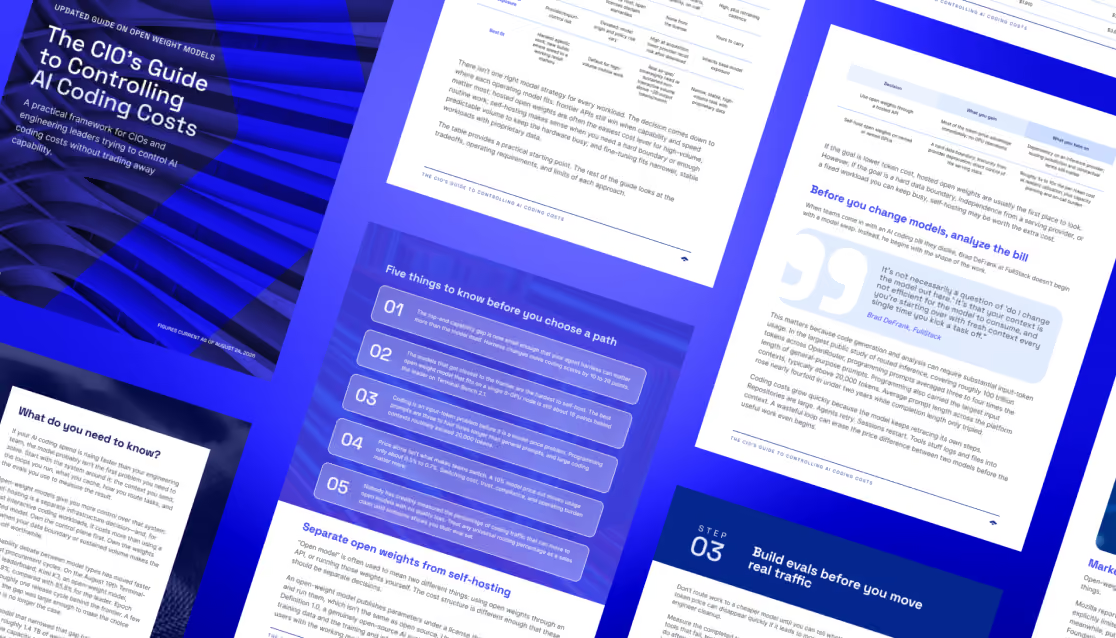
How can you cut your AI coding costs without switching models?
This guide gives you the math, the meaningful benchmarks, and a six-step plan to cut spend without giving up capability.
Enjoyed the article? Get new content delivered to your inbox.
Subscribe below and stay updated with the latest developer guides and industry insights.
Thank you! Your submission has been received!
Oops! Something went wrong while submitting the form.
Iframe is blocked. Accept cookies to load it.
Thank you! Your submission has been received!
Oops! Something went wrong while submitting the form.
We use cookies to provide our services, to allow us to better understand our audience, and to provide and serve personalized ads or content. By using our website, you consent to the terms of our Privacy Policy and our Cookie Policy, and the use of cookies, pixels, and other technology as described more fully therein